≡ Menu

An old (2004) post of mine on LewRockwell.com about the patent process:

“a cooked dough product having a light, flaky, crispy texture”

Posted by Stephan Kinsella on February 21, 2004 01:10 PM

For those curious about the actual patent process, Chef America, Inc. v. Lamb-Weston, Inc. is an interesting and short recent case. This is a typical example of how patent attorneys describe reality and how federal judges handle patent disputes.

The case concerns U.S. Pat. No. 4,761,290 (PDF version; USPTO version), owned by plaintiff Chef America.

The patent covers “[a] process for producing a dough product which is convertible upon finish cooking by baking or exposure to microwaves in the presence of a microwave susceptor into a cooked dough product having a light, flaky, crispy texture.” The patent explains that with prior dough products “[i]n large measure, instead of the desired light, flaky, crispy texture, the cooked products have been found to be leathery, in the case of baked products, or soggy in the case of microwave heated products.” It involves the process of “applying a layer of shortening flakes between the dough and a light batter which is applied to the dough, setting the batter and subsequently melting the shortening flakes present in the set batter in order to form pin holes or air cells in the batter and at the surface of the dough. Upon finish cooking, these pinholes or air cells form a porous product and permit the batter to be quickly heated and browned, resulting in a dough product having a light, flaky, crispy texture to the pocket.”The patent’s technical description explains that the dough is cooked in an oven, at a temperature from about 400 degrees F. to 850 degrees F. The problem is that the claims of the patent–which specify what invention is legally protected–include the step: “heating the resulting batter-coated dough to a temperature in the range of about 400° F. to 850° F. for a period of time ranging from about 10 seconds to 5 minutes to first set said batter and then subsequently melt said shortening flakes, whereby air cells are formed in said batter and the surface of said dough”.

The claim should have said heating the dough “at” that temperature, not “to” that temperature. The dough is in an oven which is at 400° F. to 850° F., but the dough does not reach this temperature. If it did, it would burn up. Lamb-Weston was accused of infringing the claims of Chef America’s patent. But Lamb-Weston pointed out that it did not heat dough “to 400° F.”; therefore, it did not infringe the claims.

Chef America argued “that ‘to’ should be construed to mean ‘at’ because otherwise the patented process could not perform the function the patentees intended”. In other words, the claim is nonsensical if you construe “to” to mean “to”; anyone skilled in the art (e.g., a chef) reading the claim would understand it to mean that the oven is at the specified temperature, not the dough being cooked.

However, the appeals court held that the language was unambiguous and the court would not rewrite it. As the court stated, “we construe the claim as written, not as the patentees wish they had written it. As written, the claim unambiguously requires that the dough be heated to a temperature range of 400° F. to 850° F.”

This was the correct ruling, IMHO.

Share
{ 1 comment }

From the Examiner: patents being used for fascist controls on farmer (h/t Geoff Plauche). For related posts, see

H.R. 193 would force farmers to pay a fee on saved seeds and register them

Farmers around the country Fridayexpressed frustration after learning about House Resolution 193. H.R. 193 would require farmers to register their seeds with the Secretary of Agriculture after a harvest. The farmers would then have to pay a fee for retaining those seeds. However, H.R. 193 is not that simple.

Farmers who purchase and grow patented seeds are the ones who would have to register their seeds after a harvest. A patented seed is a seed that is the product of human intervention and has been claimed as intellectual property. Although it may seem like a recent trend, Louis Pasteur made the first patent on a living organism in 1873. Pasteur patented yeast. Most patents in question, however, are patents by the company Monsanto on their genetically engineered seeds.

H.R. 193 would change things for farmers who purchase patented seeds and then grow those seeds. After the harvest, many farmers save the seeds that they can, seeds produced from the product they already paid for. H.R. 193 would force those farmers who save their seeds to register those seeds with the Secretary of Agriculture. After they register those seeds, the farmers would then have to pay fees set aside by the Secretary of Agriculture for keeping the seeds, “and for other purposes”.

Read more>>

Share
{ 1 comment }

Shareable: Why The Intellectual Commons Isn’t Good Enough

Courtesy of this P2P Foundation blog post by Michel Bauwens (who has blogged previously about my anti-IP work, e.g. Materiality of the Intellectual Commons and Against the artificial scarcity induced by IP law), I was made aware of an interesting post from Shareable (from a couple years ago). The author is surprised to find anti-IP views among the “far-right”. As he writes:

When writing about the commons, one is likely to stumble into some awfully strange bedfellows. The last place I expected to find an attack on the institution of intellectual property was the Ludwig von Mises Institute, a far-right libertarian think-tank. And yet, there it is, right on their site: “Ideas Are Free: The Case against Intellectual Property,” a lecture from the 2010 Annual Meeting of the Property and Freedom Society by Stephan Kinsella. What would make a free-market fundamentalist oppose any kind of right to property?

Of course, I am not in any sense a right-winger or right-libertarian; nor am I a left-libertarian. Standard libertarians reject the left- and right prefixes. We reject the coherence of the “right” or “conservative” philosophy; we reject the substance of leftism; we reject the implications of the left-right spectrum, which seeks to relegate more radical, coherent, and sound views—namely, libertarianism—to some “middle” status. We are not in-between left and right; we are orthogonal thereto. We are far superior to the evil left and the evil and incoherent right (see Better than the Nolan Chart). And we are not opposed to property—no one is; everyone has some view of property rights. The particular libertarian property allocation rules are unique and what define us (see What Libertarianism Is); but “IP” is misnamed, and is not property (Intellectual Properganda; Intellectual Poverty). Rather, it undermines and invades libertarian property rights (Intellectual Property Rights as Negative Servitudes). It is a state-granted monopoly privilege, not a genuine libertarian property right. That is why we libertarians oppose IP: because we are pro-property rights, and IP is anathema thereto. In fact, the only coherent reason to oppose IP is in the name of sound property rights. Other criticisms of IP are confused, or not fundamental.

Here’s the post:


When writing about the commons, one is likely to stumble into some awfully strange bedfellows. The last place I expected to find an attack on the institution of intellectual property was the Ludwig von Mises Institute, a far-right libertarian think-tank. And yet, there it is, right on their site: “Ideas Are Free: The Case against Intellectual Property,” a lecture from the 2010 Annual Meeting of the Property and Freedom Society by Stephan Kinsella. What would make a free-market fundamentalist oppose any kind of right to property? [continue reading…]
Share
{ 0 comments }
World Economic Forum: IP and Health Risk

World Economic Forum: IP and Health Risk

The World Economic Forum’s Insight Report, “Global Risks 2013” (Eighth Edition)  identifies “the current IP regime” as being a key factor in contributing to the problem of our increasing health risk:

Interestingly, respondents to the Global Risks Perception Survey  connected antibiotic-resistant bacteria to failure of the  international intellectual property regime. This global risk is  defined in the survey as “the loss of the international intellectual  property regime as an effective system for stimulating innovation  and investment” – that is, going beyond the mechanisms of  protecting IP to encompass the idea that the ultimate purpose of  the IP system is to stimulate worthwhile innovation. The  connection highlights a global market failure to incentivize  front-end investment in antibiotic development through the  promise of longer-term commercial reward, a failure which also  applies to drugs to fight malaria and vaccines for pandemic  influenza.

The report also addresses the failure of the IP regime to stimulate innovation:

Breakthroughs in antibiotic innovation will require pooling and sharing of knowledge among academia, private companies and government regulators.37 Companies and foundations like GlaxoSmithKline (GSK) and the Bill and Melinda Gates Foundation are pioneering an “open-lab” approach to research which refutes the idea that secrecy and patented monopolies are the bedrock of innovation. [p. 32]

(h/t Michael McKay)
Share
{ 0 comments }

From Glyn Moody at Techdirt:

The Main Problem With Patented GM Food Is The Patent, Not The Fact That It’s GM

from the hard-to-swallow dept


The acrimonious debate and serious lobbying that developed around California’s Proposition 37, which would have required the labelling of genetically-modified ingredients in food products had it passed, is an indication that the subject inspires extreme views and involves big money. But an interesting post in Slate argues that GM labelling is really a minor issue compared to the main problem — gene patents:

GM foods’ effect on health is uncertain, but their effect on farmers, scientists, and the marketplace is clear. Some GM foods may be healthy, others not; every genetic modification is different. But every GM food becomes dangerous — not to health, but to society — when it can be patented. Right now, the driving force behind the development of new genetic crop modifications is the fact that they possess the potential to be enormously profitable

As the article points out, the leading player here, Monsanto, has built its empire on this fact:

It was utility patent protection that opened the door for Monsanto’s present-day global seed and insecticide portfolio, including rights to its infamous “terminator” or “suicide seed” technology (which effectively sterilizes second-generation plants and makes it not only futile but a legal violation for farmers to gather seeds for next year’s crop). Monsanto has prosecuted farmers who discover GM corn or soy sprouts growing on their land after the wind carries seeds over from neighbors’ GM fields. The basis for such ridiculous lawsuits? Plant patent laws: These farmers are inadvertently violating Monsanto’s intellectual property rights.

Read more>>

Share
{ 1 comment }

Brito: What’s Wrong With a Copyright Alert System?

I’ve mentioned the (generally excellent) Surprisingly Free podcast before. It’s hosted by Jerry Brito of George Mason, who is refreshingly skeptical of modern patent and copyright and interviews a variety of people with varying degrees of skepticism about the system. But Brito can’t bring himself to oppose patent and copyright root and branch. As I noted in Republicans More Radical than Libertarian Copyright Moderates, Brito says things like:

“If copyright is weak, then it will provide little incentive to create. … But if it is too strong, then it will limit the public’s ability to enjoy and build on creative works, which after all is the reason why we have copyright in the first place.”

When encountering IP maximalists like Stan Liebowitz (Stan Liebowitz on copyright and incentives, who argues for perpetual copyright terms), he is admirably skeptical, but even though he is exposed to more radical IP skeptics like Tom Bell (Tom Bell on copyright reform), again, he continues to argue that copyright is basically legitimate. In a recent Reason Hit & Run blog post, for example, he writes:

I don’t take a back seat to anyone in criticizing our out-of-control copyright system. Copyrights are too long and too strong, penalties for infringement are disproportionate, and federal enforcement has gotten out of hand. Yet those of us who seek to reform copyright should keep in mind that piracy is real, and copyright holders have a legitimate interest in enforcing their rights. [What’s Wrong With a Copyright Alert System?]

No, they do not have a legitimate interest in enforcing the positive monopoly privileges the state grants them, since the state has no right to grant such rights, as such rights are incompatible with legitimate private property rights.

Brito’s post concerns the new “six strikes and you’re out” system for copyright enforcement that ISPs have adopted (Top ISPs agree to become copyright cops)—the new “Copyright Alert System”. Brito characterizes this  system as “the result of a private agreement between ISPs and the recording and movie industries”, even though it is an agreement among an industry of state-caused oligopolists and would never make sense absent state copyright law (Brito recognizes that “The agreement is nominally voluntary, although former New York Attorney General (now Governor) Andrew Cuomo strongly suggested to ISPs that they cooperate, and the Obama Administration’s IP czar Victoria Espinel helped broker the deal”).

Brito downplays concern about this system by saying it’s a “private” system that is better than “public enforcement”:

The EFF and others talk about surveillance and snooping, but in fact the monitoring in question takes place over publicly accessible networks. And while it’s true that the Copyright Alert System’s private arbitration flips the burden of proof, it’s not clear “public enforcement” is really such a great alternative.

Such nominally “private” enforcement might be less-bad than explicit state enforcement, but we get this dilemma only if we fail to consider a far better alternative—abolish copyright—which Brito rules out of court by saying that “copyright holders have a legitimate interest in enforcing their rights” and by opposing copyright abolition. If we insist that we keep copyright, we are left squabbling over who is should enforce this artificial state-granted monopoly privilege: state agencies, or private oligopolized crony capitalist corporations. [continue reading…]

Share
{ 4 comments }

5 people who are making a killing off of piracy

From geek.com:

5 people who are making a killing off of piracy

Piracy gets a bad reputation from most of the content creators in the world, but not everyone agrees. In fact, some people have managed to make piracy, and a relaxed attitude toward copyright, work in their favor. Here are five such individuals who don’t pirate themselves (at least that we know about) but managed to turn this fact of internet life into good business.

Psy
Have you heard about this Gangam Style thing? The answer to that is almost certainly an emphatic “yes.” Gangam Style, from South Korean pop/rap star Psy has taken the internet by storm, and part of that success has come by taking a relaxed attitude toward copyright infringement.

There have been remixes, mashups,vre-postings, and of course, torrents of Gangam Style ever since it first caught on. Rather than go after people infringing on the content, Psy has leaned back and watched the advertising dollars roll in. The Gangam Style video on YouTube is now the most viewed ever. It currently has nearly 1 billion views. It is estimated that Psy will pull in about $8.1 million this year thanks to his internet popularity. Popularity he wouldn’t have had if no one had been able to share the song.

Read more>>

Share
{ 0 comments }

I had the pleasure of finally meeting in person law professor Tom Bell (one of the handful of IP attorneys to publicly oppose IP)1 at Libertopia in San Diego last September.2

In a recent interview by Jerry Brito on the excellent Surprisingly Free podcast (one of my favorites), Bell discusses his views on copyright and his chapter “Five Reforms for Copyright,” in the recent book Copyright Unbalanced: From Incentive to Excess, edited by Brito (which is, ironically, and unfortunately, not published under any kind of Creative Commons license nor made available free in PDF form or otherwise; Mercatus page). [Brito’s book is reviewed by Tom Palmer here.]

Tom Bell on copyright reform

Thumbnail image for Tom Bell on copyright reform

Tom W. Bell, professor of law at Chapman University and author of the concluding essay in Copyright Unbalanced, a new book edited by Surprisingly Free’s own Jerry Brito, discusses the ways in which copyright has evolved over time and why reform is vital.

Bell differentiates copyright from other types of property, arguing that conflating the two terms causes great confusion amongst laypeople and, over time, corrodes the value placed in tangible property rights. According to Bell, copyright is a privilege created by statute that doesn’t exist in a state of nature and is not recognized by common law.

As a special type of economic good, copyright must be treated differently than tangible property rights, according to Bell, who outlines five proposals for copyright reform.

While Bell is not opposed to copyright, he argues that copyright enforcement has gone too far, and lawmakers should structure policies to lead us towards a world in which we conceivably do without it.

In his excellent and concise chapter, Bell argues that copyright has changed so much since 1790 that it has deviated dramatically from the original idea for copyright in the Constitution, and now poses a grave threat to our freedom and liberties. Bell argues for a return to the Founders’ Copyright, among four other reforms:

  1. Reinstate the Founders’ Copyright Act,
  2. Withdraw the US from the Berne Convention,
  3. Develop misuse doctrine into an escape from copyright,
  4. Focus copyright policy on consumers’ costs, not producers’ profits, and
  5. Reconceive “IP” as “Intellectual Privilege.”3

Regarding relabeling IP as “intellectual privilege,” see my post Intellectual Poverty, suggestion other possible terms that could be used to more accurately describe patent, copyright, and other IP laws.

The Founder’s Copyright would be much narrower than the current metastasized copyright system: it would offer an initial 14 year copyright term followed by another 14 year term, if applied for (compared to life of the author plus 70 years, now, and automatic copyright protection); no criminal sanctions; only maps, charts, and books covered, but not movies, photographs, paintings, sculptures, plays, music, architectural works, boat hull designs, and software; only exact, literal reproduction is covered, not quotations of a portion of the work, not derivative works (like sequels to a novel). This would be a radical improvement in copyright and would probably get rid of 95% or more of its current mischief.

Brito is also somewhat skeptical of copyright and IP but is not an abolitionist; he adopts the utilitarian approach which holds that we want something between zero copyright protection and the very strong copyright we have now (see his discussion in Geoff Manne on copyright and Brito: What’s Wrong With a Copyright Alert System?; also Republicans More Radical than Libertarian Copyright Moderates and Stan Liebowitz on copyright and incentives). In Bell’s wide-ranging interview with Brito, he discusses a variety of problems with modern views on copyright. For example, he challenges the idea that copyright should be thought of as property; Brito seems to agree (see Classifying Patent and Copyright Law as “Property”: So What?); he observes the danger of this analogy: that the limits put in place on copyright to prevent its excesses (like fair use) could be imported back onto real property law and weaken real property rights (Tom Bell: Copyright Erodes Property?); and other issues.

The Hayekian Knowledge Problem and the Copyright Term

One other thing worth mentioning—in this interview Bell and Brito talk about the (Hayekian) “knowledge problem” being one reason it’s difficult to know what optimum copyright term to set (Brito and Manne make similar observations in another podcast episode; see Geoff Manne on copyright). And in the introductory chapter to Copyright Unbalanced, Brito writes (my bolding added):

You should be skeptical of Congress’s ability to develop a rational policy given the knowledge problem copyright presents and the public choice pressures at work. [p. 7, Kindle Edition]

… The fact that copyright does not emerge spontaneously does not mean it is illegitimate, or even unwise. What it does mean is that we should be cautious about how we create such a property right and how we define that right.

As F. A. Hayek showed, created orders are handicapped by the limited knowledge of their planners. This is in contrast to emergent orders, like customary or common law, which evolve slowly through trial and error. Such bottom-up processes are the product of human action, but not human design. As a result they incorporate dispersed knowledge and tend to match economic efficiency.

Copyright is a created order. Not only did it not emerge spontaneously, it is in fact a tool to create scarcity through state action. But why would we want to introduce scarcity where there is none? And why would we want to limit use where there is no conflict? [p. 11]

Good question. And, in a section entitled COPYRIGHT’S KNOWLEDGE PROBLEM:

The knowledge problem inherent in legislatively created rights is one reason why a delicate balance is difficult to reach. Not only are the contours of copyright centrally planned, but as Richard Epstein has noted, “There are in fact no ‘natural’ boundaries here, similar to the metes and bounds of land” to guide policy makers.

Conservatives and libertarians tend to easily recognize the knowledge problems in other government programs. For example, consider subsidies for renewable energy, which are also arguably meant to promote the production of a public good.

How does Congress know that the market is not already providing the right amount of investment in renewable energy? Without a government subsidy, there would still be investment in renewable energy technologies. By creating a subsidy, Congress is saying it doesn’t think it’s enough, but it has no way of truly knowing that.

Putting aside how Congress can know that there should be more investment in renewable energy, the other question is, how much investment is optimal? Without a market process to guide such investment, Congress can’t know how much is enough. So when Congress offers a certain amount of subsidy, it’s guessing. It’s likely offering too little or too much, with each error introducing its own inefficiencies.

The same challenges exist for copyright. Without copyright, there would still be songs written and movies made. Congress just thinks there wouldn’t be enough. So, it offers a subsidy in the form of copyright protection to incentivize more creative output. The same questions we asked about renewable energy present themselves: How does Congress know we wouldn’t have “enough” creative works without copyright? And assuming it knows that, how does it know the right amount of incentive to offer?

The first Copyright Act, which the Framers legislated, was limited to maps, charts, and books, which meant that other kinds of expressive works, such as songs and plays, were not protected. The Framers must have thought they would get enough such works without a subsidy. Were they wrong? Today songs and plays are protected, but fashion designs are not. Do we have the right balance now? How do we know?

The first Copyright Act also set a copyright term of 14 years renewable for 14 more, and required authors to register their works before receiving protection. Was 14 years enough, or too little? Today the copyright term is life of the author plus 70 years. Is that too much, or not enough? How do we know?

Also, requiring registration and renewal meant that only those authors who sought a subsidy got one. Only 5 percent of books published at the time were registered for copyright, and a small minority of their authors sought renewal, making the subsidy modest and somewhat self-regulating.

Today there is no requirement for registration or renewal, and anything you write is automatically protected whether you want it to be or not. Does such a massive trade of access for incentive get us closer to striking the delicate balance? How do we know?

This is not to say that because the ideal contours of copyright are unknowable, we should therefore have no copyright. After all, we also don’t know that zero is the right amount of copyright. However, understanding that there is a knowledge problem in copyright is useful. It tells us that while Congress may inevitably have to make an educated guess when it designs copyright, it should be humble and not take lightly the possibility that it will strike the wrong balance and introduce serious inefficiency. [pp. 13-15; endnotes omitted]

This entire approach is problematic, as I discuss in Knowledge, Calculation, Conflict, and Law and my post Knowledge vs. Calculation.

According to Hayek, there is dispersed knowledge in society that is difficult for any central planner to gather (or keep up with as it dynamically changes), and difficult even for the individual actors who possess it to articulate in an objective way, since it is “tacit.” Yet people’s dispersed knowledge affects how they buy and sell, and thus gets “reflected” in the overall price structure of the economy. Even this conception of prices “conveying” or “encoding” knowledge is problematic, in my view (as mentioned in the two linked pieces), but at most, it means that individual knowledge of relative resource scarcity is reflected in prices. This is because the knowledge of individuals, whether tacit or otherwise, that affects the prices they form, is these individuals’ knowledge (or forecasts or opinions) about the demand for, usefulness of, and supply and availability of scarce resources.  That is, according to Hayek, the free market economy and its price system provides a way to help economize in the face of scarcity; it helps allocate scarce resources more efficiently, by means of a price system embodying or reflecting or transmitting various knowledge individual actors have about relative scarcities of, and supply of and demand for, scarce resources.

The Misesian case against central economic planning is that in the absence of a free market price system, there is no way to calculate—no way for the entrepreneur to forecast and compare possible plans on terms of profit maximization, because resources are heterogenous and incomparable. The future is always uncertain, but entrepreneurs have no way of comparing contemplated projects in cardinal terms, without some common, numerical frame of reference. They cannot even determine after the fact whether a project was as successful or more successful than anticipated, or than alternative projects could have been, without some cardinal means of comparison. A free market price system permits such calculation because the entrepreneur can calculate in money terms and compare various possible projects and alternative uses of scarce resources and select the project expected (in his entrepreneurial judgment) to yield the greatest monetary profit. And he can use money prices to assess how a project has done (cost accounting). In this way, to the extent entrepreneurs are successful (profit), resources are allocated to their most valuable uses. The Hayekian case against central planning emphasizes the difficulty a central planning agency has in acquiring knowledge that is dispersed and tacit knowledge. But even here, the knowledge is knowledge of relative scarcities of resources, of the supply of and demand for these resources.

But is this the reason the legislature has difficulty knowing what the optimum copyright term (and scope, etc.) should be? No. There are, instead, several other, and far more fundamental, reasons legislators cannot be expected to get the “right” copyright term. First, there is the political process itself: entrenched interests like Disney, Hollywood, the music industry, and so on, push Congress to keep ratcheting up copyright scope and penalties and term, not because of any finding that it is optimum, but for political reasons (which Brito acknowledges, in referencing “the public choice pressures at work”; in observing that “humility and restraint are not qualities readily found in the modern Congress”; in observing that “The process by which the terms and scope of copyright are decided is a political one” prone to “rent-seeking”).

Second, in the case of allocation of scarce resources we know that each resource has an exclusive use and can only be used for use project A or B. If the resource is used for the “wrong” plan then there is waste. Thus, there is a need to have some system that permits optimum allocation of the resource. This is the function of a free market in which private property rights are respected and money is used for calculation. But the copyright monopoly is justified by its proponents as stimulating the production of creative works—essentially, patterns of information, knowledge—that have some “value” to society that is greater than the costs imposed on the economy by the copyright system. Information patterns are not scarce resources. It is difficult to imagine how the price system, even in the Hayekian conception, which is useful in helping allocate scarce resources to their most efficient uses by overcoming the knowledge problem faced by central planners, provides information about how much value a copyright monopoly generates and how much cost it imposes.

Tabarrok's Innovation vs. patent strength curve

Tabarrok’s Innovation vs. patent strength curve

Third, the idea that legislators face a knowledge problem in knowing where the optimum is for copyright strength and term, relative to costs it imposes and benefits it allegedly generates, presupposes that there is an optimum. But there is no reason whatsoever to presuppose this. (See Tabarrok: Patent Policy on the Back of a Napkin.) In the analogous case of subsidies for renewable energy, Brito notes: “It’s likely offering too little or too much”, as if zero is the obviously wrong choice even here. Why? Zero is the right choice for both renewable energy subsidies and for the subsidy of copyright. In the case of renewable energy subsidies, at least the subsidies likely increase renewable energy R&D and technology, since money is poured into it. This still does not mean it’s worth it, since renewable energy tech is developed at the expense of other technology or projects that are now unaffordable since tax dollars were siphoned away to stimulate renewable energy. But in the copyright case, there is no reason to believe that there is more creative work on net stimulated because of the copyright system in the first place; there is certainly good reason to believe that the patent system decreases net innovation. At the very least, the copyright and patent systems lead to severe distortion of their respective fields: culture and creative works, innovation and technology (Destructive CreationLeveraging IP).

Imagine a similar approach being taken to the prison sentences being imposed for marijuana use. The prohibitionist might say that zero penalty is “obviously” “too low,” but he might also admit that torture and the death penalty for possession of an ounce of pot is obviously “too high”; thus, there is some optimum “in between.” It might be difficult to know what this optimum penalty is: is it a $100 fine? A year in prison? Ten years in prison? And then the prohibitionist could say, “Well, because of the Hayekian knowledge problem, it’s hard to know what the optimal penalty should be. But we know it’s between zero (legalization) and the death penalty; given this; a seemingly-arbitrary 5 year prison sentence is “closer to optimal”, or “better,” than a zero penalty or capital punishment. But the reason you can’t find the “right” punishment is that there is no optimum; or, rather, the optimal punishment is zero. But even if we concede that there should be some finite (non-zero, non-“infinite,” i.e. capital punishment) penalty for marijuana possession, and even if we concede we cannot know what the optimal amount of punishment should be, it is not because of the knowledge problem. For how could the most efficient free market imaginable tell us the “right” or most efficient amount of punishment to impose? The free market is efficient in the sense that it permits the efficient allocation of scarce resources. It is this ideal situation that the “knowledge problem” faced by central planners is contrasted to. What has this to do with coming up with a punishment of people who are engaged in a victimless crime?

And it is similar in the case of copyright, since there is no reason to think that there is a curve with a peak. Brito writes: “we also don’t know that zero is the right amount of copyright”. Well what kind of argument is this? If you don’t have some kind of proof that some copyright does increase social welfare, then why have it at all? Utilitarians seem to admit copyright puts limits on speech and imposes various costs on individuals. They believe this cost is justified if it leads to net gains in cultural innovation. But they have no evidence that it does. Shouldn’t the burden of proof be on them to show that their utilitarian claims are true? Until they do, shouldn’t we refrain from imposing copyright on society? Just consider all the economic and societal interventions Congress could engage in if it could say “well, we are not sure this law is optimal or producing good results, but on the other hand, we don’t know that not having the law is optimal either”! How is this a justification for having a law and then trusting Congress to tweak it? If Brito is right that Congress cannot know what the optimal copyright term is, and cannot even know that zero is not the right term … why have copyright at all, even on utilitarian grounds?
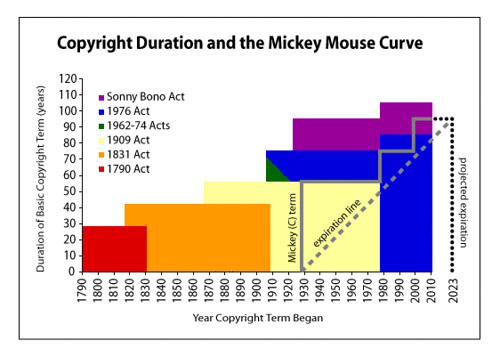
Copyright Duration and the Mickey Mouse Curve

Copyright Duration and the Mickey Mouse Curve

The truth is that, as in the case of drug prohibition, the “optimal” amount of copyright is zero. This is true on both moral and empirical grounds. Moral: since copyright infringes on property rights (see Intellectual Property Rights as Negative Servitudes); empirical, since there is no evidence that patent or copyright lead to any net increase in innovation or artistic creation at all, much less an increase that is greater than the costs of such a scheme (and it is undeniable that IP distorts innovation and the creative fields) (see The Overwhelming Empirical Case Against Patent and Copyright; also Legal Scholars: Thumbs Down on Patent and Copyright). If the “curve” is monotically downward sloping—meaning that the greater the copyright protection, the worse off we are both in rights terms and also in economic terms—then the reason legislators cannot find its optimum is not because of the knowledge problem that plagues central planners trying to efficiently allocate scarce resources, but because there is no peak to find. But they truth is they are not trying to find the optimum; they do not even care. They keep ratcheting copyright terms upwards, enhancing penalties, increasing copyright scope, pushing it onto other countries, at the behest of Big Content special interests. They do not pretend to have the faintest clue that there even is an optimum, much less that they know, or that anyone can know, what it is.

(Update: Mises himself, a utilitarian of sorts (more of a consequentialist, I think) in the field of political ethics, also had a few murky statements on IP, which I note in Mises on Intellectual Property. An Austrian economist friend observed to me that:

The … thing that struck me as I read [your post] was Mises’s view in Human Action (pp. 657-659). He, too, claims that there is no optimum with respect to the configuration of patents and copyrights, but that different configurations of IP render different patterns of resource use. Each pattern of resource use is optimal for a given configuration of IP. But there is no way to compare the pattern of resource use under one configuration with the resources use under a different configuration. This seems to be a generalizable principle for Mises, that the configuration of property rights lies outside the market’s economizing process of resource use and, in fact, is a requisite for it.

In other words, the problem that plagues central economic planning, whether it’s characterized as Mises’s calculation problem or as Hayek’s knowledge problems, and which do not pose a problem for a genuine free market order, is not the reason a legislature cannot determine whether or not to have copyright or what form it is to take.)

Finally: the fundamental reason it’s impossible to compute these things in the first place is the subjective and intersubjectively incomparable and ordinal, not cardinal, nature of value. Not to mention the problem with counterfactuals and fact that there are many unseen, undeterminable costs to any such regulatory scheme.

Utilitarian scholars who argue the copyright system should be reformed because we are on the wrong side of the peak, but that there is a peak and that it’s possible for a corrupt legislature of a criminal state to find the optimum, or even to want to find it, are wrong. The optimum amount of copyright is the amount that is compatible with freedom and property rights: zero.


  1. See Patent Lawyers Who Oppose Patent Law [update: this is a slight overstatement; Bell is not completely against IP, but is for fairly radical reform]; also Reason.TV: Too Much Copyright; Bell’s draft book, Intellectual Privilege: Copyright, Common Law, and the Common GoodThe Great Debate on Intellectual Property, in Cato Policy Report (January/February 2002); Tom Bell: Copyright Erodes Property?Tom W. Bell on Intellectual Property; other copyright writing by Bell. []
  2. See Intellectual Nonsense: Fallacious Arguments for IP (Libertopia 2012) []
  3. Kindle Locations 2001-2007). Mercatus Center at George Mason University. Kindle Edition. []
Share
{ 9 comments }

This is the opening of “Five Reforms for Copyright,” by law professor Tom Bell (one of the handful of IP attorneys to publicly oppose IP),1 his chapter in the recent book Copyright Unbalanced: From Incentive to Excess:

ON NOVEMBER 28, 2009, police arrested a 22-year-old Chicago woman named Samantha Tumpach, jailed her for two nights, and charged her with “criminal use of a motion picture exhibition”—a felony offense punishable with up to three years in prison. Her crime? She had captured two brief clips of The Twilight Saga: New Moon while recording her family’s surprise birthday celebration for her sister, who had come to the theater to watch the film.2 Tumpach copied under four minutes of the movie in total and obviously had no intention of making a bootleg for resale. “You can hear me talking the whole time,” she explained.3 Officials eventually dropped the charges, but the damage had been done. Tumpach brought suit for malicious prosecution, intentional infliction of emotional distress, negligence, and defamation.4 Her complaint did not, however, name the ultimate cause of her distress: a copyright regime that has grown too big and too powerful.


  1. See Patent Lawyers Who Oppose Patent Law; also Reason.TV: Too Much Copyright; Bell’s draft book, Intellectual Privilege: Copyright, Common Law, and the Common GoodThe Great Debate on Intellectual Property, in Cato Policy Report (January/February 2002); Tom Bell: Copyright Erodes Property?Tom W. Bell on Intellectual Propertyother copyright writing by Bell. []
  2. Dan Rozek, “Woman Arrested for Trying to Record ‘Twilight’ on Digital Camera,” Chicago Sun-Times, December 2, 2009. []
  3. Ibid. []
  4. Aliyah Shahid, “Twilight Taper, Samantha Tumpach, Sues Illinois Theater after Taping Twilight Saga: New Moon,” New York Daily News, June 29, 2010. []
Share
{ 0 comments }

From C4SS:

How “Intellectual Property” Impedes Competition

Posted by  on Jan 4, 2013 in Left-Libertarian – Classics • Comments (1)The following article was written by Kevin Carson and published by The Freeman.

Any consideration of “intellectual property rights” must start from the understanding that such “rights” undermine genuine property rights and hence are illegitimate in terms of libertarian principle. Real, tangible property rights result from natural scarcity and follow as a matter of course from the attempt to maintain occupancy of physical property that cannot be possessed by more than one person at a time.

“Intellectual property,” on the other hand, creates artificial scarcity where it does not naturally exist and can only be enforced by invading real, tangible property and preventing the owner from using it in ways that violate the supposed intellectual property rights of others. As Stephan Kinsella points out, had a particularly gifted Cro-Magnon man been able to patent the building of log cabins, his heirs today would be entitled to prevent us from building cabins on our own land, with our own logs, until we paid whatever tribute they demanded.

The business model required by proprietary digital information is even more invasive of genuine property rights than traditional copyright law. The digital copyright regime in force under the terms of the Digital Millennium Copyright Act (DMCA), the WIPO Copyright Treaty, and the TRIPS provisions of the Uruguay Round of the General Agreement on Tariffs and Trade (GATT), focuses entirely on preventing one from using his own hard drive and other property as he sees fit. It is actually illegal, thanks to such legislation, to sell hardware capable of circumventing DRM (digital rights management) or to publicize the codes enabling someone to circumvent it. As Cory Doctorow points out, “It’s funny that in the name of protecting ‘intellectual property,’ big media companies are willing to do such violence to the idea of real property–arguing that since everything we own, from our t-shirts to our cars to our e-books, embody someone’s copyright, patent and trademark, that we’re basically just tenant farmers, living on the land of our gracious masters who’ve seen fit to give us a lease on our homes.” [continue reading…]

Share
{ 0 comments }

From Slashdot (h/t Wendy McElroy). For related posts about the interrelationship between patent and copyright, for example how Microsoft uses monopoly profits garnered from software copyright to fund the acquisition of patents that it can use to further hammer competition, see Controls breed controls, Monopolies breed monopolies;  Apple vs. Microsoft: Which Benefits more from Intellectual Property?;  Patent Cross-Licensing Creates Barriers to EntryGoogle’s Schmidt on the Patent-Caused Smartphone OligopolyThe Microsoft-Apple Gesture OligopolyNortel Patents Sold for $4.5 Billion to Consortium Which Includes Apple.

So, now, companies can use copyright profits to acquire patents which help them enforce their copyrights.


New Sony Patent Blocks Second-hand Games

Posted by samzenpus 
from the one-console-to-play-them-all dept.
silentbrad writes in with a story about a Sony patent that would block the playing of second-hand games.“… the patent application was filed on 9 December 2012 by Sony Computer Entertainment Japan, and will work by linking individual game discs to a user’s account without requiring a network connection meaning any future attempt to use this disc on another user’s console won’t work. The patent explains that games will come with contactless tags that will be read by your console in much the same way as modern bank cards. When a disc is first used, the disc ID and player ID will be stored on the tag. Every time the disc is used in future, the tag will check if the two ID’s match up and, if not, then the disc won’t work. The document goes on to explain that such a device is part of Sony’s ongoing efforts to deter second-hand games sales, and is a far simpler solution than always-on DRM or passwords. It’s worth noting that Sony has not confirmed the existence of the device, and the patent doesn’t state what machine it will be used in, with later paragraphs also mentioning accessories and peripherals. … There’s also the issue of what happens should your console break and need replacing, or if you have more than one console. Will the games be linked to your PSN account, meaning they can still be used, or the console, meaning an entire new library of titles would need to be purchased?”
Share
{ 1 comment }

Kevin Carson: Intellectual Property is Theft!

Reposted from Distro of the Libertarian Left:

Intellectual Property is Theft!

Intellectual Property is Theft!: How “Intellectual Property” Impedes Competition

Originally published as How “Intellectual Property” Impedes Competition.

Kevin Carson (2009)

ma19

Copying is not theft. Monopoly is.

Real, tangible property rights result from natural scarcity and follow as a matter of course from the attempt to maintain occupancy of physical property that cannot be possessed by more than one person at a time. Intellectual property, on the other hand, creates artificial scarcity that does not naturally exist and can only be enforced by invading real, tangible property and preventing the owner from using it in ways that violate the supposed intellectual property rights of others …. Intellectual property also serves as a bulwark for planned obsolecence and high-overhead production.

Corporations rely on increasingly authoritarian legislation to capture value from propriety information…. Privileged, state-connected economic interests are becoming increasingly dependent on such controls. But unfortunately for them, such controls are becoming increasingly unenforceable thanks to Bittorrent, strong encryption, and proxy servers…. This has profoundly weakened corporate hierarchies in the information and entertainment industries. In this environment, the only thing standing between the old information and media dinosaurs and their total collapse is their so-called intellectual property rights.… Without intellectual property, in any industry where the basic production equipment is widely affordable, and bottom-up networking renders management obsolete, it is likely that self-managed, cooperative production will replace the old managerial hierarchies.


Introduced May 2011.

Share
{ 1 comment }

Update: See Are anti-IP patent attorneys hypocrites?, collecting various posts about this topic.

***

A Romanian translation of my monograph Against Intellectual PropertyÎmpotriva Proprietăţii Intelectualewas recently published. It was with my blessing, but my permission was not needed, since I had released it under a Creative Commons-Attribution Only (CC-BY) license. I would release it under CC0 if this was possible and legally effective. But it’s not. (See Let’s Make Copyright Opt-OUTCopyright is very sticky!)

Quite often some IP proponent will try the smartass retort, “Oh yeah? Well if you don’t believe in copyright I guess you won’t mind if I slap my name on your book and make a million bucks selling it, hunh?!” I mean, if the book would sell that well, why haven’t I made a million on it…. Why does the pirate think he can profit where I couldn’t? These retorts are never serious, and never coherent. Some of them imply the author is a hypocrite for merely having a copyright in his work, even though it’s automatic and impossible to get rid of. Some of them imply it’s hypocritical even to sell one’s book if one does not believe in copyright, even if the author doesn’t mind others copying it. They seem to think that if they just make this challenge, they can prove that copyright is justified. It’s bizarre. Others argue that I’m a hypocrite because I’m a patent lawyer, and oppose IP—and that if N. Stephan Kinsella is a hypocrite, why, that proves that IP is valid! QED! (See Patent Lawyers Who Don’t Toe the Line Should Be Punished!Rothbard on Lawyers, Accountants, Locks and Safes–and patent lawyers?Are anti-IP patent attorneys hypocrites?An Anti-Patent Patent Attorney? Oh my Gawd!The Most Libertarian IP Work.)

The latest example of the smart-ass approach involves the aforementioned Romanian translation. Someone took the translation, stripped off my name, and reposted it on another site, with an Intel-Inside like logo saying “Commie Inside.” Below is the first part of it, with automatic translation from Google Translate:

Against intellectual property

Today I translated this pamphlet in support of communism. You can contact me at the address [email protected] for account details where you can make cash donations (fiat), the physical address where you can send donations and more money (gold), or the destination bitcoin 48NDR15end1glt6flnXfty2isd3LZw4jmK2saQ, noting that when bitcoin system will be broken and their infinite replication will be possible, funds will return to your property (to everyone), obviously the quotations bitcoin today (12/30/2012). Text can be purchased in physical form extremely rare autographed poster for $ 100 (one hundred) RON (edition 2012), Euro, U.S. Dollars $ $ $, Swiss francs or gold grams choice, do not offer credit . I thank Karl Marx brother Groucho idea and for a sense of humor. This text is original.

He seems to think he will anger me by taking my name off, by asking for donations, by calling me a commie, and by dishonestly stating that his “text is original.” Why would I care? Do as you please, Mr. Pro-IP Romanian. I’m happy to call your bluff. I hope you make some money off of this, but I doubt you will. All you did was impose a cost on yourself (time, effort) for no purpose whatsoever, since you made no point at all, and put forth no coherent defense of IP whatsoever. If you are trying to show what horrible things would happen in a copyright-free world … you failed, because this harms no one.

This is not the first time something similar has happened. For example, as I noted in Russell Madden’s “The Death Throes of Pro-IP Libertarianism”, [continue reading…]

Share
{ 11 comments }

The Negligence Theory of Copyright Liability

Ed. note: Usually liability for copyright is “direct”—as a result of actions by a person that amount to copyright infringement. There are also types of “secondary” liability, such as “contributory” or “vicarious” infringement. Under the doctrine of contributory infringement, “One who knowingly induces, causes or materially contributes to copyright infringement, by another but who has not committed or participated in the infringing acts him or herself, may be held liable as a contributory infringer if he or she had knowledge, or reason to know, of the infringement.” As for vicarious liability: “A person may be held liable for the infringing acts committed by another if he or she had the right and ability to control the infringing activities and had a direct financial interest in such activities.”

Ms. McElroy’s article below discusses an attempt to expand copyright liability by adding a new type of “secondary” liability: negligent. But as noted in an EFF article cited by McElroy, arguments for the negligence theory of copyright liability  

ignore[]  traditional theories in favor of an unprecedented claim based on negligence and a 1932 case about boats.

It’s a creative theory. It’s also wrong.

First, there is no negligence theory of copyright liability. Zip, none, nada. Only direct, vicarious and contributory (which includes inducement) ….

This theory also ignores the safe harbor provisions of the DMCA.

—Ed.

The Negligence Theory of Copyright Liability

By Wendy McElroy

A new business model has emerged from America’s litigious nature: copyright trolling. A copyright troll is someone who uses copyright law in an opportunistic manner for no other reason than to make money through lawsuits or the threat thereof. After notifying an alleged infringer of impending litigation, the troll offers to settle out of court for a sum that is often less than the cost of defending a lawsuit.

The issue of trolling is distinct from the question of whether or not protecting intellectual property (IP) is a valid function of law. Arguably, those who support the legal protection of ideas – copyright and patent – should be more alarmed than those who argue against IP. Trolls typically use an overly broad interpretation of the law to extort pre-court profits.1 The process results in bad publicity and occasional court decisions that are unfavorable for copyright enforcers. It also provides ammunition to anti-IP advocates. They can point to trolling as a reflection of the injustice and harm caused by IP laws.

One overly broad interpretation of IP law is currently being pushed to the forefront: the negligence theory of copyright liability. [continue reading…]

  1. http://www.copyright.gov/title17/92chap5.html#504. []
Share
{ 1 comment }