I’ve been squabbling in last few days with Craig Wright on Twitter. I append some below. Now he has some out with some babbling faux-econometric “proof” of optimal patent terms or something: Craig Wright, “The Price of Ideas,” Craig’s Substack (June 20, 2026). It’s just a big pretentious word salad. He doesn’t not seem to realize some of us are Austrians and reject this entire approach—the same way Rothbard and Hoppe reject the standard utilitarian model attempting to justify antitrust law.1 I specifically address, among many problems with standard defenses of IP, the utilitarian defense; this is just one of many problems with the case for IP. See, e.g., Kinsella, “The Problem with Intellectual Property,” Part III.B; Against Intellectual Property, “Utilitarian Defenses of IP”; Kinsella, “Law and Intellectual Property in a Stateless Society,” Part III.A, in LFFS. Wright does not deal with this at all. He just marches on as if there is nothing wrong methodologically or ethically with utilitarian arguments for law and rights.
Before the evidence, the mechanism — because you cannot weigh a trade-off you have not drawn. Figure 1 is the standard monopoly diagram, and it contains, in one picture, both the libertarian’s complaint and the economist’s reply.
Three regions follow. The blue rectangle is producer surplus — the wedge (P_m − c) × Q_m. This is the only region that can repay the cost of expression F. Knock it out and the fixed cost is unrecoverable. The red triangle is the deadweight loss: the buyers who value the good above c but below P_m, who would have been served under competition and are not served under monopoly. This is the static cost of intellectual property, and — this is the point worth sitting with — Kinsella and Boldrin and Levine are simply correct that it exists.There is no honest version of the pro-IP argument that denies the red triangle. The green region is the consumer surplus that survives.
The orthodox claim is not that the red triangle is illusory. It is that, in the absence of the blue rectangle, the good is not produced, so the relevant comparison is not “monopoly versus competition” but “monopoly versus nothing.” If the work would exist either way, IP is pure deadweight loss and the abolitionist wins on that work. If the work exists only because of the blue rectangle, then the consumer surplus it generates — the entire area under the demand curve above price — is a benefit that would otherwise be zero, and it must be set against the triangle. Which case obtains is, again, empirical. So let us go and measure.
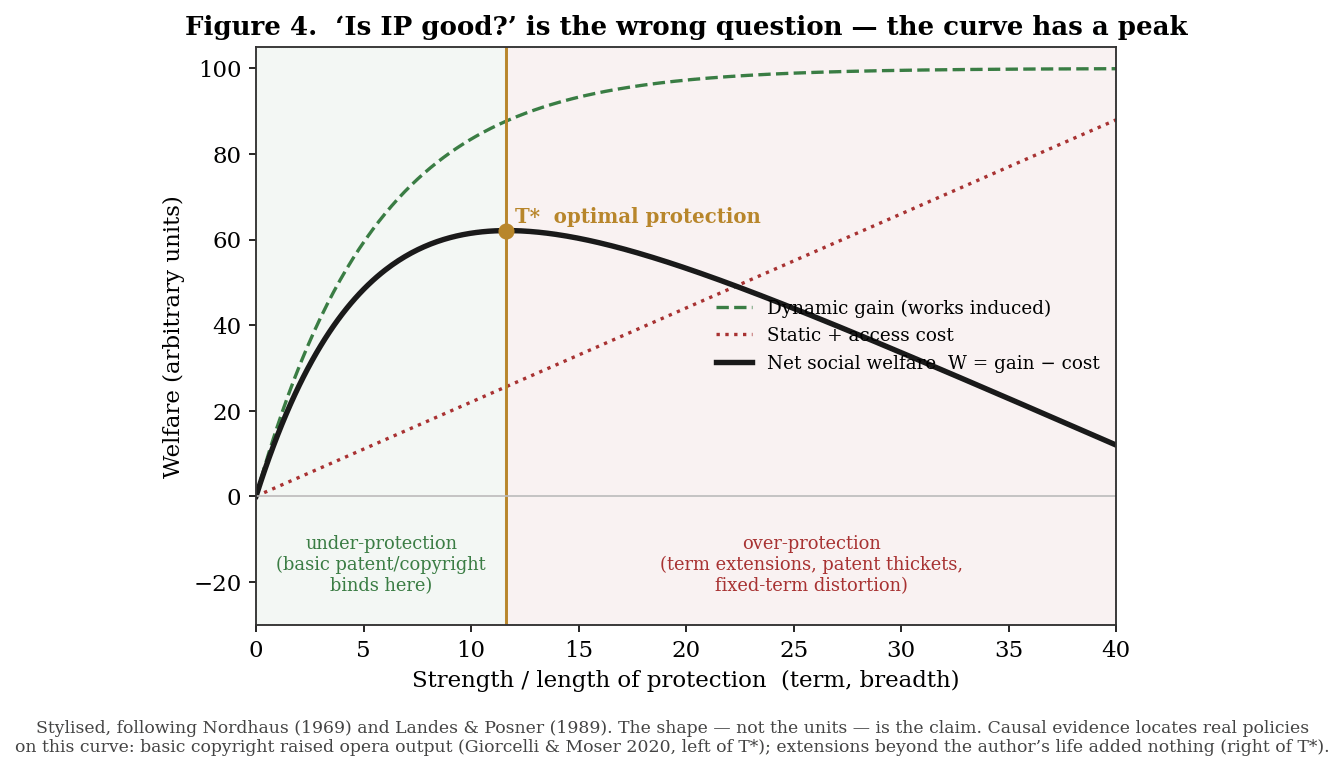
In any case, after more of this, he produces some curve, reminiscent of the Tabarrok Curve,2 where, as best I can tell, he insinuates the patent term is around 12 years. Okay, Craig.
This whole thing is painful.
Basically, as he reveals in one of his tweets, he wants some committee of experts to fine-tune the IP system and to make all kinds of optimal distinctions on the scope and length of patent term of all types of inventions and works of art, and who knows what other types of IP:
The first fallacy is the false dilemma. My position is not “finite IP or perpetual IP, choose one.” That is his little wooden box, not mine. The actual position is that intellectual creations can generate legitimate property interests, and that different categories of intellectual property may have different legal incidents, scopes, terms, remedies, and limits. Patent is not copyright. Copyright is not trade mark. Trade mark is not trade secret. Trade secret is not passing off. Design rights are not reputation. These are different juridical structures protecting different interests.
… The fourth fallacy is the straw man. I have not argued that every patent and copyright must last forever. I have not argued that every thought floating through someone’s head should be fenced off until the sun burns out. The argument is that invention, authorship, disclosure, confidential knowledge, commercial identity, goodwill, and reputation can be economically valuable interests capable of legal protection. Law then calibrates the protectionaccording to the nature of the asset. That is not contradiction. That is legal architecture.
Ha. Just let the experts handle it! They are so wise! This appears to be the view of the Randians, who think you just leave it to the experts to figure out the right term. They just need to “properly calibrate” it.3 After all, there is nothing wrong with legislation; according to Objectivist IP shill Murray Franck, “The same minds that employ induction and deduction to decide a particular case, making common law, can employ those methods to legislate universal laws.”4 Or J. Neil Schulman’s view that you could have the legal system determine on a case by case basis the “right” patent or logoright term length using information and probability theory to estimate how long it likely would have taken someone else to independently re-invent the patented item. As I wrote in The Patent Eligibility Restoration Act, n.3:
Adam Mossoff & Eric Claeys, “Patent Injunctions, Economics, and Rights“; Christopher B. Seaman, “Permanent Injunctions in Patent Litigation After eBay: An Empirical Study“. These support finite terms for patents, even though the number is totally arbitrary: “the exclusionary rights secured by a patent should account for “how long it would have taken, in the absence of knowledge of the invention, for independent discovery” resulting from the productive labors of others.43 This concern is addressed by duration limits.44″ (P. 7) It’s hard to believe they seriously believe that Congress knows and had determined what the “right” patent term should be. 17 years? Why? Why should it be the same for all types of patents? Why shouldn’t the courts or the PTO figure it out? Jesus Christ, how can they bear to repeat such utter nonsense! This was the same stupid shit Neil Schulman proposed, as I noted elsewhere: “which is what J. Neil Schulman proposes in his logorights idea–just have some panel of “experts” use “information theory” to figure out how long each patent should last–1.3 years for this one. 26 years for that one. and so on.” See Optimal Patent and Copyright Term Length. As Schulman writes: “Taking the “lowering entropy” argument too far into the area of physical thermodynamics runs one quickly into problems of both fact and theory; the comparative “entropy levels” of a car, a piece of junk, and a chunk of ore are incalculable. Nevertheless, I believe the “entropic” paradigm of regarding creation as a “calculable increase in improbability” is sound within the context of information theory, where one discusses the “entropy” of a signal; and, in fact, I’m told there are existing formulas, used by the Search for Extra-Terrestrial Intelligence (SETI), to calculate the “improbabilities” of a signal being a “natural” occurrence as opposed to being artificially generated “information.” J. Neil Schulman, Origitent: Why Original Content is Property (Steve Heller Publishing, 2018), p. 40. And now you have these guys buying into this. What’s their authority? Nozick’s dilettantish remarks in his anarchy book; he didn’t know anything about IP law, or even how to justify rights! Oh, and Ayn Rand, who made up some makeweight argument. And of course the Congress and the US Code that “says” what the patent term is. Oh, that’s some proof! See also Yaron Brook on the Appropriate Copyright Term; Hawley Introduces Bill to Reduce the Copyright Term; Reason: Copyright Should Last Half A Century; and see the remarks on copyright term and related matters by Tom Bell and Jerry Brito in Tom Bell on copyright reform; the Hayekian knowledge problem and copyright terms.
This is all the gibberish Wright believes: there should be different types of IP, different categories, scopes, terms, maybe it’s infinite, maybe not, maybe different for patent than for copyright, maybe different for different types of patents…. it’s not a natural right at all, don’t worry about it expiring at an arbitrary time determined by some benevolent and omniscient panel of government experts… What total nonsense.
***
Recent tweets
@NSKinsella‘s argument is not a serious objection to intellectual property. It is a false dilemma in a cheap suit. He says that if IP has finite terms, then it cannot be a natural right; and if it is perpetual, then it amounts to killing the human race. That is not logic. That is… https://t.co/2v5mIx8qvi
— S Tominaga (Aka Dr Craig Wright) (@CsTominaga) June 21, 2026
@NSKinsella‘s argument is not a serious objection to intellectual property. It is a false dilemma in a cheap suit. He says that if IP has finite terms, then it cannot be a natural right; and if it is perpetual, then it amounts to killing the human race. That is not logic. That is… https://t.co/2v5mIx8qvi
— S Tominaga (Aka Dr Craig Wright) (@CsTominaga) June 21, 2026
@NSKinsella‘s argument is not a serious objection to intellectual property. It is a false dilemma in a cheap suit. He says that if IP has finite terms, then it cannot be a natural right; and if it is perpetual, then it amounts to killing the human race. That is not logic. That is… https://t.co/2v5mIx8qvi
— S Tominaga (Aka Dr Craig Wright) (@CsTominaga) June 21, 2026
That argument is a dressed-up false dilemma. It says: either IP is finite, in which case it cannot be a natural right, or IP is perpetual, in which case civilisation dies. Neither branch follows.
A property right can be real without being absolute, unlimited, or eternal in every…
— S Tominaga (Aka Dr Craig Wright) (@CsTominaga) June 21, 2026
“IP is not ownership of “ideas.” Copyright protects expression, not the idea. Patent rights concern a claimed invention, not a loose thought.”
All law is enforced. By … force. Physical force. Just as you can only violate rights by the initiation of physical force–as your…
“Stephen, let us put your position plainly, since obscurity is such a convenient hiding place.”
Another sign of our stupidity. Your name is Stephen so surely in your life you have encountered the different name Stephan. I am not Stephen. A fellow Stephen should realize this but…
this is is all just incoherent smokescreen and noise. Notice you pose as making a point but you are not saying anything: you don’t define anything; you make implicit assertions and assumptions; you do not make a case for anything. You low IQ chumps… not only can you not make an…
anything peaceful is permitted of course.
But your little schema has nothing to do with IP rights.
Ideas or information cannot be owned since they never exist as independent things but are just arrangements of features of material substrates which are already owned by someone by…
This is the problem with Stephen Kinsella: he disproves nothing, then struts away as if noise were logic.
He offers contradiction, innuendo, and bullshit in place of argument, then expects others to bow because the performance is delivered with the manners of a bully.
— S Tominaga (Aka Dr Craig Wright) (@CsTominaga) June 19, 2026
If he says finite terms, then it’s not a natural right. If he says perpetual, then he’s in favor of killing the human race not just slowing down its progress
That argument is a dressed-up false dilemma. It says: either IP is finite, in which case it cannot be a natural right, or IP is perpetual, in which case civilisation dies. Neither branch follows.
A property right can be real without being absolute, unlimited, or eternal in every…
— S Tominaga (Aka Dr Craig Wright) (@CsTominaga) June 21, 2026
The case against intellectual property presents itself as rigorous natural law. It is neither. It smuggles in a narrow physicalist theory of property — only tangible rivalry counts, only permanent physical possession is real ownership, only the parties to a contract can be bound — and then declares everything outside that picture artificial. But the property law we already have is built almost entirely out of the excluded remainder: leaseholds, easements, covenants that run to strangers, options, debts, choses in action. The physicalist test, applied honestly, does not refute intellectual property. It voids most of property law. This essay shows where the argument fails, technically, and concedes everything it gets right.
The Center for the Study of Innovative Freedom (C4SIF) is dedicated to building public awareness of the manner in which so-called “intellectual property” (IP) laws and policies impede innovation, creativity, communication, learning, knowledge, emulation, and information sharing. We are for property rights, free markets, competition, commerce, cooperation, and the voluntary sharing of knowledge, and oppose IP laws, which systematically impede or hamper innovation. IP law should be completely and immediately abolished.
We provide news commentary and analysis and scholarly resources from our unique pro-property, pro-market, pro-innovation perspective.






I just wonder what is the price of the pi number. After all, it is an idea :)))))
Is it 3.1415927 ????