Related
- (All by Kinsella), “Patents, Pharma, Government: The Unholy Alliance,” Brownstone Institute (April 1, 2024)
- The Overwhelming Empirical Case Against Patent and Copyright
- Tabarrok and Murphy: Why Are US Drug Prices So High?
- “Intellectual Property Advocates Hate Competition”
- Are Patents and Copyrights “Monopolies”?
- IP Rights as Monopolistic Grants to Overcome the Public Goods Problem
- “Decouple Trade and IP Protection,” Brownstone Institute (Dec. 4, 2024)
- The China Stealing IP Myth
- “Free-trade” pacts export U.S. copyright controls
- Patents and Pharmaceuticals
- “FDA and Patent Reform: A Modest Proposal” (May 5, 2023)
- “Are Patents Needed to Make Up for FDA Kneecapping?” (July 2, 2011)
- KOL469 | Haman Nature Hn 149: Tabarrok on Patents, Price Controls, and Drug Reimportation
- Optimal Patent and Copyright Term Length
- Tabarrok: Patent Policy on the Back of a Napkin
- Pharmaceutical Shills and Think Tank Corruption: Sally Pipes’s The World’s Medicine Chest: How America Achieved Pharmaceutical Supremacy―and How to Keep It
- IP can’t be socialistic, since the Soviet Union didn’t recognize IP law.”
See Lawrence Wilson and Sylvia Xu, “The Loophole Drug Makers Use to Keep Prices High: How pharmaceutical companies use the patent system to delay generic drugs from coming to market,” Epoch Times – In Depth – Premium Reports (
As I noted in my post IP Rights as Monopolistic Grants to Overcome the Public Goods Problem, IP proponents support these monopoly privileges on explicitly anticompetitive grounds. Take this explicit opening passage in an article by an ardent IP advocate, Jerome H. Reichman, a law professor at Duke:
Governments adopt intellectual property laws in the belief that a privileged, monopolistic domain operating on the margins of the free-market economy promotes long-term cultural and technological progress better than a regime of unbridled competition.
… Intellectual property laws typically provide qualified creators with temporary grants of exclusive property rights that derogate from the norms of free competition in order to overcome the “public goods” problem inherent in the commercial exploitation of intangible creations.7
Bob Parant left his home on Long Island for the first time when he enrolled in college. Always interested in sports, he decided to try out for the football team in his sophomore year.
One day, Parant got a message to report to the athletic office.
“The coach calls me in and says, ‘You’ve got diabetes mellitus,’” Parant said. “That was back in 1972, and that’s where it started.”
Parant, now 73, has been living with diabetes for over 50 years.
He’s generally upbeat about his condition, despite the unending regimen of blood testing and insulin injections. None of that stopped him from having a successful career in pharmaceutical sales.
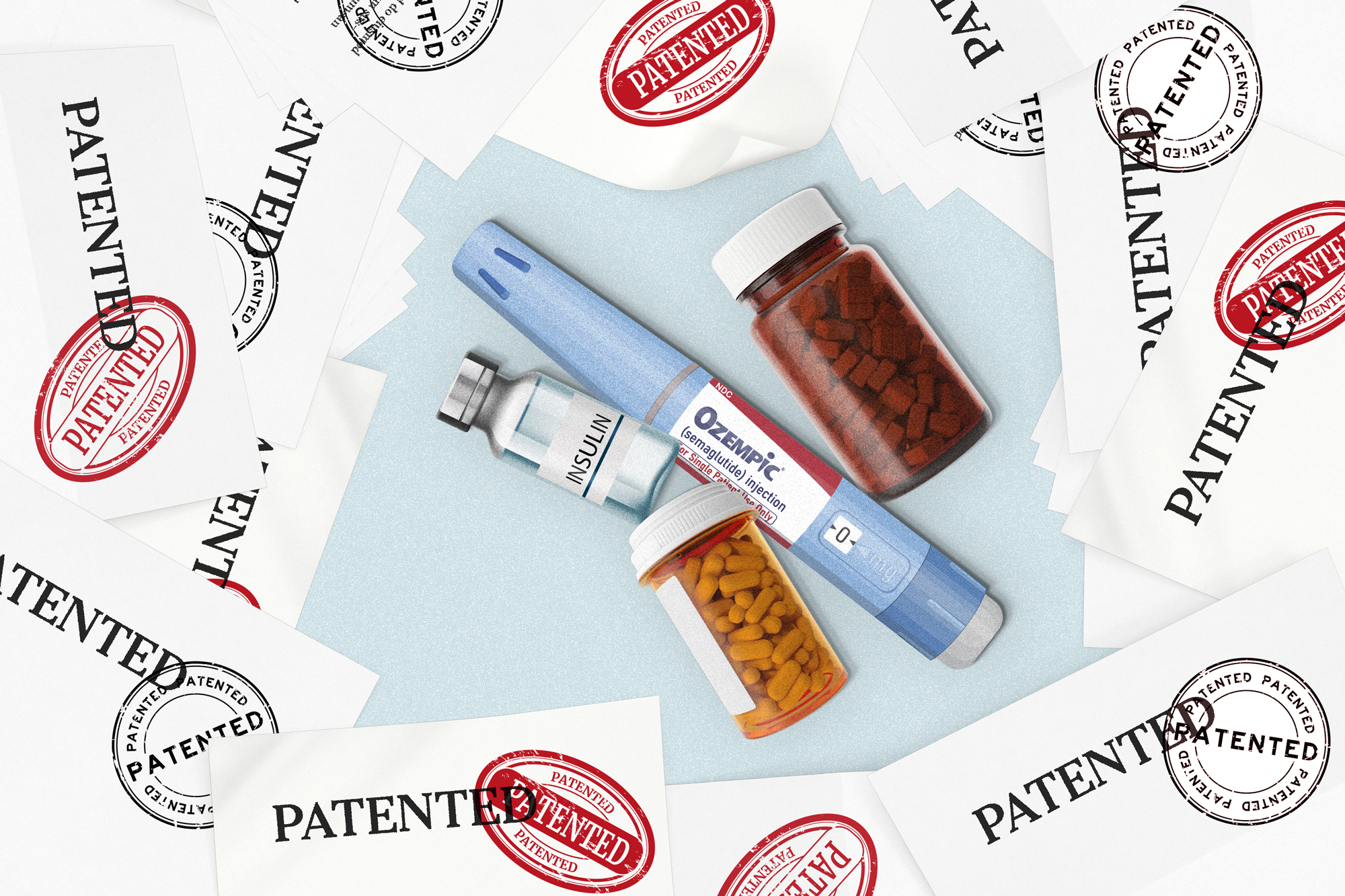
Yet one thing troubles Parant about needing this drug to stay alive. It’s the way drug makers seemingly game the system to keep prices high.
“They have a patent for a certain period of time, so they’re protected,” Parant said.
A drug patent generally lasts for 20 years, though the period of exclusivity—during which only the patent holder can produce the drug—varies by drug type.
That enables the creator to control prices and recoup the cost of development. After that, anyone can make and market the item.
But opening the market to competition can be delayed by new patents, which can be created at any time for a particular drug, and can cover a variety of things.
“[Drug manufacturers] come out with another formulation of the drug, which gives them another number of years. And they just keep going, and generics and biosimilars cannot come into the market,” Parant said.
That tactic is known as a patent thicket.
The problem has been around since at least 2001, when Carl Shapiro of the University of California–Berkeley described it this way: “A patent thicket [is] a dense web of overlapping intellectual property rights that a company must hack its way through in order to actually commercialize new technology.”
Grok summary
Summary: “The Loophole Drug Makers Use to Keep Prices High” (The Epoch Times, May 24, 2026)
The article examines how pharmaceutical companies use patent thickets—dense webs of overlapping patents—to extend market exclusivity for brand-name drugs, delay generic and biosimilar competition, and maintain high prices.
How Patent Thickets Work
- A primary patent covers the active ingredient (typically 20 years).
- Companies file additional patents for minor variations: new coatings, dosages, delivery methods, formulations, or new uses.
- These are linked via terminal disclaimers, creating a thicket.
- When generics try to enter, the brand company can file multiple separate infringement lawsuits, making legal challenges extremely costly and time-consuming for smaller competitors.
Examples Cited
- Insulin: Eli Lilly’s Humalog gained 17 extra years, Novo Nordisk’s Novolog 27 years, and Sanofi’s Lantus 28 years of protection through overlapping patents. One generic attempt for Lantus was withdrawn after extensive litigation. Prices stayed high (e.g., $541/month wholesale in 2019) until Medicare negotiations lowered them.
- Ozempic: First patent 2006, approved 2017, protected by overlapping patents until 2037. Taxpayers spent over $2 billion via Medicaid in 2023 (> $1,000 per claim), while insured patients may pay as little as $25 copay.
- Trikafta (cystic fibrosis): 35 patents, some running to 2038. Annual cost > $370,000 (vs. independent estimate of $67k–$85k as reasonable). Earliest patents expire soon, but thicket delays generics.
- Keytruda (cancer): 66 U.S. patents; generated $163 billion in revenue since 2014.
Patient Impact
Stories highlight financial strain:
- Bob Parant (diabetes, 50+ years) criticizes barriers despite supporting profits.
- Kris Garcia (multiple bleeding disorders) saw his construction business collapse under rising insurance costs.
- Don Kreis’ daughter’s Trikafta bill equals ~3× his salary.
Costs are ultimately borne by insurers, employers, and taxpayers even when patients pay low copays.
Proposed Solution: The ETHIC Act
- Bipartisan bill (introduced 2025 by Rep. Jodey Arrington and Sens. Hawley, Welch, Klobuchar).
- Would limit brand companies to asserting only one patent per patent group in infringement lawsuits.
- Supported by patient advocates and many scholars; opposed by groups arguing multiple patents are needed for complex drugs and that the bill threatens innovation.
Counterarguments
- Drug development costs $1–2 billion per new drug.
- Companies (e.g., Merck on Keytruda) argue heavy R&D investment justifies returns and that thickets protect genuine innovations.
- USPTO notes that raw patent counts don’t accurately reflect value.
The article frames patent thickets as a key driver of persistently high U.S. drug prices, with the ETHIC Act presented as a targeted reform to increase competition without eliminating patent protections.
- “Patent vs. Copyright: Which is Worse?” [↩]
- We are all copyright criminals: John Tehranian’s “Infringement Nation” [↩]
- Intellectual Property Rights as Negative Servitudes
- Classical Liberals, Libertarians, Anarchists and Others on Intellectual Property. [↩]
- Hello! You’ve Been Referred Here Because You’re Wrong About Intellectual Property: “IP can’t be socialistic, since the Soviet Union didn’t recognize IP law.”
- Tabarrok and Murphy: Why Are US Drug Prices So High?
- IP Rights as Monopolistic Grants to Overcome the Public Goods Problem, quoting Reichman, “Charting the Collapse of the Patent-Copyright Dichotomy: Premises for a Restructured International Intellectual Property System,” Cardozo Arts & Ent. L.J. 13 (1995): 475. See also “Intellectual Property Advocates Hate Competition.” [↩]





The mention of “patent thickets” really stood out—it’s wild how a web of overlapping patents can block generics for years. My own family has felt the sting of this with a common asthma inhaler; cheaper alternatives exist abroad but aren’t available here. Simple regulatory fixes could untangle so much of this.