
[note: see update here.]
As noted by Mike Masnick on Techdirt (post reprinted below), due to the monopoly granted by patent (yes, it is a monopoly), people are literally dying because Fabrazyme is in short supply and the sole, monopolistic manufacturer, Genzyme, can’t make enough quickly enough–and no one else is permitted to make it due to the patent. I’m sure the intellectual propergandists will callously, arrogantly, and smugly retort that without patents, Genzyme would never have invented the drug in the first place, and instead of, oh, 5,000 people dying, 20,000 would die. So saving 15,000 (I’m guessing at the numbers) is better than none, right? So the ones who die have no complaint about the patent system, since without it they’d die anyway. What a chilling mentality; and of course there is no reason to think drugs would not be invented absent patents.
If the concern here is that pharmaceutical companies need the be able to charge monopoly prices to be able to increase revenues enough to provide enough return on investment to make the original research worthwhile, wouldn’t a simpler and more direct solution be to remove the costs already imposed on them by the state–taxes, regulations, FDA process–instead of trusting that same destructive state to “help” them? The history of innovation and patenting is rife with example after example of near-simultaneous invention occurring, but the first to file (or invent, depending on the jurisdiction) gets the monopoly. Absent patents, they would all be able to take products to market. They all benefit already from the accumulated body of human knowledge that they had no role in producing. They build on the insights and discoveries of others from the past; and in the future, people will build on their discoveries being made now. What is wrong with this? Emulation and learning are good things. The market thrives on competition; competition is not possible without the freedom to emulate. When current innovation incrementally builds on knowledge from the past, when future innovation will build on knowledge from the present–it is bizarre and obscene to impose artificial limits on contemporaneous learning and sharing and emulating and competing.
Absent patents, there would be even more innovation. As Robert Weissman from Public Citizen, quoted by Masnick, notes: “ Of course there are no competing suppliers — why would any firm try to enter a market it believed closed by a patent monopoly?” Companies avoid engaging in R&D in patented markets. Of course, this is one reason patents distort the market and R&D, as explained by Rothbard and others.1
And yet, in Orwellian fashion, the intellectual properteers justify IP in the name of promoting innovation. War is peace. Sickness is health. Murder is collateral damage. And stultifying innovation is somehow promoting it!
The victims of this murderous policy in this case tried to lobby the NIH to authorize other companies to produce some more of the life-saving drug–and pay royalties to Genzyme. How is Genzyme harmed by this? They would be receiving the proceeds of a private tax levied in their favor courtesy of the USPTO. But, predictably, disgustingly, the NIH rejected the petition. There is no justification for this outrage. What the petitioners basically want is a compulsory license. The feds have the authority to grant this. There is no good reason not to. As I argue in Reducing the Cost of IP Law: [continue reading…]
- See Rothbard, Man, Economy, and State and Power and Market:
“It is by no means self-evident that patents encourage an increased absolute quantity of research expenditures. But certainly patents distort the type of research expenditure being conducted. For while it is true that the first discoverer benefits from the privilege, it is also true that his competitors are excluded from production in the area of the patent for many years. And since one patent can build upon a related one in the same field, competitors can often be indefinitely discouraged from further research expenditures in the general area covered by the patent. Moreover, the patentee is himself discouraged from engaging in further research in this field, for the privilege permits him to rest on his laurels for the entire period of the patent, with the assurance that no competitor can trespass on his domain. The competitive spur for further research is eliminated. Research expenditures are therefore overstimulated in the early stages before anyone has a patent, and they are unduly restricted in the period after the patent is received. In addition, some inventions are considered patentable, while others are not. The patent system then has the further effect of artificially stimulating research expenditures in the patentable areas, while artificially restricting research in the nonpatentable areas.”
See also Arnold Plant, “The Economic Theory Concerning Patents for Inventions,” Economica, New Series, 1, no. 1 (Feb., 1934), p. 43. [↩]



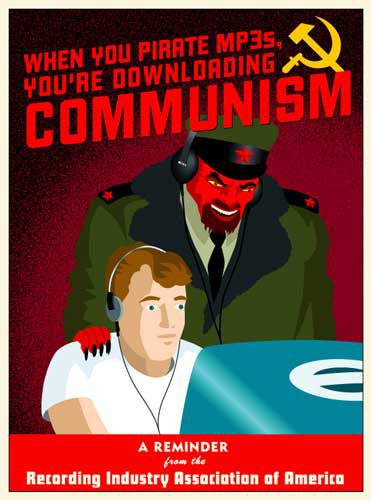


 The RIAA is famous for targeting college students with DMCA takedown notices or even full lawsuits. The MPAA however, has never been active on this front.




{ 76 comments… read them below or add one }