
≡ Menu

Property Title Records and Insurance in a Free Society

Land registry

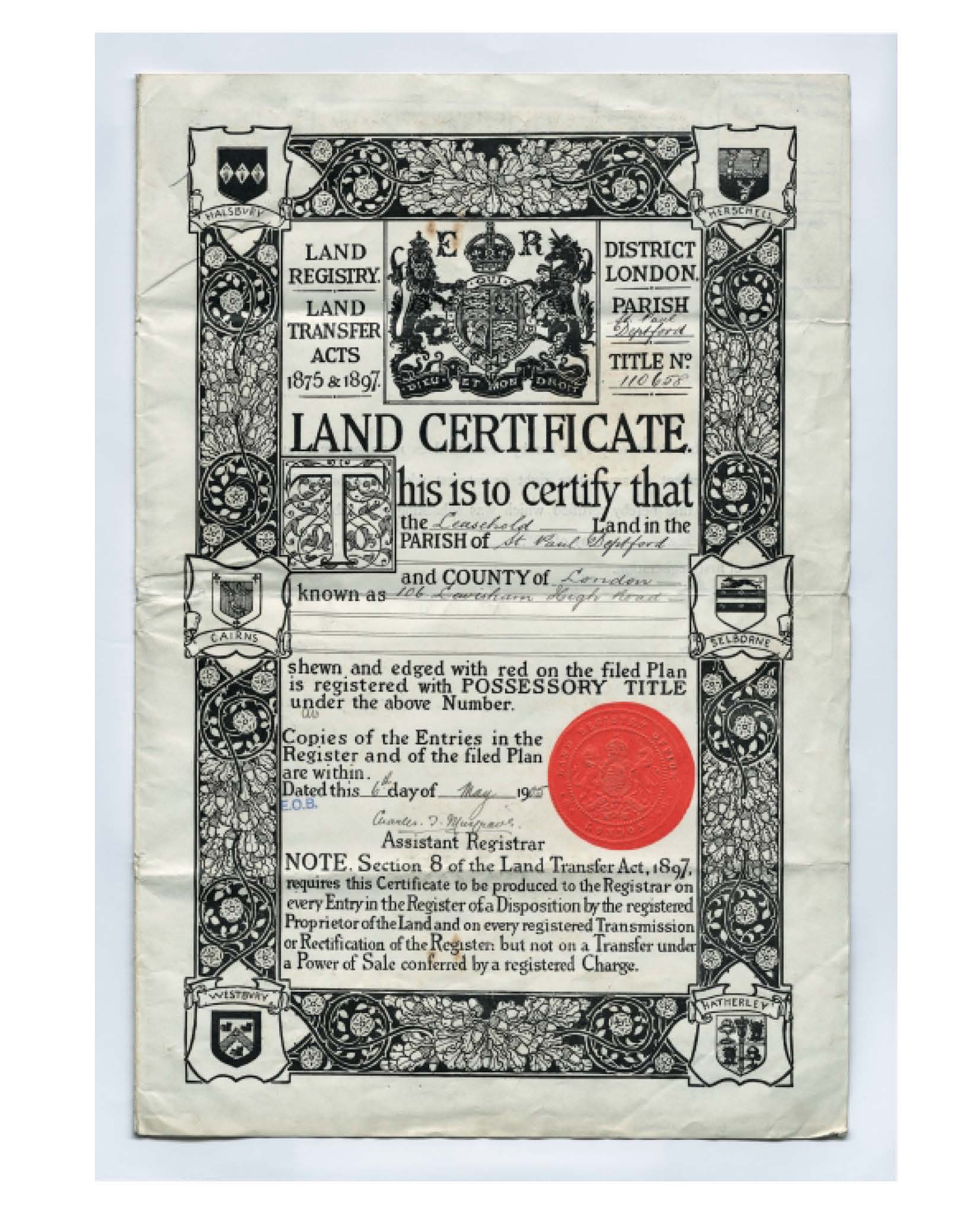
Land Registry: Land Certificate, from A Short History of Land Registration in England and Wales

Related:

[Update: see also the discussion or property title insurance in KOL058 | Guest on Gene Basler Show: Anarcho-capitalist issues (2010); KOL390 | Disenthrall with Patrick Smith: Aggression and Property Rights in the Libertarian Party Platform; KOL338 | Human Action Podcast Ep. 308 with Jeff Deist: Rothbard on Punishment, Property, and Contract.]

Opponents of intellectual property often point out that modern patent and copyright are purely legislated, artificial schemes. For anarcho-libertarians and libertarians opposed to legislation as a means of forming law, this is yet another stake in the heart of IP. (See my post The Mountain of IP Legislation, and my article “Legislation and Law in a Free Society.”)

So it’s not surprising that one retort of the IPers is to argue that patent- and copyright-like rights “could” evolve in common law courts. Even though they didn’t; even though the idea of statutorily enacted schemes arising from judicial decisions is more than implausible: it’s ridiculous. Some of them simply posit that there could be private “title” offices in a free society akin to real property title records in use today: you just go down and “register” your “idea”; later, when you sue an “infringer” of “your” idea in court, you can prove you “own” it by introducing evidence from the IP title records office. For example, in a recent Mises blog thread, someone suggested there might be some private invention title office (at November 30, 2010 at 1:08 pm; my reply, at November 30, 2010 at 11:21 pm). And the anarcho-libertarian Tannehills, in their classic The Market for Liberty, argue (pp. 58-59):

Ideas in the form of inventions could also be claimed by registering all details of the invention in a privately owned “data bank.” Of course, the more specific an inventor was about the details of his invention, the thought processes he followed while working on it, and the ideas on which he built, the more firmly established his claim would be and the less would be the likelihood of someone else squeezing him out with a fake claim based on stolen data. The inventor, having registered his invention to establish his ownership of the idea(s), could then buy insurance (from either the data bank firm or an independent insurance company) against the theft and unauthorized commercial use of his invention by any other person. The insurance company would guarantee to stop the unauthorized commercial use of the invention and to fully compensate the inventor for any losses so incurred. Such insurance policies could be bought to cover varying periods of time, with the longer-term policies more expensive than the shorter-term ones. Policies covering an indefinitely long time-period (“from now on”) probably wouldn’t be economically feasible, but there might well be clauses allowing the inventor to re-insure his idea at the end of the life of his policy.

One problem with the Tannehills’ reasoning was the question-begging assumption that it’s “theft” to use an idea if it’s “unauthorized”; this presupposes there is property in information. [continue reading…]

Share
{ 6 comments }

Libertarian and other IP advocates sometimes get miffed when you refer to a patent or copyright as a monopoly privilege granted by the state (see my post Are Patents “Monopolies”?). But some IP proponents are quite forthright about this. Take this explicit opening passage in an article by an ardent IP advocate, Jerome H. Reichman, a law professor at Duke:

Governments adopt intellectual property laws in the belief that a privileged, monopolistic domain operating on the margins of the free-market economy promotes long-term cultural and technological progress better than a regime of unbridled competition.

… Intellectual property laws typically provide qualified creators with temporary grants of exclusive property rights that derogate from the norms of free competition in order to overcome the “public goods” problem inherent in the commercial exploitation of intangible creations.1

Notice how much is packed into this short passage. First, an explicit admission that IP grants are monopolistic and derogate from free market norms and are opposed to a regime of “unbridled competition”–i.e., IP is anti-competitive. As is to be expected–after all, it’s a monopoly grant. Second, that IP rights are only temporary–they are a mere policy tool, not a natural right (natural rights are not temporary).2 Third, that the legitimacy of IP is based on the modern economic idea of “public goods.”3

Update: From a recent article in Harvard’s Journal of Law and Technology (JOLT):

The “patent bargain” is an easily understood concept. Awarding an inventor twenty years exclusivity naturally entails considerable social cost — a cost that rises in direct proportion to the value of the covered invention. In certain instances — those where the patented technology is so useful that no substitutes exist — the award of a patent creates a complete economic monopoly.

— Alan Devlin, “The Misunderstood Function of Disclosure in Patent Law

Bonus quote from the same article:

To derive value from her insights, an inventor must transform abstract conceptions into a commercial product or license her discovery to a third party who will do the same. But if an inquisitive rival can inspect the end product and derive the underlying invention for himself, the inventor’s ability to reap pecuniary reward from her innovation will be jeopardized. To counter this dilemma—a problem deemed endemic in public goods—an inventor will have to manufacture complexity into her end product, artificially rendering it unsusceptible to reverse engineering. Like the myriad inventions that Da Vinci put to paper in impenetrable fashion, innovators would do everything within their power to mask their discoveries from unwelcome eyes.

But the truth is, as noted in my post Leveraging IP, due to the existence of IP, companies complicate and distort the design of their products to take advantage of IP rights, from Omega adding copyright-protected logos on watches to use an arcane aspect of copyright law to block price arbitrage imports; to laser printer vendors adding needless patented circuits to prevent competition from generics.

[Mises cross-postarchived comments]

  1. Reichman, “Charting the Collapse of the Patent-Copyright Dichotomy: Premises for a Restructured International Intellectual Property System,” Cardozo Arts & Ent. L.J. 13 (1995): 475. []
  2. See Tom W. Bell, Intellectual Privilege: Copyright, Common Law, and the Common Good, Part 1, Chapter 3, Sec. B.1. []
  3. See, on this fallacious notion, Hans-Hermann Hoppe, “Fallacies of the Public Goods Theory and the Production of Security,” in The Economics and Ethics of Private Property []
Share
{ 6 comments }

Exaggerated commentary (unfortunately) from Viacom:

Viacom Says YouTube Ruling Will ‘Completely Destroy’ Copyright

Viacom appealed Friday its unsuccessful $1 billion copyright lawsuit against Google’s YouTube in a case testing the depths of copyright-infringement protection under the Digital Millennium Copyright Act of 1998.

Viacom, on behalf of its MTV, Comedy Central, Black Entertainment Television, Paramount Pictures and Nickelodeon units, is seeking to overturn a June ruling that, if it survives, is a boon for internet freedom — and a decision that would make it more difficult for rights holders to protect their works.

The media concern told the New York-based 2nd U.S. Circuit Court of Appeals on Friday that, if the lower decision stands, “it would radically transform the functioning of the copyright system and severely impair, if not completely destroy, (.pdf) the value of many copyrighted creations.”

The June 23 decision at issue by U.S. District Judge Louis L. Stanton of New York said internet companies, even if they know they are hosting infringing material, are immune from copyright liability if they promptly remove works at a rights holder’s request — under what is known as a takedown notice.

Stanton disagreed with Viacom’s claims that YouTube had lost the so-called “safe harbor” protection of the DMCA. Viacom maintains Google does not qualify, because internal records showed Google was well aware its video-hosting site was riddled with infringing material posted by its users.

Share
{ 0 comments }

From Cory Doctorow at BoingBoing (related post: see my Intellectual Property Imperialism):

Wikileaks cables reveal that the US wrote Spain’s proposed copyright law

Cory Doctorow at 2:24 PM Friday, Dec 3, 2010

Spain’s Congress is about to vote on a new and extremely harsh copyright/Internet law. It’s an open secret that the law was essentially drafted by American industry groups working with the US trade representative.

But it gets gets more interesting: 115 of the Wikileaks cables intercepted from the US embassy in Madrid were tagged with “KIPR” — that is, relating to “intellectual property,” The big question has been: will El Pais, the Spanish newspaper that has the complete trove of Wikileaks cables release them in time to effect the vote on the new law?

Well, now they’ve started. The first 35 of the 115 cables have been released, and they confirm the widespread suspicion: the Spanish government and the opposition party were led around by the nose by the US representatives who are the real legislative authority in Spain.

So here’s the new question: when the Spanish Congress votes on America’s copyright law this month, will they vote for their sovereignty, or act like a US puppet state?

Share
{ 1 comment }

From the Federalist Society. It’s very interesting. Richard Espstein’s utilitarian approach seems very flawed to me, but it’s interesting to hear his take–it exemplifies a lot of mainstream thinking about IP policy. It’s unfortunate that the legitimacy of IP seems to be taken for granted by most (?) legal thinkers in the conservative/”libertarian” Federalist Society. At least Epstein mentions that his former student (?) Tom Bell has an anti-IP view (see his Intellectual Privilege: Copyright, Common Law, and the Common Good). Gigi Sohn of Public Knowledge was, I think, the best and most IP- and state-skeptical on the panel.

Minimizing Risk and Maximizing Reward: IP as Regulatory Policy or Property Right?

2010 National Lawyers Convention

November 18, 2010

Richard A. Epstein, Brett M. Frischmann, Mark F. Schultz, Gigi B. Sohn, Paul R. MichelThe following audio was recorded on November 18, 2010.

Minimizing Risk and Maximizing Reward:
IP as Regulatory Policy or Property Right?
11-18-10
Running Time: 01:23:55
[audio Full Audio]
[video Video on YouTube]

THURSDAY, NOVEMBER 18

Intellectual Property: Minimizing Risk and Maximizing Reward: IP as Regulatory Policy or Property Right?
2:00 p.m. – 3:30 p.m.

  • Prof. Richard A. Epstein, Laurence A. Tisch Professor of Law, New York University School of Law
  • Prof. Brett M. Frischmann, Yeshiva University, Benjamin N. Cardozo School of Law
  • Prof. Mark F. Schultz, Southern Illinois University School of Law
  • Prof. Gigi Sohn, President and Founder, Public Knowledge
  • Moderator: Hon. Paul R. Michel (ret.), United States Court of Appeals, Federal Circuit

The Mayflower Hotel
Washington, DC

Share
{ 4 comments }

Supreme Court refuses innocent infringement P2P case

From arstechnica. Not surprising. Alito, though right on the morality, is probably wrong on the law: the law is unjust, and an ass. And this is not surprising: our criminal state will of course not permit ignorance of “the law” to be a defense or excuse.

Supreme Court refuses innocent infringement P2P case

By Nate Anderson | Last updated 4 days ago
The US Supreme Court today refused to hear the case of a file-swapper who claimed she was an “innocent infringer,” but one justice at least understands the absurdity of the current law.

The case concerned Whitney Harper, who shared some music on the family computer when she was a teenager and was subsequently hit with a lawsuit from the RIAA. Harper claimed that she was an “innocent infringer” who went straight when she learned about copyright law, and that she had thought P2P use was basically like (legal) Internet radio.

A federal court in Texas allowed Harper’s claim, which reduced her liability to $200 per song instead of the usual statutory minimum of $750. An appeals court overturned the ruling; as it pointed out, copyright law currently states that one can’t claim “innocence” so long as a copyright notice was printed on the physical “phonorecord.” But because Harper had downloaded on computers and never seen the CD version of her songs, she argued that the provision was patently unfair and appealed to the Supreme Court.

The justices today refused to hear the case, though Samuel Alito dissented (PDF). “This provision was adopted in 1988, well before digital music files became available on the Internet,” he wrote. “But a person who downloads a digital music file generally does not see any material object bearing a copyright notice, and accordingly there is force to the argument that §402(d) does not apply. In such a case, the question would simply be whether the infringer ‘was… aware and had… reason to believe,’ that the downloading was illegal.”

While the Court is most likely to act on issues where the different Courts of Appeal are divided, Alito argued that the case should have been taken anyway. “Although there are now no conflicting Circuit decisions,” he said, “I would grant review in this case because not many cases presenting this issue are likely to reach the Courts of Appeals. The Court has decided not to grant review at this time, but if a conflict in the Circuits develops in the future, the question presented, in my judgment, is important enough to warrant review.”

For now, though, Harper’s verdict remains in place: $750 for each of the 37 songs at issue, or $27,750.

Share
{ 0 comments }

From the WSJ blog:

For years, fashion designers have been wishing, hoping, praying, lobbying for better copyright protection for their designs.

Well, on Wednesday, the industry got a leg up in its long quest, when the Senate Judiciary Committee unanimously passed the Innovative Design Protection and Piracy Prohibition Act, also known as the fashion design protection bill.

The bill, introduced by Senator Charles Schumer earlier this year, would help to protect the intellectual property rights of designers by creating an amendment to chapter 13 of the Copyright Act– an act that currently applies only to vessel hulls.

Vessel hulls? That’s right, vessel hulls.

The current bill, which could go to before the full Senate before the December recess, creates a “substantially identical” standard for infringement, largely borrowed from trademark law. It would create a 3-year term of protection, for designs that have both originality and novelty.

For a good overview of the bill’s specifics, click here.

Read more>>

Share
{ 1 comment }

Funding for Creation and Innovation in an IP-Free World

The case against IP is not hard to make; patent and copyright (say) are artificial state-granted monopoly privileges that undercut and invade property rights. But the consequentialist and utilitarian mindset is so entrenched that even people who see the ethical problems with IP law sometimes demand that the IP opponent explain how innovation would be funded in an IP-free world. As I noted in The Creator-Endorsed Mark as an Alternative to Copyright:

I’m reminded of John Hasnas’s comments in his brilliant, classic article The Myth of the Rule of Law:”

What would a free market in legal services be like?

I am always tempted to give the honest and accurate response to this challenge, which is that to ask the question is to miss the point. … It is possible to describe what a free market in shoes would be like because we have one. But such a description is merely an observation of the current state of a functioning market, not a projection of how human beings would organize themselves to supply a currently non-marketed good. To demand that an advocate of free market law (or Socrates of Monosizea, for that matter) describe in advance how markets would supply legal services (or shoes) is to issue an impossible challenge.

With the advent of state IP legislation, the state has interrupted and preempted whatever other customs, business arrangements, contractual regimes and practices, and so on, that would no doubt have arisen in its absence. So it’s natural for those new to the anti-IP idea to be a bit nervous about replacing the current flawed IP system with … a vacuum. It’s natural for them to wonder, well what would occur in its absence? As I noted, the reason we are not sure is the state has snuffed them out. This is similar to the FCC which preempted and monopolized the field of property rights in airwaves just as they were starting to develop in the common law; now people are used to the idea of the state regulating and parceling out airwave or spectrum rights and might imagine there would be chaos if the FCC were abolished (for more on this see David Kelley & Roger Donway‘s 1985 monograph Laissez Parler: Freedom in the Electronic Media, as discussed in my post Why Airwaves (Electromagnetic Spectra) Are (Arguably) Property).

So, because people are bound to ask the inevitable: we IP opponents try to come up with some predictions and solutions and answers. Thus, in the end we must agree with Hasnas:

Although I am tempted to give this response, I never do. This is because, although true, it never persuades. Instead, it is usually interpreted as an appeal for blind faith in the free market, and the failure to provide a specific explanation as to how such a market would provide legal services is interpreted as proof that it cannot. Therefore, despite the self-defeating nature of the attempt, I usually do try to suggest how a free market in law might work.

So. How would content creators be rewarded in an IP-free market? I have tried to collect some answers in Innovations that Thrive without IP. I also came across some other ideas in TWiT 275 (81:45 to about 85:17). First they discuss the site Kickstarter, “a new way to fund creative ideas and ambitious endeavors…. Kickstarter is powered by a unique all-or-nothing funding method where projects must be fully-funded or no money changes hands.” As an example they discuss Scott Wilson’s use of the service to raise funds to sell watchbands for use with the new iPod nano (which has a clock interface). The set a goal of having $15,000 committed; as of the date of this post they have had almost $500k pledged. This guarantees enough funding and demand for the product to get off the ground.

They also discuss IndieGoGo, which allows projects to be funded. For example, people with low budget documentaries could post their project description to try to get funding. For example, one would-be documentarian wanted to do a film based on some collegiate a capella group; he needed to raise $1000 and raised twice that. The hosts also mention the site Quirky.com, which enables “social product development.” This lets you outsource various parts of engineering or manufacturing or product development to others, and give them a cut of profits. And then there is the micropledging service The Point, used recently by Austro-libertarians Bob Murphy (to challenge Paul Krugman to a debate–$56k pledged so far) and Vijay Boyapati to raise almost $20k for the Mises Institute–see Jeff Tucker’s The Age of Micro-Patronage).

[Mises cross-post]

Share
{ 2 comments }

As reported by Mike Masnick on Techdirt:

Axl Rose Sues Activision For $20M Because Guitar Hero Shows Former GNR Guitarist Slash

from the that’s-some-mighty-impressive-hatred dept

How much does Guns ‘N Roses singer Axl Rose hate former guitarist Slash? So much that he’s suing Activision for $20 million because Activision included a virtual version of Slash in the latest version of Guitar Hero, despite claimed promises not to do so. While the likelihood of success may depend on contract specifics, it does seem rather silly to care about this. The claim that “This lawsuit is about protecting Guns N’ Roses,” is obviously bogus. There is nothing about “protecting” involved here.

Share
{ 0 comments }

Steve Jobs action figure

Peter Surda sends me this:

Re this post: Looks like every day brings a new IP misuse. Apple has forced the manufacturer of a Steve Jobs action figure off the market, due to alleged copyright and trademark infringement. Even though the action figure is not called Steve Jobs at all.

This not only shows how IP is used to squash market participants by the use of force, it also shows how it promotes making bad business decisions. Spending money on getting rid of free marketing does not sound like a smart plan, rather more like a double loss. Which subsequently, it will be argued, will need to be compensated by more invasive laws.

Share
{ 0 comments }

From Mises Blog, Nov. 29, 2010. Archived comments below.

Peter Zura, in the 271 Patent Blog, notes, in Supreme Court Prepares to Chop Down “Clear and Convincing” Standard for Proving Patent Invalidity, that the Court has agreed to hear the appeal of the Microsoft Corp. v. i4i Ltd., case. In this case, i4i sued Microsoft for patent infringement and was awarded a $290M judgment, based on Microsoft’s use of XML in Word.

At issue here is the burden of proof Microsoft needs to satisfy to prove i4i’s patents invalid. Let me try to explain without getting overly legally technical. When a patent application is filed, the applicant is supposed to submit all the material prior art he is aware of. The patent office Examiner also does a search to try to find other prior art. He or she then examines the patent application in light of the prior art that is submitted and that found by the Examiner. If a patent eventually issues, then it is said to have a “presumption of validity”. A defendant can argue that the PTO made a mistake and “should not” have issued the patent–say, because it was obvious in view of some prior art–but he has the burden of proof–but it’s an uphill battle. If the defendant argues that the patent is obvious in view of prior art that the Examiner already considered (or that is similar to–cumulative with–prior art considered by the Examiner), then it’s even harder. If he finds prior art totally different from what the Examiner considered, maybe it’s easier to argue–you don’t have to argue the Examiner made a mistake, just that he didn’t see certain prior art.

Now, when you have the burden of proof there are various standards of proof, to-wit: preponderance of the evidence (more likely than not) and “beyond a reasonable doubt”, at two ends of the spectrum; with “clear and convincing evidence” being somewhere between. The question Microsoft put to the Supreme Court was which standard should be used to consider a patent’s validity, when there is new prior art submitted that has not yet been considered. If the Court says preponderance is sufficient (as they seem likely to do), this makes slightly easier to challenge a patent’s validity, in some situations (where prior art is found that is not the same as or cumulative to the prior art the Examiner considered). But the defendant still has the burden of proof; the patent is still presumed valid. And the defendant is going to make the same arguments for invalidity. It’s probably very rare when a given defendant in a given patent infringement suit would lose based on the C&C standard but win on the preponderance standard; these standards are not exact and a judge swayed by an argument for invalidity (or not) is likely to usually have the same conclusion regardless of the standard of proof.

[continue reading…]

Share
{ 2 comments }

Pirate-slaying censorship bill, COICA, gets unanimous support

As reported on Arstechnica,

The Combating Online Infringement and Counterfeits Act (COICA) sets up a system through which the US government can blacklist a pirate website from the Domain Name System, ban credit card companies from processing US payments to the site, and forbid online ad networks from working with the site. This morning, COICA unanimously passed the Senate Judiciary Committee.

This is an ominous development. The feds are already seizing domains under other laws (see Feds seize 82 domains accused of selling counterfeit goods); COICA is sure to expand this and other IP enforcement activities. (See other COICA posts.)

Unfortunately, COICA, like the dreaded ACTA, seems likely to pass.

Update: On TWIT 275 Leo Laporte and his guest hosts discuss and rightly criticize COICA. One of the guest hosts, Zadi Diaz, joins in the criticism of COICA, and then says “this is why we need net neutrality.” This shows just how confused non-libertarians can be about property rights and the role and nature of the state. Consider: she is concerned about the baleful effects of regulations, laws, and controls created and enforced against private individuals and companies by the untrustworthy state; and to combat this, she suggests that the state should impose regulations on private companies and the Internet! Net neutrality legislation is a bad, and unlibertarian, idea. (See my posts A Libertarian Take on Net Neutrality and Net Neutrality Developments, and Geoffrey Allan Plauché, CrunchGear vs. the Tea Party on Net Neutrality.)

Also: EFF on US domain copyright seizures

Share
{ 2 comments }

From Michael Geist (related post: see my Intellectual Property Imperialism):

Intellectual Property Appears to Figure Prominently In Wikileaks Cablegate

Monday November 29, 2010

Read more>>

Intellectual property policy has long been closely linked to U.S. trade policy, so it should come as little surprise to find that it appears to figure prominently in the cables obtained by Wikileaks.  Although only a couple hundreds have been posted thus far, the Guardian has supplied a full list of all 251,287 cables.  The list includes tags for each cable, so that the subject matter can be decoded.  The Guardian has also posted a glossary of the tags, but omits KIPR, which appears to be the intellectual property tag (I base this conclusion on the correlation between the KIPR tag and the WIPO tag, to a specific reference to copyright in one of the cables, and the fact that IPR is a common acronym for intellectual property rights).

Assuming KIPR is indeed the tag for intellectual property, there are 65 cables originating in Canada (almost all from the U.S. embassy in Ottawa) that address the issue.  Overall, there are a large number of IP-related cables, with approximately 2500 including the KIPR tag.  Moreover, 84 of the cables include the WIPO tag.

The cable release could provide new insight into the influence and pressures by the U.S. on Canada and other countries on intellectual property policy.  Several politicians have already described Bill C-32 as a bill designed with the U.S. in mind and as the cables become public, the behind-the-scenes pressures on the issues may come further to light.

Share
{ 2 comments }

The economic case for open access in academic publishing

As the founder and editor of Libertarian Papers, an open access journal, I agree. From Arstechnica:

The economic case for open access in academic publishing

By Adam Stevenson | Last updated about 6 hours ago

As hyperbolic as it may sound, academic publishing is the curator and guardian of the accumulated scientific knowledge of the human race, 1600 to present. It is also a cornerstone of modern science, preferentially selecting well-executed research through the peer review process. However, academic libraries are facing decreasing budgets, and even highly ranked universities are having to cut back on journal subscriptions. Since these subscriptions account for up to 75 percent of publishers’ revenues, the entire system is feeling the pressure of the economic crisis.

But that’s not the only source of strain. As content migrates to the Web and becomes increasingly difficult to control, the “walled garden” subscription business model used by the publishing industry is facing the same issues as other major content providers. This article examines the academic publishing industry and looks at the impacts of business models from both an academic and economic standpoint.

Academic publishing is big business. Yearly revenue estimates for the industry top $12 billion worldwide. If you account for the time that researchers spend preparing and reading journal articles, the total cost tops $100 billion per year. Academic publishing is also spectacularly profitable; 2009 earnings reports from two of the largest publishing houses, Elsevier and Wiley, show that the profit margin for scientific journals is 30-45 percent and profits from scholarly journal business units have increased every year since 2005.

When many people see these numbers, they naturally ask whether it would be better to adopt online-only publishing and cut commercial publishers out of the process. After all, it’s the scientists who perform the research, write the articles, edit the journals, and perform peer review. Article authors also usually pay “page charges” of $600-$2,000 to either the publisher or the academic society that owns the journal. Ultimately, it’s these same scientists who pay the subscription fees to academic publishing houses to access others’ work.

Surely there is no need for a publisher when researchers do the vast majority of the work and pay for the results. Further, articles can be archived online, eliminating physical “dead tree” editions and the costs of printing them.

Read more>>

Share
{ 0 comments }