≡ Menu

TED Curator Chris Anderson on Crowd Accelerated Innovation

TED Curator Chris Anderson on Crowd Accelerated Innovation–This is a fascinating article in Wired about how sharing information sparks innovation. (h/t Matt Bynum). A few excerpts:

When we decided to post TED talks free on the web four years ago, something unexpected happened: Speaker behavior changed. Specifically, they started spending more time preparing for the talks. The slots are 18 minutes long, but in many cases the speakers had crammed weeks or even months of preparation into those 18 minutes.

… So in [the] TED talks, an upward spiral of improvement was taking place, prompted by the use of online video. This seemed an interesting phenomenon, and suddenly I started seeing more examples wherever I looked. I couldn’t find a name for it anywhere, so I began thinking of it as Crowd Accelerated Innovation. But what is that, exactly? Does it have implications for the way we work? Will it affect the future of how we learn?

Yes—and yes. I believe that the arrival of free online video may turn out to be just as significant a media development as the arrival of print. It is creating new global communities, granting their members both the means and the motivation to step up their skills and broaden their imaginations. It is unleashing an unprecedented wave of innovation in thousands of different disciplines: some trivial, some niche in the extreme, some central to solving humanity’s problems. In short, it is boosting the net sum of global talent. It is helping the world get smarter.

… The true significance of online video has been mischaracterized and underreported.

Share
{ 0 comments }

An intriguing new idea: Copyheart! What a great replacement for copyright it would be–and, if it were legally binding, for Creative Commons type licenses. If I am not mistaken, this is another project from the fertile mind of Nina Paley, who also helped develop the Creator-Endorsed mark idea (see my post The Creator-Endorsed Mark as an Alternative to Copyright).

By Nina, on December 3rd, 2010

♡ Copying art is an act of love.

People copy stuff they like. They don’t copy stuff they don’t like. The more a work is copied, the more valuable it becomes. Value isn’t taken away by fans, it is added by them, every time they copy.

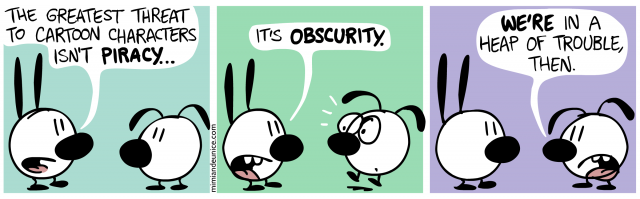
Obscurity

? Love is not subject to law.

Although we appreciate and use Free Licenses when appropriate, these aren’t solving the problems of copyright restrictions. Instead of trying to educate everyone on the complexities of copyright law, we’d rather make our intentions clear with this simple statement:

? Copying is an act of love. Please copy. [continue reading…]

Share
{ 0 comments }

From Nina Paley’s site, a great post that shows how monstrous IP advocates can be: they penalize us all (especially those of us opposed to IP) first for imposing this law on us and forcing us to comply; then, when we do comply, they seek to use that against us, charging us with hypocrisy, or support of the IP system, etc. Terrible.

I’m reposting this (originally posted July 2009) for a third time, because misinformation continues to spread all over the interwebs. I should post it more often.

correction

Dear Journalists Dear Journalists, bloggers, commenters, etc.,

Some of you are writing that I was forced to choose the Creative Commons Attribution Share Alike license because the film is violating copyright. That is completely untrue, but has become the dominant motif of stories I read about the project. The confusion is understandable, so I attempt to sort it out below.

Sita Sings the Blues is 100% legal. I am free to release it commercially, which is why the film is gaining a number of commercial distributors in addition to its free sharing/audience distribution, which is also legal, and wonderful.

Sita Sings the Blues is in complete compliance with copyright regulations. I was forced to pay $50,000 in license fees and another $20,000 in legal costs to make it so. That is why I am in debt.  My compliance with copyright law is by no means an endorsement of it. Being $70,000 in the hole reminds me daily what an ass the law is. The film is legal, and that legality gives me a higher moral ground to stamp my feet upon as I denounce the failure that is copyright.

Having paid these extortionate fees, I could have gone with conventional distribution, and was invited to. I chose to free the film because I could see that would be most beneficial to me, my film, and culture at large. A CC-SA license does not absolve a creator of compliance with copyright law. The law could have sent me to prison for non-commercial copyright infringement. I was forced to borrow $70,000 to decriminalize my film, regardless of how I chose to release it. [continue reading…]

Share
{ 0 comments }

In my post Patents Kill: Compulsory Licenses and Genzyme’s Life Saving Drug, I noted that, due to the monopoly granted by patent (yes, it is a monopoly), people are literally dying because the drug Fabrazyme is in short supply and the sole, monopolistic manufacturer, Genzyme, can’t make enough quickly enough–and no one else is permitted to make it due to the patent.1

In response to my blogging about this, I received an email today from (ironically) a patent attorney (appended below), C. Allen Black, Jr. Yes, I know he’s a patent attorney–but nonetheless, he is heroically representing pro bono two victims of the murderous FDA-patent regulatory system caused drug shortage. As noted in the press release issued by Black on behalf of his clients:

Mr. Joseph M. Carik was diagnosed with Fabry disease in 2005, before the shortage so he receives only a 30% dose.  Ms. Britton was diagnosed in 2010 after the shortage so she is not allowed access to the drug.  As a result of rationing, all petitioners have had their symptoms return, including pain and burning in their extremities (neuropathy); decreased kidney function (proteinuria), severe gastrointestinal symptoms, and cardiac problems.

This is an outrage–a clear example of the destruction to human life caused by the state–in particular, its patent and FDA systems. As noted above, there is a shortage because of the patent, but combined with the FDA. I frankly do not understand why Genzyme itself has not licensed its patent to others, at least for the time being, if only for humanitarian reasons. But even if they don’t the FDA/fedgov ought to impose a compulsory license, which it has the statutory power to do; and/or the FDA ought to approve the “alternative drug, Replagal® manufactured by Shire Pharmaceuticals.” This mess is the result of the intersection of state regulatory systems. I’ve noted this before in my posts State Antitrust (anti-monopoly) law versus state IP (pro-monopoly) law; When Antitrust and Patents Collide (Rambus v. FTC)The Schizo Feds: Patent Monopolies and the FTC; The Schizophrenic StateIntel v. AMD: More patent and antitrust waste; Are Patents “Monopolies”?; Patents, Prescription Drugs, and Price Controls. The FDA imposes costs and delays, and then the state and IP proponents use this as an excuse to argue for a patent system: the patent monopoly price is needed to “make up” to the pharmaceutical companies the damage they suffer from the FDA system (which is not really always a damage, since it works in some ways like a patent since the FDA might approve your drug and not those of competitors, giving you a patent-like monopoly; and also because the relatively high cost FDA compliance imposes on smaller companies–for examples of how large corporations often lobby for and benefit from (relatively speaking) antitrust and other regulations, see State Antitrust (anti-monopoly) law versus state IP (pro-monopoly) law).

In this case, as explained by Black’s email, there is a shortage because

62% of Fabrazyme (Genzyme Corp) is sent overseas even though overseas patients have access to the alternative treatment, Replagal by Shire Pharmaceuticals. Replagal is not approved for use in the US and Shire has withdrawn its FDA application for approval, so no alternative treatment exists for Americans …. The result is the tragically ironic situation that there is no drug shortage overseas, but, here in the US, no new patients receive treatment and pre-existing patients are still rationed to less than half the recommended dose. There have already been three deaths reported in the US under the rationing, but none reported overseas. Even more bizarre, is that the FDA is importing Replagal to replace the Fabrazyme that was shipped overseas in the first place. However to receive treatment the patients must show “critical medical need” on an individual basis.

The FDA-patent victims here tried to get another manufacturer into the market but the NIH said “no.” As Black told me, “The FDA is our last resort because they are the only administrative body that can allocate drug during a crisis.” So now, these poor, sick people, who are denied access to a necessary drug because of the state’s murderous regulations, have to petition and beg the FDA to use its emergency decree powers to help ameliorate a crisis that it (and the fedgov) caused in the first place. Their plight reminds of those poor, sick people who need medical marijuana but have to skulk in the shadows, live in fear, or beg their master-the-state for permission to ease their own misery.

Here are Black’s email to me and press release. Please consider signing the Citizen Petition to help these people out: it’s available at http://www.patentlawyersite.com/files/Download/Web%20CITIZEN%20PETITION%20TO%20ALLOCATE%20AGALSIDASE%20BETA.doc.

Black has more information on his clients and this situation at his page Fabrazyme and March-In Rights. [continue reading…]


  1.  For more on compulsory licensing, see Hickey, Kevin J.; Ward, Erin H., “The Role of Patents and Regulatory Exclusivities in Drug Pricing” (01/30/2024). []
Share
{ 9 comments }

Really wonderful, insightful review by Mises Institute President Doug French of Steven Johnson‘s Where Good Ideas Come From: The Natural History of Innovation.

Connect Ideas, Don’t Protect Them

Mises Daily: Wednesday, January 19, 2011 by

Where Good Ideas Come From: The Natural History of Innovation

“We are often better served by connecting ideas than we are by protecting them.”

Steven Johnson

Every day, virtually every minute, someone’s good idea is making your life better. You’re staring at one right now and later you will likely have a miniature version in your hand. Except, someone decided along the way that it could be part of a telephone, which of course used to be plugged into the wall, but was eventually freed to be carried about.

Remember the phone Gordo Gecko called Bud Fox on, while walking on the beach at sunrise, telling Bud he would be rich, in the movie Wall Street back in 1987? As cutting edge as it was at the time, movie audiences hooted in laughter last year when in the opening scene of Wall Street: Money Never Sleeps, Gecko collects a few personal belongings upon leaving jail, among them, that phone: a plastic brick with an antenna no less. You couldn’t make a butt call with one of those, for sure.

Now of course, your phone fits in your palm, shoots pictures, and does most of the things your PC does. What you use everyday started out as good ideas. Good ideas are built upon by better ideas. And the results are not just felt in the abstract but become very real to millions.

“Thoughts and ideas are not phantoms,” Ludwig von Mises wrote in Theory and History. “They are real things. Although intangible and immaterial, they are factors in bringing about changes in the realm of tangible and material things.”

So where do these ideas come from, and how can we come up with more of them? What is the best environment for breeding ideas? That’s what Steven Johnson looks to find out in his book, Where Good Ideas Come From: The Natural History of Innovation.

Read Full Article>>

Share
{ 0 comments }

Bob Murphy on Intellectual Property and Funding Ideas

A nice excerpt from Bob Murphy’s article My Debate Challenge to Paul Krugman:

Intellectual Property and Funding Ideas

The most relevant lesson for Austrian economists is that we are seeing the transformation of funding mechanisms for those in the business of creating ideas. Before the rise of modern capitalism, artists and writers needed the support of wealthy patrons. But with capitalism and its “mass production for the needs of the masses,” this dependence on the philanthropy of the rich receded.

The innovators of today are taking advantage of the new frontier of the Internet. Recognizing the obsolescence of “intellectual-property” laws, they are dreaming up new ways to earn a living from the production of ideas.

Yes, if the state suddenly stopped enforcing ownership claims on intangible, nonscarce things, we can imagine all sorts of potential problems. But surely these budding entrepreneurs — and thousands more rising from the ranks — are just the people to solve them.

Share
{ 1 comment }

Intellectual Freedom and Learning Versus Patent and Copyright,” Economic Notes No. 113 (Libertarian Alliance, Jan. 18, 2011)

Related Mises.org post; archived comments below:

Kinsella: “Intellectual Freedom and Learning Versus Patent and Copyright”

My article, “Intellectual Freedom and Learning Versus Patent and Copyright,” was published today in Economic Notes (No. 113, Jan. 18, 2011), a publication of the UK-based Libertarian Alliance. (This article is based on my speech of Nov. 6, 2010, at the 2010 Students for Liberty Texas Regional Conference, University of Texas, Austin; audio and video versions may be found here; see also below.)

Mises Academy: Stephan Kinsella teaches Libertarian Legal TheoryIn my various publications and speeches about intellectual property (IP), I’ve approached it from a variety of angles. In this article, I consider the role of information and learning, and the role of property rights, in human action. I use a praxeological analysis to argue that human action employs scarce resources or means, but that action is guided by non-scarce ideas and knowledge.1 Property rights are recognized in means because they are scarce; but ideas are not scarce things: they are infinitely reproducible. The growing body of knowledge is a boon to mankind. Property rights is needed for scarce means so that they can be peacefully and productively used in action; property rights in ideas restricts, impairs, and impedes learning and the use of information to guide one’s actions. Copying information and ideas is not stealing. Learning is not stealing. Using information is not trespass. In this article, I urge young libertarians to stay on the vanguard of intellectual freedom, and to fight the shackles of patent and copyright.

Incidentally, my 6-week Mises Academy course “Libertarian Legal Theory: Property, Conflict, and Society” starts at the end of this month (Jan. 31-Mar. 11, 2011). I describe it in my article “Introduction to Libertarian Legal Theory,” Mises Daily (Jan. 3, 2011).

Archived comments:

{ 13 comments… read them below or add one }

Beefcake the Mighty January 18, 2011 at 1:16 pm

I wonder how long it will take Silas to make his usual assinine statements. We know he won’t bother actually reading this paper.

REPLY

Stephan Kinsella January 18, 2011 at 1:37 pm

He’s been banned from the blog.

REPLY

Beefcake the Mighty January 18, 2011 at 1:41 pm

No kidding? What was the final straw? Of course, now he’s crowing about how he’s “won”, that he was banned because his “arguments” couldn’t be refuted, etc. Just can’t win with that guy.

REPLY

Stephan Kinsella January 18, 2011 at 2:16 pm

I’m really not sure. It wasn’t my doing (though he outrageously accused me of being behind it, even though I argued in previous bans to have him reinstated).

Where’s he crowing about it?

REPLY

Beefcake the Mighty January 18, 2011 at 2:19 pm

I don’t actually know that he is; I’m just speculating that he’s viewing this as a badge of honor thing. In the interest of fairness, I retract any suggestion that he is crowing about it (although I can make informed guesses based on his previously observed behavior).

REPLY

Colin Phillips January 19, 2011 at 5:52 am

That seems like a mistake. First of all, I’m sure he’s intelligent enough to get around the ban if he wants to, secondly, given his vitriolic temperament it is almost certain that he will do so, and simply use someone else’s name, like that person pretending to be Dave Narby does.

I’m pleased to hear it was not your doing, Stephan.

REPLY

Stephan Kinsella January 19, 2011 at 2:23 pm

He’s gone by various nyms–John Sharp, Person, Richard Harding. Who knows what others he has.

REPLY

Matt January 18, 2011 at 4:00 pm

Aww, I think I learn as much from the arguments with Silas as from the articles themselves….

REPLY

matskralc January 19, 2011 at 3:28 pm

Yeah, I’d say two things have formed the largest parts of my current thinking on IP:

1) Kinsella’s book, articles, blog posts, etc.

2) Peter Surda’s responses to Silas.

REPLY

Andras January 19, 2011 at 1:30 am

Sad!

REPLY

AskanIPquestion January 19, 2011 at 8:00 am

hmm as an objectivist he has to obey the wish of mises.org. Remember: IP dictates everything.

But I agree with others here: If someone that eager to spread the objectivist word is “banned” he will try and find a way to get back. Therefore it would be better imho to let him back here under his “real” name.

REPLY

Dick Fox January 19, 2011 at 8:59 am

It is amusing when I debate this issue, economists who deal with scarce resources are always concerned with increasing the supply to increase production and reduce production costs. Yet, when they deal with IP, non-scarce resources, they are constantly attempting to reduce the supply and by doing so reduce the production based on the supply and increase the cost. Seems kind of “non-economic” to me.

It simply makes no sense to me. It is like stimulating the economy by rationing air.

REPLY

Edgaras January 20, 2011 at 1:59 pm

hehe spot on.

REPLY

  1. Ideas are Free: The Case Against Intellectual Property: or, How Libertarians Went Wrong; Stephan Kinsella, “Intellectual Property and the Structure of Human Action,” StephanKinsella.com (Jan. 6, 2010); idem, “Law and Intellectual Property in a Stateless Society,” in Legal Foundations of a Free Society (Houston, Texas: Papinian Press, 2023), Part III.D;  idem, “Against Intellectual Property After Twenty Years,” in Legal Foundations of a Free Society, Part IV.E. []
Share
{ 9 comments }

My article, “Intellectual Freedom and Learning Versus Patent and Copyright,” was published today in Economic Notes (No. 113, Jan. 18, 2011), a publication of the UK-based Libertarian Alliance. (This article is based on my speech of Nov. 6, 2010, at the 2010 Students for Liberty Texas Regional Conference, University of Texas, Austin; audio and video versions may be found here; see also below.)

Mises Academy: Stephan Kinsella teaches Libertarian Legal TheoryIn my various publications and speeches about intellectual property (IP), I’ve approached it from a variety of angles. In this article, I consider the role of information and learning, and the role of property rights, in human action. I use a praxeological analysis to argue that human action employs scarce resources or means, but that action is guided by non-scarce ideas and knowledge. Property rights are recognized in means because they are scarce; but ideas are not scarce things: they are infinitely reproducible. The growing body of knowledge is a boon to mankind. Property rights is needed for scarce means so that they can be peacefully and productively used in action; property rights in ideas restricts, impairs, and impedes learning and the use of information to guide one’s actions. Copying information and ideas is not stealing. Learning is not stealing. Using information is not trespass. In this article, I urge young libertarians to stay on the vanguard of intellectual freedom, and to fight the shackles of patent and copyright.

Incidentally, my 6-week Mises Academy course “Libertarian Legal Theory: Property, Conflict, and Society” starts at the end of this month (Jan. 31-Mar. 11, 2011). I describe it in my article “Introduction to Libertarian Legal Theory,” Mises Daily (Jan. 3, 2011).

[Mises Blog cross-post]

Share
{ 1 comment }

Mick Jagger on making money in music

Good post by Doug French at Mises blog:

In an extraordinary piece by Zoe Heller for the New York Times Style Magazine, Rolling Stones front man and financial overseer Mick Jagger talks about (among other things) the business of rock & roll.

“[Jagger’s] beady oversight of the Rolling Stones’ financial affairs has, famously, helped make the band one of the richest in rock ’n’ roll history,” Heller writes. “When he is on the road, he has been known to keep a map in his dressing room, indicating the city at which the tour will go into profit.”

And that’s how the Rollings Stones make money. The A Bigger Bang tour, from 2005 to 2007, was the highest-grossing tour of all time raking in $558 million. “The band has also been ahead of the curve in recruiting sponsors, selling song rights and flogging merchandise. ‘The Stones carry no Woodstockesque, antibusiness baggage,’ Andy Serwer noted approvingly back in 2002 in Fortune magazine.”

Is Jagger crying about free downloads and declining CD sales? Nope. “There was a window in the 120 years of the record business where performers made loads and loads of money out of records,” Jagger says. “But it was a very small window — say, 15 years between 1975 and 1990.”

Share
{ 0 comments }

Quote of the Week: Doctorow on Copying and Life

“… as Cory Doctorow at BoingBoing put it:

Three or four billion years ago, by some process that we don’t understand, molecules began to copy themselves. We are the distant descendants of those early copyists – copying is in our genes. We have a word for things that don’t copy: ‘dead’.”

H/t Mcneil, writing in Hitler’s XBox: How Copyright Laws Threaten Our Mashup Culture.

Share
{ 0 comments }

Are Libertarians For Intellectual Property?–IEET Discussion

An IEET discussion from 2009:

Are Libertarians For Intellectual Property?


J. Hughes

J. Hughes
Ethical Technology

Posted: Aug 26, 2009

Intellectual property, like biopolitics, is not a simple left-right issue. There are arguments for and against patents on human genes, and patents in general, from both progressives and libertarians. Stephan Kinsella, for instance, is a libertarian critic of intellectual property.

Mr. Kinsella recently weighed in with a longish comment on the debate between Randy Mayes and David Koepsell on human gene patents here at the IEET. With his permission I repost that comment here.

imageMr. Koepsell,

I read with interest your comments above criticizing IP from a self-professed libertarian perspective. I am a libertarian and a practicing patent attorney and I too oppose patent rights (one of the few patent attorneys who dare to)—patents are, as you say, unnatural and artificial privileges granted by the state at the expense of real property rights. My website contains various articles, books, and speeches on this topic, including Against Intellectual Property, and my recent speech “Intellectual Property and Libertarianism.”  I’m also affiliated with the Mises Institute, so I suppose Mr. Mayes has my work in mind when he unfairly, uncharitably, and falsely disparages and dismisses us as “idealogues.” [continue reading…]

Share
{ 1 comment }

An Objectivist IP Argument for Taxation

From my blog, 2009:

An Objectivist IP Argument for Taxation

by Stephan Kinsella on February 24, 2010

Objectivists say they are against taxation; they say that you can fund a state by some kind of contract fee or lottery system. Obviously, you can’t, not without the state compelling membership or outlawing competitors, which permits them to charge monopoly prices which amounts to a tax.

But Objectivists are strongly pro-intellectual property (see Why Objectivists Hate Anarchy; IP: The Objectivists Strike Back!). They believe you deserve to be rewarded for creative, innovative, inventive action. But note that they also are extremely fond of the American Constitution and Founders; they believe the Constitution is a great achievement of the intellect–this corresponds with their belief that a proper state, such as the original American state, is a great value to man. Well, put two and two together: the Founders gave us a great creation: the Constitution, and our system of government. We all benefit from it. It’s only fair that the Founders charge us a royalty for our use of their creation–and naturally, the state itself is the agency as the natural successor to its parent-creators, the Framers and Founders, to inherit and manage this royalty-collecting right. Don’t call it a tax–call it a royalty.

Share
{ 2 comments }

TechFreedom

A new group, TechFeedom, is launched:

TechFreedom is a non-profit, non-partisan technology policy think tank launched in 2011. Our mission is to promote the progress of technology that improves the human condition and expands individual capacity to choose. We advance the freedoms that make experimentation, entrepreneurship and investment possible, and thus unleash the ultimate resource: human ingenuity.

We have four specific goals:

To make the case for pragmatic optimism by highlighting the benefits of technological change and bottom-up, market-based solutions to concerns raised by change.
To highlight the costs to consumers of regulatory intervention.
To develop and defend the least restrictive means for government to remedy real harms—focusing on increased education, innovation in consumer empowerment tools, and better enforcement of existing laws.
To facilitate constructive, serious dialogue on technology policy through regular events.

Not sure if they are sincere and economically literate–that is, opposed to IP on principle–but time will tell.

Share
{ 0 comments }

In Anarcho-Capitalism and Intellectual Property Right, The Vincenton Post (December 10, 2009), some Objectivist nym attacks my anti-IP views (citing Greg Perkins). He writes: “Now let me reproduce here the argument made by Greg Perkins against some Libertarian scholars against intellectual property. Perkins wrote the following:” …

Consistency FAIL!

Share
{ 0 comments }