≡ Menu

[From my Webnote series]

Related:

Friedman wrote, in Capitalism and Freedom:

there are many “inventions” that are not patentable. The “inventor” of the supermarket, for example, conferred great benefits on his fellowmen for which he could not charge them. Insofar as the same kind of ability is required for the one kind of invention as for the other, the existence of patents tends to divert activity to patentable inventions.

As I noted in The Forgotten Costs of the Patent System, the patent system “skews resources away from theoretical R&D and toward practical gizmos and applications, which surely has some cost as well”. Friedman recognized this, but still, bizarrely, supported patents (though he wanted shorter terms). Rothbard also recognized this,1 but, unlike Friedman, opposed patents (sort of; he supported “common law” or “contractual” copyright which includes inventions like mousetraps).2

Update:

See on this also Arnold Plant, “The Economic Theory Concerning Patents for Inventions,” p. 43. As Rothbard writes (Man, Economy, and State, pp. 658–59): “It is by no means self-evident that patents encourage an increased absolute quantity of research expenditures. But certainly patents distort the type of research expenditure being conducted. . . . Research expenditures are therefore overstimulated in the early stages before anyone has a patent, and they are unduly restricted in the period after the patent is received. In addition, some inventions are considered patentable, while others are not. The patent system then has the further effect of artificially stimulating research expenditures in the patentable areas, while artificially restricting research in the nonpatentable areas.” See also Milton Friedman on the Distorting Effect of Patents.

See also Petra Moser, Patents and Innovation in Economic History (Feb. 2016): “when patent rights have been too broad or strong, they have actually discouraged innovation”. “Moser looks at the products exhibited at the World Exhibitions of the late nineteenth century and asks whether the presence or absence of patent systems across countries affected the types of industries that emerged. She finds that countries that either lacked patent systems entirely or that had weakly enforced patents tended to focus on a small set of industries that depended on technologies that could not be backward engineered, such as the manufacture of scientific instruments.”.

See also See p. 21 of Machlup & Penrose, “The Patent Controversy in the Nineteenth Century” (1950), pointing out that in the late 1800s debate over patents, “Some writers held that patents may promote technological innovation in earlier stages of industrial development while at more advanced stages they become retarding influences.”

See Rothbard:

It is by no means self-evident that patents encourage an increased absolute quantity of research expenditures. But certainly patents distort the type of research expenditure being conducted. For while it is true that the first discoverer benefits from the privilege, it is also true that competitors are excluded from production in the area of the patent for many years… Moreover, the patentee is himself discouraged from engaging in further research in this field, for the privilege permits him to rest on his laurels ….

Man, Economy, and State and Power and Market, p. 752.

See also quote from Patents Kill: Compulsory Licenses and Genzyme’s Life Saving Drug

Update: See also

Julio H. Cole, “Patents and Copyrights: Do the Benefits Exceed the Costs?”, J. Libertarian Stud. 15, no. 4 (Fall 2001): 79–105, the section “Distorted Incentives,” p. 93.

See

IP Watchdog: “Inventing with Intent: Where Engineering Rigor Meets Business Reality“, an interview with prolific inventor/patentee Fred Shelton, who has more than 3000 patents. Of course Shelton, like buffoon and patent shill Gene Quinn, are in favor of patents. Shocker! But Shelton inadvertently reveals how patents are distorting to inventive activity, as noted above. From the transcript:

[33:38] … maybe it’s just a corporate thing. I don’t that I’ve ever come across [some corporate client saying] “I don’t want to provide the patent person with what they need.” What I do think I’ve seen is an engineer on a team has an idea, the corporation and the the business leadership decides they want to do something with it. They don’t want the engineer distracted. They take whatever they’ve have, put it into a ball, and throw it over the fence and say, “File this.” I would agree that doesn’t end up being a very powerful thing because again the inventor came up with a single solution in their one little area.

They don’t realize multiple embodiments matter. They don’t realize their answer is a third of the total answer, not all of the total answer. And when you want to patent this for the ability to make a good successful moat, I need the other two thirds as well. And in that sense, that’s probably the one thing I personally do differently than practically everybody I’ve come across. I create almost the patent strategy in the invention portion. I even get to a point where these are the kind of the focal areas you would want maybe the claims to be.

I don’t want to write claims. I’m not an expert in that area, but this seems to be the unique piece. And what I see then is okay now let’s make sure I fully enable and give you your multiple options so that you can really articulate as the patent professional this is that part of that claim that is going to be a big deal …

and in the most recent version of like my new version of this now that I’m the customer and the inventor we went through and we created all of the claims for all of the embodiment up front. We actually ended up filing a patent that had I think 17 different independent sets with multiple dependents on each of them. And then what we did is then we revised it and only had them review the beginning one. So what I did is create the entire strategy and the entire continuation strategy but then only work in the patent office on the very first one while still maintaining the protection for all of them.

Now this is inside baseball to some degree. What he is talking about is how a company has an engineer, and they incentive them to file patents—pay them patent filing bonuses, and so on. (The “Productivity” of Patent Brainstorming.) To build up the corporation’s patent warchest: this his value on Wall Street, or with potential acquirers, or it can be used defensively, to ward off patent lawsuits, or as a revenue source by offensively and aggressively “asserting” the patent–in essence, extorting others and becoming a sort of patent troll (e.g. IBM makes a lot by “licensing” its patents).

The very existence of the patent system distorts where R&D dollars flow; they tend to flow more into patentable areas than pure research, math, physics, etc., the outcome of which is less patentable. And as can be seen here, it distorts the innovations produced since, as this guy notes, he has in mind the types of patents he can get–the type of “moat” he can build (sometimes also called a picket fence)—so he comes up with other embodiments to claim more than necessary, so as to make the patent more offensive, dangerous, broader, more valuable, more of an offensive extortion threat, and so on. His mistake is in thinking he is unique; he’s not special. This is how patent lawyers and businessmen and salesmen and engineers think, whether they are more or less conscious of it or not.

But basically this is an example of how invention strategies are influenced, distorted, skewed by the patent process. Consider what he is saying: if there were no patent system, he would just invent what he needs to for a given problem, and would not waste time trying to package the idea with as many related extensions to maximize his patent extortion threat.

  1. See Murray N. Rothbard, Man, Economy, and State, scholar’s ed’n (Auburn: Mises Institute, 2004) , ch. 10, sec. 7: “It is by no means self-evident that patents encourage an increased absolute quantity of research expenditures. But certainly patents distort the type of research expenditure being conducted. . . . Research expenditures are therefore overstimulated in the early stages before anyone has a patent, and they are unduly restricted in the period after the patent is received. In addition, some inventions are considered patentable, while others are not. The patent system then has the further effect of artificially stimulating research expenditures in the patentable areas, while artificially restricting research in the nonpatentable areas.” See also Arnold Plant, “The Economic Theory Concerning Patents for Inventions,” in Selected Economic Essays and Addresses (London: Routledge & Kegan Paul, 1974), p. 43 (originally published in Economica, New Series, vol. 1, no. 1, Feb., 1934, 30-51).   []
  2. In the end, he was pro-IP and weak and confused. See Classical Liberals, Libertarians, Anarchists and Others on Intellectual Property. []
Share
{ 16 comments }

Interactive timeline_ The history of patents in America - JSOnliInteractive Graphic Illustrates How U.S. Patent System Has Driven American Economy notes:

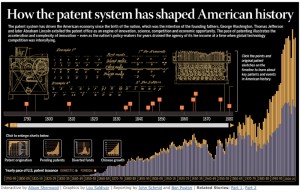
Last month, the Milwaukee Journal Sentinel published two articles documenting the current state of the U.S. patent system (seeThe Milwaukee Journal Sentinel Gets It Right about Patents“). The authors of those pieces, John Schmid and Ben Poston, have now compiled an interactive graphic that shows how the U.S. patent system has shaped American history and innovation. The graphic contains a number of elements, including a timeline of key patents and significant events in American history, a comparison of domestic and foreign patents issued between 1790 and 2009, and charts showing the top countries and states in which U.S. patents originated, the number of pending applications between 1981 and 2009 and average application pendency between 1983 and 2008, fee diversion between 1992 and 2004, and rapid growth of the Chinese patent system between 1999 and 2008.

[continue reading…]

Share
{ 1 comment }

Are Patents Needed to Make Up for FDA Kneecapping?

Update: See Kinsella, “FDA and Patent Reform: A Modest Proposal” (May 5, 2023)

Even some opponents of IP sometimes say that the case for patents is strongest in the field of chemicals and pharmaceuticals,1 although this empirical/utilitarian argument is eviscerated in ch. 9 of Boldrin & Levine’s Against Intellectual Monopoly.

A friend told me:

I think there may be a slightly stronger argument that patents are more economically significant in the chem and pharma industry, from a certain point of view. I know of a number of people who have said that regulation and legal issues from FDA/EPA/etc. basically rot away at the profits of the industry, and it’s very hard for the non-mega-corps to expect return without “IP protection”. If the former statement is true to a significant enough extent, then you could see why people would accept the latter as the current state of things and a kind of “necessary evil.”

Again, it’s from a certain point of view, and there is an economic argument against IP anyway, but without some serious reflection you wouldn’t see it.

As I wrote in reply, this is just an example of a more general phenonemon: the state kneecaps you then offers you a wheelchair. For example they force unemployment on blacks then they take jobs with the military, or welfare. Here, the state (via the FDA) imposes costs, and the state (via the patent system) gives advantages to some companies (at the expense of competitors and consumers). The patent system itself, though it benefits some oligopolistic companies, imposes immense costs on the economy, as does the FDA and related laws like antitrust. So the patent-FDA-antitrust regulatory complex simply harms people and the economy, and is yet another instance of how the state can only destroy, not create wealth.

  1. See here and here. []
Share
{ 2 comments }

From Macrumours:


Nortel announced that they had concluded an auction to sell of its patents and patent applications to a consortium consisting of Apple, EMC, Ericsson, Microsoft, RIM and Sony. The final winning bid was $4.5 billion and includes over 6,000 patents and patent applications covering wireless, 4G, networking optical, voice internet, semiconductors and more.

“Following a very robust auction, we are pleased at the outcome of the auction of this extensive patent portfolio”, said George Riedel, Chief Strategy Officer and President of Business Units, Nortel. “The size and dollar value for this transaction is unprecedented, as was the significant interest in the portfolio among major companies around the world.”

We had previously reported that Apple had been interested in buying up the patents off Nortel Networks which had filed for bankruptcy in 2009. The interest in the portfolio was significant due to the broad reach of the patents, especially in the area of wireless networking and LTE technology. Google was also said to be one of the early interested parties by placing an opening bid of $900 million on the patents.

One research firm has estimated that there are 105 patent families deemed essential to deployment of LTE (4G) technology, with Nokia controlling 57 of those families. Ericsson is said to control 14 families, while Nortel, Qualcomm, and Sony are each reported to control about seven families. The companies that are part of the winning bid will presumably provide access to these patents to those companies.

A few things to note about this. First, this is a perfect example of the barreirs to entry patents can create.1 This will create a “walled garden” to outsiders, barriers to entry that help those in the club to form a quasi-oligopoly. I would not be surprised if the FTC scrutinizes this as anti-competitive; typical of the schizo state to grant monopolies and then to penalize their use on the other hand.2

Also, if I did my math right, the value being paid is $750,000 per patent. Let’s say Nortel spent say $30k on average to obtain and maintain each patent (for a big company like Nortel this may be about right; can be cheaper if you are more efficient). That is a ROI of 25x (2500%).

Update: See also Betabeat, $4.5 Billion Purchase of Nortel Patents is a Potent Reminder How Broken the System has Become. And in an odd twist, instead of bidding in round numbers, Google first bid “$1,902,160,540 — a reference to Brun’s constant — and later bidding $2,614,972,128 for the Meissel-Mertens constant, they ended up submitting a bid for $3.14159 billion“, or pi billion dollars (see Google Bid Pi Billion Dollars For Nortel Patents). Also: Google’s “Pi” In The Face, by MG Siegler, writing on TechCrunch.

[Mises]

  1. See Patent Cross-Licensing Creates Barriers to Entry; Apple vs. Microsoft: Which Benefits more from Intellectual Property?; Microsoft Copyrights –> Patent Dominance; Google’s Defensive Patent Acquisition. []
  2. See State Antitrust (anti-monopoly) law versus state IP (pro-monopoly) law; Antitrust vs. Trademark Law. []
Share
{ 4 comments }

Mises on IP (Bylund)

From Mises Blog (archived comments below):

Mises on IP

June 29, 2011 by 

Ludwig von Mises writes in Human Action on the nature of copyrights and patents:

If there are neither copyrights nor patents, the inventors and authors are in the position of an entrepreneur. They have a temporary advantage as against other people. As they start sooner in utilizing their invention or their manuscript themselves or in making it available for use to other people (manufacturers or publishers), they have the chance to earn profits in the time interval until everybody can likewise utilize it. As soon as the invention or the content of the book are publicly known, they become “free goods” and the inventor or author has only his glory. (p. 657, Scholar’s Edition)

The analysis is as clear and sound as anything else Mises ever wrote, and the implications are obvious. That the “digital” information economy provides the means to easily make and distribute copies does not change anything; in fact, the faster pace of the market affects all industries and products (however at varying degrees).

One might wonder what could possibly be wrong with being an entrepreneur in the market. The answer is: Nothing. Unless you already enjoy a politically enforced privilege, of course, because then you would prefer and push to keep it. That is the nature of privilege, after all.

{ 27 comments… read them below or add one }

anon June 29, 2011 at 7:38 am

This effort reminds me of the effort of religious nutcases looking in their holy books trying to find answers to today’s questions.

Reply

Per Bylund June 29, 2011 at 8:16 am

How so, “anon”? I cannot even see the resemblance. Mises comments on the nature of copyrights and patents – and that without them authors and inventors would be “in the position of an entrepreneur.” And he continues to make the argument more explicitly, and discusses the economics of the issue. I find it quite insightful.

Granted, the application of Mises’s reasoning on modern digital media is mine. But I sincerely doubt Mises would consider such products different in principle from other products so that they would call for a different economic analysis (that would be Krugman-talk, not Mises-talk). The only one making pseudo-religious claims here would be you, anon, in that you somehow find Mises’s economic analysis of copyrights and patents inapplicable on certain types of products (you don’t provide an argument why or when this is so, however). Or could it be that your view is that Mises’s thinking is temporally bound and therefore it was applicable only on the market as it was when Mises was alive? So Misesian analysis would be applicable on Volvo 164 (produced 1968-1975) but not on Volvo 200 series (produced 1974-1993)?

I find Mises’s statement on the economic consequences of copyrights and patents quite enlightening and economically correct. And he makes the same claim in several places in Human Action; I suggest you read it if you wish to criticize its content.

Reply

Shay June 29, 2011 at 10:49 pm

You need to distinguish between finding an answer based merely on authority (as some are in old religious books) and one based on an argument which the listener can evaluate for himself. This is of the latter kind, and thus its age is irrelevant. This is why we can read wisdom from some philosophers of thousands of years ago and it is still as relevant and understandable today as it was then.

Reply

scineram June 29, 2011 at 9:29 am

I agree the implications are obvious. In the digital age that profit opportunity window is rapidly closing, therefore the entrepreneurs have much less incentive to create those goods.

Reply

Andrew June 29, 2011 at 9:37 am

It may shrink in time but not necessarily in scope, e.g. with subscription models enabling a large customer base to be served instantly and simultaneously.

Reply

Matthew Swaringen June 29, 2011 at 1:35 pm

Yeah, that’s why we have even higher budgets for films and games today than 10 years ago.

Reply

coturnix19 June 29, 2011 at 3:01 pm

No, that’s because of inflation.

Reply

DixieFlatline June 29, 2011 at 6:11 pm

I agree the implications are obvious. In the digital age that profit opportunity window is rapidly closing, therefore the entrepreneurs have much less incentive to create those goods.

Right, because as the ability to share information increases, there are less digital goods being created each day … DERP DERP DERP HURRRR HURRR HURRRR

Reply

scineram July 2, 2011 at 12:25 pm

Thanks to all for pointing out the current state of the entertainment market while the Mises quote starts with “If there are neither copyrights nor patents”.

Reply

Shay June 29, 2011 at 10:51 pm

But likewise, in this digital age the authors have many more opportunities for low-cost customization and constant changes to the material, based on feedback from their audience. It goes both ways.

Reply

Wildberry June 29, 2011 at 11:01 am

Unless you already enjoy a politically enforced privilege, of course, because then you would prefer and push to keep it. That is the nature of privilege, after all.

Yes, say the right to own private property. I want to keep that. That is the nature of privilege, after all.

On the same page you quote from, Mises says this:

“It is unlikely that people would undertake the laborious task of writing such publications if everyone were free to reproduce them. This is still more manifest in the field of technological invention and discovery.”

Reply

Andras June 29, 2011 at 12:42 pm

Sorry Wildberry, the second part of the von Mises quote did not fit the agenda.
Please, move along, nothing to see here!

Reply

Per L Bylund June 29, 2011 at 1:22 pm

Wildberry, those statements are very different. The one I quoted was Mises’s economic analysis, where he basically concludes that economically copyrights and patents are protecting monopoly privileges and that without them these monopoly-holders would be entrepreneurs (like everybody else). The second statement, the one you quote, is Mises’s guess of what might be the result of government not granting such privileges – this is a policy prediction.

My post was primarily on the economics of IP (which I tried to make more interesting through adding a kind of sweeping comment on the nature of privilege). This is, after all, the Mises Economics Blog. I let others make normative conclusions (including policy suggestions) based on the economic issue.

Reply

Stephan Kinsella June 29, 2011 at 9:27 pm

Remember, too, Mises and Hayek wrote in a pre-Internet age. The cases they point out as being difficult to imagine happening without copyright–laborious things like encyclopoedia–if they had known of Wikipedia who could imagine they would not revise their predictions here?

Hayek explicitly said:

it is not obvious that such forced scarcity is the most effective way to stimulate the human creative process. I doubt whether there exists a single great work of literature which we would not possess had the author been unable to obtain an exclusive copyright for it; it seems to me that the case for copyright must rest almost entirely on the circumstance that such exceedingly useful works as encyclopaedias, dictionaries, textbooks and other works of reference could not be produced if, once they existed, they could freely be reproduced. 

http://blog.mises.org/9247/hayek-on-patents-and-copyrights/

In fact as Salerno notes, Hayek thought copyright stimulated the wrong kind of production – http://blog.mises.org/17228/hayek-contra-copyright-laws/

Mises also recognized that all creative work and invention is derivative http://blog.mises.org/13202/misesian-vs-marxian-vs-ip-views-of-innovation/

Mises also recognized that creators do not create b/c of articifical stimuli provided by IP: “The problem involved has nothing to do with the activities of the creative genius. These pioneers and originators of things unheard of do not produce and work in the sense in which these terms are employed in dealing with the affairs of other people. They do not let themselves be influenced by the response their work meets on the part of their contemporaries. They do not wait for encouragement.”

He thinks that some things that might go away without copyright, we should not bemoan: “We may disregard the problem of second-rate authors of poems, fiction, and plays and second-rate composers and need not inquire whether it would be a serious disadvantage for mankind to lack the products of their efforts”

He does think some laborious things like encyclopedia would be unlikely absent copyright, but as noted above, this was pre-Wikipedia.

He aslo explicitly notes IP is controversial: “Patents and copyrights are results of the legal evolution of the last centuries. Their place in the traditional body of property rights is still controversial.” And he explictily says he takes no stance: “It is beyond the scope of catallactics to enter into an examination of the arguments brought forward for and against the institution of copyrights and patents.”

Reply

Wildberry July 5, 2011 at 7:01 pm

@Stephan Kinsella June 29, 2011 at 9:27 pm
I’ve been meaning to get to this, but you and Peter have kept me busy on the servitude thread.

Remember, too, Mises and Hayek wrote in a pre-Internet age. The cases they point out as being difficult to imagine happening without copyright–laborious things like encyclopoedia–if they had known of Wikipedia who could imagine they would not revise their predictions here?

Are you saying that the emergence of technologies transforms what was once a legitimate right into a non-right?

So, if technology emerges which makes stealing a car easier, you are saying that this might be sufficient to revise the “wrongness” of car theft?

The “laborious things” you seem to be thinking of, is a capital investment in a product. It is the investment needed to produce the first instance of a given work, whether poem or encyclopedia. Clearly the producer is the rightful owner of that product. What property theory requires that that property right magically vanish the moment he lets anyone actually read it buy a copy to take home?

Hayek explicitly said:

it is not obvious that such forced scarcity is the most effective way to stimulate the human creative process. I doubt whether there exists a single great work of literature which we would not possess had the author been unable to obtain an exclusive copyright for it; it seems to me that the case for copyright must rest almost entirely on the circumstance that such exceedingly useful works as encyclopaedias, dictionaries, textbooks and other works of reference could not be produced if, once they existed, they could freely be reproduced.

http://blog.mises.org/9247/hayek-on-patents-and-copyrights/

Hayek appears to be making a distinction between literary works of art, to which Mises refers to as the work of the “creative genius” [ Human Action, Scholar’s Edition; p. 657]

The problem involved has nothing to do with the activities of the creative genius. These pioneers and originators of things unheard of do not produce and work in the sense in which these terms are employed in dealing with the affairs of other people. They do not let themselves be influenced by the response their work meets on the part of their contemporaries. They do not wait for encouragement.

This merely reflects the shared view of Mises and Hayek, in my opinion, that the strongest case for IP, specifically copyrights, was to be made concerning works other than pure art, which may be produced for non-commercial reasons. However those works for which there could be no other motivation for their production, the observation regarding producing for external markets, holds true.

In fact as Salerno notes, Hayek thought copyright stimulated the wrong kind of production – http://blog.mises.org/17228/hayek-contra-copyright-laws/

I read Salerno’s article and the Hayek reference in context. I am not at all convinced this was an anti-copyright statement, but rather a view that copyrights may well contribute to the ability of dissenting views to reach the daylight of public consumption. He seems to be speculating on the control that the demagogues would have to limit the dissemination of dissent, and how that is influenced by copyright law. In any case, it is far from a foregone conclusion that Hayek was against copyrights to any degree that rivals Kinsella’s views.

Mises also recognized that all creative work and invention is derivative http://blog.mises.org/13202/misesian-vs-marxian-vs-ip-views-of-innovation/

The entire quote selected by Mr. Tucker includes this:

All this does not in the least affect the truth that each step forward was made by an individual and not by some mythical impersonal agency. It does not detract from the contributions of Maxwell, Hertz, and Marconi to admit that they could be made only because others had previously made other contributions

So, being able to trace any innovation to some earlier work does not diminish the fact that some person did something to advance the cause, to the benefit of all those who enjoyed some advantage previously unavailable.

To argue otherwise is equivalent to saying that no one every can take credit for having written a novel, since obviously the alphabet was already invented.

Mises also recognized that creators do not create b/c of articifical stimuli provided by IP: “The problem involved has nothing to do with the activities of the creative genius. These pioneers and originators of things unheard of do not produce and work in the sense in which these terms are employed in dealing with the affairs of other people. They do not let themselves be influenced by the response their work meets on the part of their contemporaries. They do not wait for encouragement.”

Yes, and he goes on to say this is not germane to his point. Those works which clearly have no purpose other than economic (technical handbooks, for example) would have been produced for external economies if they could be freely reproduced.

He thinks that some things that might go away without copyright, we should not bemoan: “We may disregard the problem of second-rate authors of poems, fiction, and plays and second-rate composers and need not inquire whether it would be a serious disadvantage for mankind to lack the products of their efforts”

He is simply saying here that an author that has a monopoly on a particular book does not have a monopoly on all books. If you think a poet’s work stinks, no need to buy his book. That is how the consumer reigns supreme; authors who create demand for their products prosper and those who don’t, starve or get a day job.

He does think some laborious things like encyclopedia would be unlikely absent copyright, but as noted above, this was pre-Wikipedia.

Even Wikipedia takes some capital to generate, which by the way, is made available under the terms of the Creative Commons copyright license. Notice the owners still claim copyrights?

He aslo explicitly notes IP is controversial: “Patents and copyrights are results of the legal evolution of the last centuries. Their place in the traditional body of property rights is still controversial.” And he explictily says he takes no stance: “It is beyond the scope of catallactics to enter into an examination of the arguments brought forward for and against the institution of copyrights and patents.”

He takes no stance other than the one he has taken. However, he restricts himself to the scope of his topic of catallactics, and merely gives us all a big clue that if you are going to argue about the controversy, you must deal with the external economy issue. And he gives us the direction and tools for pursuing that.

It is not sufficient to just claim that Mises was wrong about IP, or that he resolves the controversies surrounding it by ignoring the very economics framework that is his opus. He lays out the two aspects of the problem; ideas and recipes are inexhaustible, yet producers cannot be expected to produce for external economies. Therein lies the dilemma.

Certainly his words cannot be dismissed so casually, especially on a site named Mises.org.


Reply

Wildberry July 5, 2011 at 7:02 pm

There is a bug in the edit function. It throws in extra blockquotes adn doesn’t let you edit.

Sorry.

Reply

Peter Surda July 5, 2011 at 7:49 pm

Wildberry,

Are you saying that the emergence of technologies transforms what was once a legitimate right into a non-right?

No, he’s saying that the emergence of technologies affects peoples’ imagination. But since you lack a brain in the first place, you’re unaffected.

So, if technology emerges which makes stealing a car easier, you are saying that this might be sufficient to revise the “wrongness” of car theft?

There is no right not to have your property copied in the first place.

Make up some new lies, the old ones are boring.

Reply

Matthew Swaringen June 29, 2011 at 1:34 pm

While everyone here respects Mises, his conclusion was wrong, proved by the fact places like this exist, by open source software, etc. On the area of patents and science you need only look to Terence Kealey on that subject.

The most someone may be able to say is that some high budget movies and games might not be possible without IP, but even that’s unlikely.

Reply

Wildberry June 29, 2011 at 2:43 pm

@ Matthew Swaringen June 29, 2011 at 1:34 pm

First, is it an argument to claims that because IP does not protect every written word, it should not protect anything?

Second, these things you cite happen to co-exist with IP. If IP was such a freedom-buster, as you would claim, then how is it the things you reference manage to exist at all?

The section of Mises that Per quotes argues directly against what you just said. Mises is not wrong, and if I was going to have the gumption to dismiss his work for some reason, I would at least feel somewhat compelled to offer some kind of specific rebuttal.

Reply

Wildberry June 29, 2011 at 2:31 pm

@ Per L Bylund June 29, 2011 at 1:22 pm

If you want to quote Mises on economics, I suggest you quote him in some kind of context.

You missed his discussion on monopoly, and why monopoly is normal and all around us and not something that is contrary to the operation of a free market; all private property rights secure a monopoly to that property. This understanding is not the same connotation of monopoly as that of a theoretical market monopoly, and he warns against conflating those different connotations.

Second, you have to address his conclusion, which is that without secured property rights in IP, producers of intellectual products are producing for external economies.

And despite Mr. Kinsella’s praise to you here, he has never addressed this obvious contradiction between his position on IP and that of Mises.

And despite your admonition to me that this is an economic site based on the work of Mises, IP is at some level an economic question that intersects with the principles of private property, privately owned means of production, and free market operations. This is why, no doubt, Mises found it necessary and/or important to mention IP at all in his most famous treatise on economics.

You selectively quote him out of context, use his words to support a position that is contrary to the one he takes, and then deny the obvious validity of an objection.

Andras captured all of this in his one-line comment. You pulled something from Mises out of context and tried to make it support your party line. I object.

Reply

sweatervest June 29, 2011 at 2:35 pm

Mises’ theory on monopolies and monopoly prices was also systematically refuted in Rothbard’s Man, Economy and State.

Reply

Wildberry June 29, 2011 at 7:32 pm

Mayabe you’re right. I’d be interested in a reference.

Reply

newson August 3, 2011 at 12:27 am

see armentano for why rothbard was right and mises wrong on monopoly:
http://mises.org/etexts/armentanomonopoly.pdf

Reply

Wildberry August 3, 2011 at 10:03 am

Newson;

I can’t get into this in detail right now, but for my purposes I fail to see the conflict.

Rothbard simply dismisses Mises’ first connotation of “Property monopolyas “absurd” but fails to acknowledge that he is really calling private property rights “absurd”.

Rothbard’s second definitin is one of the ways Mises said that resource monopoly can be attained, and is the just another basis for Rothbard to line up against the State.

That leave the concept of monopoly pricing, which both he and Mises agree cannot be maintained within a competitive market, since even resource monopoly results in substituting resources, i.e. wheat for corn.

As Armentano clearly states, Rothbard obviosuly prefers the “State” issue, and as such is merely a corollary of “We have IP because we have the State” argument.

Monopoly in the absence of State grant of privilege is not really much of a concern for free markets. To the extent the State intervenes, it is not free.

That leaves us exactly where I started; State granted “monopoly” in IP, specifically copyrights, is simply state-enforced private property monopoly, adn to make it into anythng else is at attempt to argue for Ancap by classifying IP as a monopoly of the state variety.

I argue that it is not necessary to pre-determine the method of coerscion employed to enforce private property rights, adn that IP is simply an example of private property monopoly.

The more I learn about Rothbard, the more it seems that he contributed very little original thought except, perhaps, in elaborating on Ancap. I don’t depend on that arguement to justify IP.

Shay June 29, 2011 at 10:58 pm

As far as I see it, property is a basic aspect of physics, not humans. If humans are using matter outside themselves in any way, then it’s not a question of whether they own it, just one of how they decide who gets to use it. They must do so, since matter has physical limitations; if it didn’t, everyone could use all matter freely and there would be no need even for the concept of property in the first place. Thus, the issues involved here are irrelevant for ideas, so you bringing up physical property is just a distraction, as far as I see it.

Reply

Virginia Llorca June 29, 2011 at 11:37 pm

@Shay. You are trying to use the concept of ‘physical property’ as an abstract. I don’t feel comfortable with that construct.

Reply

Stephan Kinsella June 29, 2011 at 11:05 am

Great post. I have other Mises quotes on IP in my post Mises on Intellectual Property.

Share
{ 2 comments }

Cool Kickstarter project. Sad we have to pay a ransom to free music, but still, given the tyrannical IP system, this is heroic:

About this project

If you feel like donating once the KickStarter project is complete, please use this link and you may donate directly on our website. All money will go towards the same project: http://www.musopen.com/donate.php

———————-

Musopen is a non-profit dedicated to providing copyright free music content: music recordings, sheet music and a music textbook. This project will use your donations to purchase and release music to the public domain. Right now, if you were to buy a CD of Beethoven’s 9th symphony, you would not be legally allowed to do anything but listen to it. You wouldn’t be able to share it, upload it, or use it as a soundtrack to your indie film- yet Beethoven has been dead for 183 years and his music is no longer copyrighted. There is a lifetime of music out there, legally in the public domain, but it has yet to be recorded and released to the public.

This isn’t just a crazy idea: we’ve done this before using donations from our website, but now we want to tackle something much more ambitious.

We want your help to hire an internationally renowned orchestra to record and release the rights to: the Beethoven, Brahms, Sibelius, and Tchaikovsky symphonies. We have price quotes from several orchestras and are ready to hire one, pending the funds.

What can I do? 1) Donate, and please spread the word. Then we will release that music in lossless quality with a creative commons CC0 license.

2) Vote for us on Reddit: http://bit.ly/dqKoPo

3) Vote for us on Digg: http://bit.ly/9YUI35

4) You can also help by voting for us on the PepsiRefresh website, tweet, and ask your friends to do the same! It could mean an extra 25k (which would guarantee a famous orchestra) http://pep.si/bAJ7XW

5) Use Twitter, facebook etc to spread the word.

6) Write to blogs! Anyone who might be interested, this is how we’ve gotten to where we are today, from the donors writing to others.

What about beyond 10k? Every $1000 buys a complete set of Mozart violin sonatas, or all of Chopin’s mazurkas, ballades, or nocturnes… a little money buys a LOT of music.

Where does the music go afterwards? Thanks to generous and free hosting from ibiblio, music will remain on our website indefinitely, and we will share it with other organizations: included in Wikipedia articles, added to archive.org, and integrated with OLPC (One Laptop Per Child) laptops.

Share
{ 0 comments }

The IP War on 3D Printing Begins

See Paramount Cease and Desist Targets 3D Printer ‘Pirate’. See also my post White paper on 3D printing and the law: the coming copyfight. Congratulations, IP libertarians–IP is about to strangle the next new breakthrough technology.

Update: see Clive Thompson on 3-D Printing’s Legal Morass; The next Napster? Copyright questions as 3D printing comes of ageFab@Home: The open source personal fabricator project; and RepRap: Free 3D Desktop Printer (h/t David Kramer).

Share
{ 6 comments }

Bourbon for Breakfast, Jeffrey TuckerJeffrey Tucker, author of the great Bourbon for Breakfast: Living Outside the Statist Quo, has a brand new book out, and it’s also fantastic:  It’s a Jetsons World: Private Miracles and Public Crimes. Of particular interest here is the section “Can Ideas Be Owned?,” containing five great chapters on intellectual property matters:

  • Our Miracle of Pentecost
  • The Socialism of Agri-Patents
  • Why Religious People Struggle with Economics
  • Ideas, Free and Unfree
  • A Movie That Gets It Right

Jeffrey Tucker, Bourbon for BreakfastThe fourth one is a favorite of mine, and appeared previously as “Ideas, Free and Unfree: A Book Commentary” (commentaries on Boldrin and Levine’s Against Intellectual Monopoly). I highly recommend this book.

Youtube Playlist.

Share
{ 1 comment }

Back to the Internet ‘stone ages’ for the NBA

… because of copyright. See this ESPN article: Back to the Internet ‘stone ages’ for the NBA. As noted there,

Take a spin today through the NBA’s digital space and you’ll encounter the usual stuff.

There’s a menacing Kevin Garnett atop the Celtics’ site, with an image of Rajon Rondo on the right margin alongside a pitch to “Get Your Tickets Now” for the 2011-12 season.

Scroll down the Clippers’ main page and you’ll find a catalog of videos featuring Blake Griffin doing Blake Griffin things.

At the Heat’s site, you’ll see an archive that contains Couper Moorhead’s “Prized Possession” features, which include game footage to break down crucial plays.

David Stern has said that if negotiations progress between now and Thursday, there’s a possibility the deadline for the current collective bargaining agreement could be extended. “We know how to stop the clock if we’re close,” Stern said.

Does it really matter if there’s an extension of the CBA in July or a lockout? After all, there aren’t any games nor do players get paid during this summer.

But for the guys who are in charge of those team websites and NBA.com, the pending deadline is a huge deal.

That’s because the moment the clock strikes midnight on the current CBA, all those images and videos of NBA players have to disappear off NBA-owned digital properties. Depending on how you interpret “fair use,” the prohibition could include the mere mention of a player’s name on an NBA-owned site, though different teams have different interpretations of this particular stipulation.

Over the past few weeks, NBA website administrators and support staff have endured two-hour conference calls and countless planning sessions to figure out how to eliminate all these photos, highlights, articles and promotional features from the sites.

There are additional gray areas that are still up for discussion: What about a photo of a Lakers fan wearing a No. 24 Kobe Bryant jersey? What about a retrospective feature on the John Stockton-Karl Malone Jazz teams? Do tweets from the team’s official Twitter feed that mention a player and/or link to an image need to be deleted? How about Facebook posts?

Nobody seems to know for certain the definitive answers to these questions and the criteria seem to be arbitrary. According to more than one team website staffer, the cutoff for images of retired players right now stands at 1992-93 — Shaquille O’Neal’s first season in the league. And social media is an area they’re still grappling with as the deadline approaches.

[H/t Skip Oliva]

Share
{ 0 comments }

The Power of Open: Stories of Creative Commons success

This is a fantastic book. Some of the more interesting and inspiring profiles include TED Talks, Nina Paley, Bloomsbury Academic, Isabella Stewart Gardner Museum’s “Classical Music for the Masses” (see their amazing podcast, The Concert,  which “has made world-class performances recorded live at the museum available to listeners across the globe”), Khan Academy, and the Public Library of Science. A common theme among many CC users is the importance of spreading ideas: as TED executive June Cohen says, “When we decided to open our library, we had one single goal: to spread ideas.”

“Sharing online was a very controversial decision. People feared it would capsize our business,
discourage people from paying for our conference, and be rejected by speakers.

“The first year after releasing videos of talks for free, we raised the cost of the conference by 50
percent and sold out in one week with a 1,000 person waiting list,” Cohen says. “Not only do
speakers lobby for the talks to be posted as soon as possible, but paying conference participants are
anxious to share talks they just heard with family, friends and colleagues.”

TED Talks featuring Swedish medical doctor and statistician Hans Rosling and his presentations on
developing countries show how CC licenses can popularize a subject. “Hans told me that posting his
“rst TED Talk online did more to impact his career than all of the other things he had done
previously,” Cohen says. “It opened up a whole new world for him.”

I think they missed one important one: the phenomenal growth and influence of Mises.org since adopting CC-BY (see, e.g., Adam Smith U, Mises Academy, and Educational Utopia; Jeffrey Tucker, “A Theory of Open”; Doug French, “The Intellectual Revolution Is in Process“; Jeffrey Tucker, and “up with iTunes U“; Kinsella, “Teaching an Online Mises Academy Course”; Kinsella, “Fifteen Minutes that Changed Libertarian Publishing” (2); Gary North, “A Free Week-Long Economics Seminar”; Kinsella, “Intellectual Freedom and Learning Versus Patent and Copyright” and “How to Slow Economic Progress”.

See Cory Doctorow’s post below (h/t Katelyn Horn).

The Power of Open: Stories of Creative Commons success

Cory Doctorow at 6:28 AM Friday, Jun 24, 2011

Jane from Creative Commons sez,

Since last fall, we’ve been talking at length to various creators about their CC stories–the impact Creative Commons has had on their lives and in their respective fields, whether that’s in art, education, science, or industry. We are thrilled to announce that we have cultivated the most compelling of these stories and woven them together into a book called The Power of Open. The stories in The Power of Open demonstrate the breadth of CC uses across fields and the creativity of the individuals and organizations that have chosen to share their work via Creative Commons licenses and tools. The Power of Open is available for free downloadunder the CC Attribution license. It is available in several languages, with more translated versions to come. You can also order hard copies from Lulu. We hope that it inspires you to examine and embrace the practice of open licensing so that your contributions to the global intellectual commons can provide their greatest benefit to all people.”But that’s not all–The Power of Open is launching with events around the world! The official launch is June 29 at The New America Foundation in Washington D.C., featuring Global Voices Online and IntraHealth, with CC CEO Cathy Casserly representing for staff. Additionally, the first event already took place on June 16 in Tokyo, Japan, with Creative Commons Chairperson Joi Ito introducing the book to the Asia/Pacific region. For the full list of events taking place in Brussels, Rio de Janeiro, London, and Paris, head on over to the thepowerofopen.org.

[Mises]

Share
{ 0 comments }

See the 2008 post below, from Mike Masnick. It concerns Nobel Prize winning physicist Robert B. Laughlin, author of The Crime of Reason and the Closing of the Scientific Mind. As can be seen in this Cato podcast, , and in the notes for this related Cato book forum,

Though we may feel inundated with information today, Nobel laureate Robert Laughlin argues that intellectual property laws and government security demands are increasingly restricting access to the most useful information. Government rules and businesses’ legal pressures to sequester information threaten the development of new knowledge, he says. The rights of free people to investigate their world are threatened. Laughlin’s fresh perspective and light, sometimes whimsical, bent do not mask the central warning of his readable book: that we risk bequeathing our heirs a world where knowledge is criminalized and our intellectual tradition of unfettered inquiry is lost.

(h/t Tibor Machan)

I haven’t read the book yet but his ideas sound intriguing. I also discuss how IP impedes the activity of learning in various articles, e.g. “Intellectual Freedom and Learning Versus Patent and Copyright.” And see also the Max Planck Society statement on copyright law and science, which voices some concerns similar to those of Dr. Laughlin.

Here’s Masnick’s 2008 post:

Nobel Prize Winning Physicist Explains How Intellectual Property Damages Innovation

from the and-another-one dept

Over the last year or so, there have been a bunch of excellent books that have come out highlighting many of the issues we talk about here on a regular basis. The latest may be The Crime of Reason and the Closing of the Scientific Mind, written by Nobel Prize winning physicist, Robert B. Laughlin. I became aware of the book thanks to the fact that he’ll be speaking at the Cato Institute this week about the book, for those of you in the Washington, DC area.

It’s funny, because when we point to all the economic research on intellectual property and innovation, we’ve been told that economists know nothing. In fact, one critic of our site has claimed that even Nobel Prize winning economists aren’t worth paying attention to — and the only Nobel Prize winners who matter are those in the hard sciences. So, I’m sure those critics will be interested in the conclusions of Laughlin, who notes that the strengthening of intellectual property laws has harmed the ability to share knowledge and to innovate. He’s quite worried about how it’s impacting research and development.

Newly aggressive patent practices are increasingly violating a principle that has been with us since Roman times and is built into our societies at many levels, including our religions: the laws of man flow from the laws of nature and are subservient to them. Patenting nature is transparently immoral. So is patenting reason, since reason and nature are one and the same. Thus, the current problem with patent law is more serious than the bellyaching of a few jaded engineers. It’s a crisis of legitimacy.

So, now we can add a Nobel Prize winning physicist to the list of critics of the patent system, along with a few Nobel Prize winning economists.

Update: I finished listening to the Cato podcast. I think Laughlin, while thoughtful and smart, is basically confused. He is not really against IP. Rather, he seems to accept the mainstream notion that (intellectual) property rights are important if you want prosperity; that if you understand economics, you see that we need IP. The cost is that this will impinge on artistic, scientific, and intellectual freedom. And that if we want security, other restrictions on the spread and use of information are necessary as well. He thinks there is a “tension” between intellectual freedom and creativity, on the one hand, and prosperity and economics and property rights on the other; that we need a “careful balance.” I.e. he accepts the logic of IP, but then he sees intuitively it causes problems, so like most people he then tries to blunt its sharp edges. Instead of realizing that the problem is IP, he wants to have it, but then limit and regulate and blunt it when it seems to harmful.

He also thinks that people who are for property rights (a) will be for IP, and (b) don’t undersatnd the creative, artistic, scientific side; and that people who are anti-IP don’t understand “economics.” This is just wrong. You can be opposed to IP because you understand economics, because you favor prosperity, because you appreciate the importance of intellectual freedom and the learning. Laughlin seems to have succumbed to scientism, like many smart engineers and scientists who think they can just sweep social and political reasoning aside and reinvent the wheel using brute force. So while he has some good insights into how IP can harm learning, science, intellectual freedom, he does not appear to have a principled or sound political-economic understanding of the right solution: it’s a radical, principled opposition to IP, not an exhortation to do more careful “balancing.”

Update: I remember now that I previously wrote about Laughlin on the Mises blog (below), also cross-posted on the AgainstMonopoly blog in The Tao of IP (which had several comments(15)).

The Tao of IP

OCTOBER 31, 2008 by 

 When I saw the title of this Cato podcast–“Intellectual Property Versus Reason” (October 20, 2008)–I was hopeful and interested. Then I noticed it’s an interview with the Nobel-winning, er, physicist Robert B. Laughlin, author of the new book, The Crime of Reason and the Closing of the Scientific Mind. Physicists and engineers are notoriously scientistic (see Yet More on Galambos; also Galambos and Other NutsLibertarian Activism–comments and C.P. Snow’s “The Two Cultures” and Misesian Dualism). But, still, the title implied Laughlin thinks IP is, well, unreasonable (Cato scholars’ IP positions seem to be mixed and largely utilitarian).

As I listened to the 16-minute podcast, I had a succession of impressions. For the first 6 or so minutes, I could not tell whether Laughlin was pro- or anti-IP. I know a bit about IP but I was not even sure what he was talking about much of the time. Oh, Laughlin is articulate enough–he speaks slowly, ponderously, and often pauses dramatically, as if struggling to pick just the right Deep Thoughts in response to Serious Questions–and even pronounces a French word or two properly. But soon it becomes obvious that his views on IP are just a mess, and he is, indeed, infected by the scientistic virus that physicists are susceptible to. It soon become clear that Laughlin believes there is a tension between economic prosperity (which requires IP) and “human rights” (in particular the “right to learn,” which IP impinges on). At first he seems to be very concerned that human rights will “give way” to IP and economic prosperity–even pessimistic about this–even while he himself seems to grant that we ought to be concerned about prosperity–and, thus, IP. So he’s pessimistic that IP is infringing the human right to learn, yet he not only thinks nothing can or will be done to stop this–after all, we’ve now entered the information age, where IP rights are even more important to economic prosperity–he even seems to think that we should not abolish IP. We need to “supply the data” to “the legislature” (Congress), and achieve the right “balance”, even though he admits he doesn’t know what the right solution even is–it’s “above my pay grade.” Naturally, then, he doesn’t blame the Congresscritters for how they have voted to date on IP issues, whether pro or con; their efforts are sincere and based on the best data possible. One wonders why he is depressed, or why he even wrote a book. I guess Nobel laureates can sell just about anything they slap their name on, which is reason enough.

I can’t bring myself to read his book now, but from this interview it seems apparent that he holds a number of erroneous views: that both the state and the democratic process are legitimate, and that legislation is the right way to make law; that IP is pro-property rights; that IP is necessary for and promotes prosperity; that there is a conflict between human rights and economic rights; not to mention his implicit scientism. In his confused attempt to weigh in on legal and economic and policy issues he reminded me a bit of physicist Fritjof Capra’s New Agey The Tao of Physics (hence the title of this post).

A few other things to note: from the Cato description of his book:

“Though we may feel inundated with information today, Nobel laureate Robert Laughlin argues that intellectual property laws and government security demands are increasingly restricting access to the most useful information. Government rules and businesses’ legal pressures to sequester information threaten the development of new knowledge, he says. The rights of free people to investigate their world are threatened. Laughlin’s fresh perspective and light, sometimes whimsical, bent do not mask the central warning of his readable book: that we risk bequeathing our heirs a world where knowledge is criminalized and our intellectual tradition of unfettered inquiry is lost.”

So he sees IP as “criminalizing” knowledge … yet is not completely opposed to it. So we need only a reasonable degree of criminalization of knowledge. I guess Laughlin chooses IP over reason… sometimes.

Publishers Weekly (from the Amazon.com listing) identifies some of the weaknesses in Laughlin’s book:

“The provocative premise of this short book is that even as we appear to be awash in information, governments and industry are restricting access to knowledge by broadening the concept of intellectual property to include things as diverse as gene sequences and sales techniques. According to Laughlin, the right to learn is now aggressively opposed by intellectual property advocates, who want ideas elevated to the status of land, cars, and other physical assets so the their unauthorized acquisition can be prosecuted as theft. With examples drawn from nuclear physics, biotechnology and patent law, Laughlin, a Nobel laureate in physics, paints a troubling picture of a society in which the only information that is truly valuable in dollars and cents is controlled by a small number of individuals. But while Laughlin poses urgent questions, he provides neither in-depth analysis nor potential solutions. Many intriguing arguments–for example, that electronic technologies such as the Internet, which inundate us with useless information, are not instruments of knowledge dissemination at all but agencies of knowledge destruction–are offered but none are usefully explored.

So Laughlin views IP as “restricting access to knowledge”–if he instead viewed IP as an infringement of property rights, he would have a harder time making the mistake of thinking IP is on the side of economic prosperity and property rights. The “right to learn,” whatever that is, is not any primary kind of right, and would seem to be jeopardized by government education and propaganda more than by patent and copyright. Again, IP undercuts and infringes property rights, and harms innovation (see herehereherehere)–if he realized this, he would not set up the false alternative of prosperity versus human rights. And the idea that IP is more important in the information age is also flawed.

Share
{ 1 comment }

The PROTECT IP Act Will Slow Start-up Innovation

From Union Square Ventures: The PROTECT IP Act Will Slow Start-up Innovation. Sure they are right. But I get tired of seeing people oppose “new extensions” of or “abuses of” IP law. They are so concrete bound and unprincipled (not sure if these guys are; I’m making a general comment); they never oppose IP in general. So here is the approach. Oppose the PROTECT IP Act, because it will slow innovation. But we shouldn’t be extreme. We should not throw the baby out with the bathwater. Se should reform the system, but not abolish it.

After all, it’s okay to slow innovation a little bit. Just not too much.

(H/t Geoff Plauche)

Share
{ 1 comment }

First, we kill all the patent lawyers

Nice piece in Computerworld. However, the author buys into the standard reasoning: “In the beginning, the U.S. patent system was meant to encourage inventors and innovation.” He is talking about “abuse”. We’ve gone “too far.” He wants business method and software patents eliminated. Why just them?

Here is my comment, posted there:

Nice post. But you are wrong to assume that the patent system at one time was justified (your comment “In the beginning, the U.S. patent system was meant to encourage inventors and innovation.”). You also write:

“What we really need is a complete overhaul of the U.S. patent system. If the Supreme Court doesn’t strike down business process patents, the federal government should take up the problem. As it is now, any software program can be attacked either by patent trolls — companies that do nothing but collect patents and then look for companies that might be implementing the ideas within them — or by big companies wanting to stomp out competition.”

The problem is not patent trolls or business and software patents. There is nothing particularly wrong with patent trolls; this is a natural result of having a patent system. (See my Patent Trolls and Empirical Thinking; Patent Law, State Courts, and Free Speech: The Case of Troll Tracker.) And there is no reason not to have patents extend to software and business methods, given the logic of the patent system. Once you set up a patent system, you can expect its scope to cover many areas, and for patent trolls to arise. As Ludwig von Mises, wrote,

“No socialist author ever gave a thought to the possibility that the abstract entity which he wants to vest with unlimited power—whether it is called humanity, society, nation, state, or government—could act in a way of which he himself disapproves.”

We do not need patent “reform” or a patent overhaul. Patent and copyrights nothing but anti-competitive grants of monopoly privilege. They are completely anathema to private property rights and the free market. People who say that patents are necessary or a good idea but have been abused or “taken too far” are part of the problem. We don’t need an overhaul. We need a brush fire. For more information on the anti-market evil of patent and copyright, see my C4SIF resources page.

Stephan Kinsella, Registered patent attorney and libertarian

Here’s the post:

First, we kill all the patent lawyers

By Steven J. Vaughan-Nichols
May 3, 2010 01:30 PM ET

Computerworld – Actually, I don’t think we should kill all the patent lawyers. Some of my best friends are patent attorneys — no, really. But I’d happily stick a knife into the American patent system.

In the beginning, the U.S. patent system was meant to encourage inventors and innovation. Abraham Lincoln is reputed to have said, “The Patent System added the fuel of interest to the fire of genius.” That was then. This is now.

Unless the Supreme Court does the right thing and tosses out business practice and, by implication, software patents with the proper decision in the Bilski case, we’re stuck with a system designed to wreck anyone who actually tries to implement his own ideas.

Read more>>

Share
{ 0 comments }

Gene Quinn argues that First U.S. Patent Laws Were First to File, Not First to Invent. I’m not 100% sure I buy his argument, but it seems reasonable enough. The reason this comes up is the US has always had a first to invent system, unlike other countries which are mostly first to file (unless Quinn is right in which case the US had a first to file system briefly, at the beginning), and the America Invents Act is poised to change to a first to file system (Patent Reform is Here! O Joy!). Yet another reason to be skeptical of claims that the current patent reform is radical and significant.

Share
{ 1 comment }