≡ Menu

Court prevents Galaxy Tab 7.7 from being shown at IFA

From TUAW: Court prevents Galaxy Tab 7.7 from being shown at IFA. More of Apple’s attempt to use state-granted monopoly privileges (patents) to kill its competitor Android. How people cannot see this as protetectionism is beyond me.

Share
{ 0 comments }

Police assisted Apple in search of man’s home (2) for a missing iPhone 5 prototype. Hmmm, sound familiar? —

The creation of monopolies reached its climax in the reign of Queen Elizabeth (1558–1603), in the latter half of the 16th century. In the words of historian Professor S.T. Bindoff, “… the restrictive principle had, like some giant squid, fastened its embracing tentacles round many branches of domestic trade and manufacture,” and “in the last decade of Elizabeth’s reign scarcely an article in common use – coal, soap, starch, iron, leather, books, wine, fruit – was unaffected by patents of monopoly.”

In sparkling prose, Bindoff writes how lobbyists, using the lure of monetary gain, obtained royal courtiers to sponsor their petitions for grants of monopoly: “their sponsorship was usually a mere episode in the great game of place-and-fortune-hunting which swayed and swirled incessantly around the steps of the throne.” Once granted their privileges, the monopolists got themselves armed by the state with powers of search-and-seizure to root out all instances of now-illegal competition.

See Rothbard on Mercantilism and State “Patents of Monopoly”.

Share
{ 0 comments }

Patent Wars: A New Age of Competition [INFOGRAPHIC]

From Patent Wars: A New Age of Competition [INFOGRAPHIC], a chart depicting various patent lawsuits in the smartphone arena. Others charts and graphics at Intellectual Property Charts, Graphs, Graphics, Diagrams.

Patent Wars infographic[via BusinessInsurance.org]

Share
{ 1 comment }

Intellectual Property Charts, Graphs, Graphics, Diagrams

I’ll collect here some useful patent and copyright graphics that I come across. Feel free to send others to me.

See this amazing FT Graphic Illustrating the Smartphone Patent Wars.

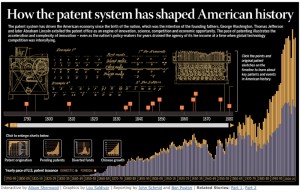
Also, from Interactive Graphic Pretends to Illustrate How U.S. Patent System Has Driven American Economy:

Interactive timeline_ The history of patents in America - JSOnli

From Motorola: Enemy or Friend of Google?: [continue reading…]

Share
{ 4 comments }

Google Chairman Eric Schmidt Hates Patents. Well, not really

As noted on this Techcrunch post, Google Chairman Eric Schmidt Weighs In On Patent Issues: They’re “Terrible” (h/t Geoff Plauche). But he is not really against patents. He is against “overbroad” patents and “bogus” patents. He thinks a solution would be to “improve” the quality of patents, by crowdsourcing, increasing PTO budget, hoping Congress “reforms” patent law, etc. The problem is not patents per se–after all, he says, “Patents are important.”

Schmidt accepts the common wisdom that patents are important, yet he sees the damage they wreak; so he is caught in a quandary. He cannot advocate patent abolition, he cannot point the finger at patents in general, if patents are “important.” All he is left with is complaints about “abuse” or “quality.” But he is wrong. The problem is not bogus patents, low quality patents, software patents, overbroad patents, bad Examiners, or patent trolls. Get rid of all these “problems” and the central problem still remains: companies can use state-granted monopoly privileges to stop competitors from competing with them.

Share
{ 0 comments }

As I explained in Types of Intellectual Property, “Intellectual property” is an umbrella term that includes many types of legal rights. They are called “property” or IP for propagandistic reasons,1 and include patent, copyright, trademark, and trade secret, plus newer rights. And there is always a push for legislation creating more types of IP, such as fashion designs. Legislation is the main source of new IP rights, of course, but the modern statist courts can contribute to. Case in point, as Mike Masnick notes here, a federal court just made up, out of whole cloth, a new IP right, which he dubs “the right to make up restrictions if it makes money.”

As Masnick write:

Two years ago we wrote about a troubling case coming out of Wisconsin, in which the Wisconsin Interscholastic Athletic Association (WIAA) claimed that it could allow a single exclusive broadcaster for high school sporting events in the state. The Gannett newspapers challenged this by streaming four different events online, eventually leading to this lawsuit. There were other highly questionable limitations on news media, including a claim that they could not even report play-by-play data. That part is the most ridiculous, as that seems like a clear violation on free speech rights, and also goes against previous caselaw that has allowed the reporting of factual game information. But, stunningly, last year, a district court judge ruled that commerce trumps the First Amendment, and since the WIAA needs to make money, such deals are just fine. This didn’t make much sense to us, and we hoped that it would be overturned on appeal.

No such luck.

Ima Fish alerts us to the appeals court ruling which upheld the lower court and seems to endorse the creation of a wholly made up new form of intellectual property right that has no basis in the law. The court clearly says that this is not a copyright case, so copyright law doesn’t apply. So what right exactly is WIAA granting to its broadcasting partner? That’s not clear at all from the ruling. If it’s not copyright, it appears to be something entirely made up by the appeals court, which might be loosely defined as “the right to make up restrictions if it makes money.” I’m not joking. The court repeatedly focuses in on the idea that the WIAA needs to make money, and that somehow makes it okay to grant a single company an exclusive license.

I don’t see how this makes much sense. I could see that they should be allowed to grant a license to an “official” broadcaster, and even give them additional access, but I don’t see how they can stop someone else from recording the material and broadcasting it as well — especially when they admit that it’s not a copyright issue.

And since this new exclusive made up imaginary right has no basis in law, we don’t know what any exceptions are. Is there a fair use exception like in copyright? The contract says other agencies can show two minutes of streaming video from events, but it doesn’t need to say that, and fair use shouldn’t be determined by a contract anyway. The whole thing seems bizarre and troubling, in that it seems to suggest that public entities can create a special kind of exclusive broadcast intellectual property right if they use it to make money.

Read more>>

  1. See Intellectual Properganda. []
Share
{ 1 comment }

Open Science versus Intellectual Property

Open Science Summit 2011Lately I’ve been learning more about the Open Science Summit, since I’ll be a panelist at the upcoming 2011 installment (Oct. 22, 2011, at the Computer History Museum in Mountain View CA). This is a fascinating and promising movement/group that is devoting a great deal of attention to how IP affects science (for more on the OSS, see The Open Science Shift, Xconomy; Open science: a future shaped by shared experience, The Guardian; footage from last year’s summit is available on the OSS Youtube channel).

In fact a good deal of the Opening Session of the 2010 Open Science Summit was devoted to IP horror stories and ways in which it interferes with science and the spread of knowledge (go to about 8:20 for the beginning of this discussion).

For a related talk, “Science is a Private Good – Or: Why Government Science is Wasteful” (video; audio; and below) delivered at the Fifth Annual Meeting of the Property and Freedom Society in Bodrum, Turkey,1, by Terence Kealey, a biochemist at the University of Buckingham and author of Sex, Science and Profits and The Economic Laws of Scientific Research.

[mises]

  1. See my Bodrum Days and Nights: The Fifth Annual Meeting of the Property and Freedom Society: A Partial Report. []
Share
{ 2 comments }

What a heroic milestone! …. not. As predicted in a recent post (Millions and Millions of Patents: Oh, the Humanity!), the United States Patent and Trademark Office Issues 8 Millionth Patent.

Horrible.

Share
{ 0 comments }

Photographer gets it

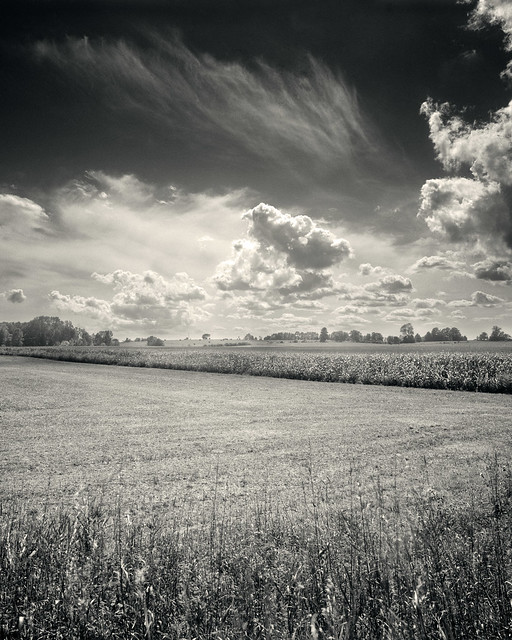
An interesting Flickr photo and post (h/t Manuel Lora). The Photographer seems to get it. I think–see my comment.

photo

Stealing The Spirit Of The Cornfield

I walked outside this afternoon to find a lovely blue sky filled with puffy cumulus clouds. Nice cool breeze, temperature in the 70s, and my car just happened to be loaded up with all my large format camera gear. So I decided to pull off on a country road and take some shots of the pretty landscape. Nothing’s better than a nice leisurely setup on a deserted road. So I got this photograph of a field and sky, and then I moved my tripod to the other side of the road to take another simple landscape scene.

Whilst under the darkcloth I hear a motor and something pull up next to me. A man in a golf cart is there. Here’s the conversation that followed to the best of my recollection: It is not necessarily word for word, but very close.

“Howdy!” I say

“Is everything OK?” he says

“Yeah, I’m just taking some pictures.”

“Of what?”

“Oh, just some landscapes.”

“Landscapes?”

“Yeah, like you know the sky, the field and whatnot. I’m a photographer.”

“So what are you gonna do with it?”

“I dunno, it’s just for fun, it’s my hobby. I’ll probably put them on my website or something”

“So you could sell them?”

“Maybe, but it’s unlikely that I’d sell any.”

“Well, you can’t do that, that’s illegal! You can’t just go and take pictures of people’s land!”

“It’s not at all illegal, I’m on public property.”

“Well my daughter is a police officer, I’ll just have to see about that!”

“I’m not doing anything illegal, I’m on a public street photographing a field. Is that your property? (points towards corn field)”

“Yes”

“And do you have a problem with me taking a picture of it?”

“Yes I do.”

“Okay fine, then I’ll leave.”

He turned his golf cart around and left. I wanted to take two more shots, but I just packed up my gear and left. It really made me mad that some people have gotta be jerks for no good reason. The vibe I got from this guy was that somehow my picture of his cornfield was going to make me rich and somehow he was going to be “screwed”. What I can’t convey in the story is the strong hostile vibe and body language\tone of voice I was getting from this man. I could sense he HATED the idea of me being there.

The photo itself holds none of the back story, it is simply a beautiful scene. But perhaps its beauty lies in the fact that there are no people in it, frightened, litigious people who cannot bear the thought of their fellow man being free to do as they wish. No people who are ready and willing to reach for the guns of the State the moment someone upsets their daily routine. No people who are unwilling to extend property rights to their fellow man. No scared and propagandized people whose only means of expression is to lash out at others.

If this man was a farmer then he knows the value of hard work. He knows the concept of homesteading. He knows the idea of making use of resources to create property where once there was almost nothing. He owns his cornfield because he makes use of it. But these concepts are universal, and they apply equally to the photographer as well. I used resources to capture light reflecting off objects in the world. An image was created on film and later manipulated in numerous ways. My own work has created this property. Everyone else is free to do the same and their photograph will become their property. My property does not negate his property in the least. My photograph does not make his corn wilt, it does not pollute his water supply, it does not kill any of his cows. The non-aggression principle has not been violated. But had I continued, I wonder if others would have?

My comment:

I like this, but I wonder if the photographer here thinks he has a property right (“copyright”) in the photograph. If so, he is as mistaken as the landowner is about the nature of property rights. Just as the photographer did not commit aggression against the landowner by taking pix of his property, so someone copying the image would not be committing aggression against the photographer–he still has his photograph. The fact that others might copy it, or even–gasp–profit off of it, does not aggress against him.

Share
{ 3 comments }

From this WikiLeaks cable: a current example of arm-twisting by the US to push our IP standards on developing countries, for the benefit of powerful American corporate IP interests (see also Intellectual Property Imperialism; Wikileaks cables reveal that the US wrote Spain’s proposed copyright lawsIntellectual Property Appears to Figure Prominently In Wikileaks Cablegate, The Economist on Patents and Innovation in China, and China and Intellectual Property).

Reference ID Created Released Classification Origin
08SARAJEVO1879 2008-12-18 15:07 2011-08-26 13:30 UNCLASSIFIED Embassy Sarajevo
VZCZCXRO9784
RR RUEHAG RUEHAST RUEHDA RUEHDF RUEHFL RUEHIK RUEHKW RUEHLA RUEHLN
RUEHLZ RUEHNP RUEHPOD RUEHROV RUEHSK RUEHSR RUEHVK RUEHYG
DE RUEHVJ #1879 3531507
ZNR UUUUU ZZH
R 181507Z DEC 08
FM AMEMBASSY SARAJEVO
TO RUEHC/SECSTATE WASHDC 9419
INFO RUEHZL/EUROPEAN POLITICAL COLLECTIVE
RUEHMO/AMEMBASSY MOSCOW 0085
RUEATRS/DEPT OF TREASURY WASHDC
RUCPDOC/DEPT OF COMMERCE WASHINGTON DC
RUEAWJA/DEPT OF JUSTICE WASHDC
UNCLAS SARAJEVO 001879 

SIPDIS 

COMMERCE FOR 4232/ITA/MAC/EUR (BURGESS AND SAVICH) 
DEPARTMENT PLEASE PASS TO USTR (MORROW, YANG) 
DEPARTMENT FOR EUR/SCE, EEB/IPE, EUR/PPD (HANNAN), 
EUR/PPD-PA,IIP/S 
TREASURY FOR LINDQUIST 
COMMERCE PLEASE PASS TO MCCAFFREY AND SMITH AT USPTO 
JUSTICE FOR CARL ALEXANDRE 
MOSCOW FOR REGIONAL IPR ATTACHE 

E.O. 12958: N/A 
TAGS: ECIN KIPR BK
SUBJECT: BOSNIA: MICROSOFT AND PM SPIRIC SIGN STRATEGIC 
PARTNERSHIP AGREEMENT 

REF: SARAJEVO 1351 

1. On December 18, the BiH Council of Ministers and Microsoft finally signed a Strategic Partnership Agreement for access to legal Microsoft applications for all state-level government ministries.  Prime Minister Nikola Spiric signed 
the agreement on behalf of the BiH Government.  The agreement 
obligates the BiH Government to use licensed software, but is 
only the first step in strengthening the state government's 
intellectual property regime.  Microsoft will now begin 
negotiations with BiH to purchase licenses for the software 
applications under the state's purview.  This marks a huge success for the U.S. Embassy, which has been working with state-level officials for three years to push for action to ban pirated and unlicensed software from ministry offices. 
(Note: Federation and RS-entity governments signed separate 
strategic partnership agreements with Microsoft in 2006.  End 
note.) 
ENGLISH
Share
{ 1 comment }

Loving the Price: The Reason for High Price in Academic Books

Interesting observation from Jeff Tucker on the Mises Blog about the reason for the inflated cost of academic books:

Loving the Price

July 29, 2011 by

This new book in Austrian theory is $711.

A similarly sized hardback in the Mises store is $25.

Just saying.

{ 14 comments… read them below or add one }

Pierre July 29, 2011 at 12:45 pm [edit]

Is there a free online version of Austrian Law And Economics? jk…

Jeffrey Tucker July 29, 2011 at 12:57 pm [edit]

No. It is just reprints from academic journals.

You do know what makes this crazy system work, right? 1) copyright monopolies, 2) tax money that is buying these books for state university libraries.

Share
{ 0 comments }

My post on the Mises Blog from June 2010

Terence Kealey: “Science is a Private Good: Why Government Science is Wasteful”

Terence KealeyI recently attended at the Fifth Annual Meeting of the Property and Freedom Society in Bodrum, Turkey (see my Bodrum Days and Nights: The Fifth Annual Meeting of the Property and Freedom Society: A Partial Report). I delivered a speech entitled “Ideas are Free: The Case Against Intellectual Property.” The speech following mine was by one Terence Kealey, a biochemist at the University of Buckingham and author of Sex, Science and Profits and The Economic Laws of Scientific Research. Kealey is a fantastic speaker and his fascinating, riveting talk, “Science is a Private Good – Or: Why Government Science is Wasteful” (video; audio), perfectly complemented my anti-IP talk–in fact his book Sex, Science and Profits has a chapter calling for the abolition of patents. (The other PFS speeches (see the Program) are being uploaded and will be linked here.)

Share
{ 0 comments }

Kinsella on Panel at Open Science Summit

Open Science Summit 2011I’ll be appearing as a speaker and panelist at the upcoming Open Science Summit, Oct. 22, 2011, at the Computer History Museum in  Mountain View CA. I’m very stoked about meeting some non-libertarians who have anti-IP or at least IP-skeptical and pro-open information/open science views–and also to visit the Computer History Museum.

Related posts:


Share
{ 2 comments }

AppleInsider reports: Apple accuses Motorola, Samsung of monopolizing markets with patents. So let’s see what’s going on. Apple uses its arsenal of patents to sue its competitors, e.g. Samsung and Motorola Mobility, to try to squelch Android.1 These guys fire back with patent countersuits of their own.2 And then Apple claims “no fair” since these patents “are associated with a particular industry standard, such as WiFi or 3G mobile networking. … When Motorola Mobility attempted to dismiss Apple’s case against it, Apple argued that Motorola had engaged in anticompetitive misconduct by attempting to use its standards-related patents as weapons….”

Chutzpah, anyone?3

  1. We Hope Apple Wins the Patent Wars; Mobile-device patent disputes heat up; Motorola: Enemy or Friend of Google?; Android Patent Trouble Worsens: Motorola Considers Collecting IP Royalties; Can patent licensing fees derail the Android express?; Apple expands lawsuit against Motorola. []
  2. The Patent Defense League and Defensive Patent Pooling; Patent Cross-Licensing Creates Barriers to Entry. []
  3. Apple: Patent Crybaby; Apple, iCloud, Appstore, and Trademark; Live by IP, Die by IP: Poetic Justice for Mattel. []
Share
{ 1 comment }