≡ Menu

“Free-trade” pacts export U.S. copyright controls

Who needs ACTA, when other trade agreements are also exporting the draconian US DMCA-type copyright provisions to other countries? See Declan McCullagh’s CNET column, excerpted below:

Free-trade pacts export U.S. copyright controls


by October 14, 2011 3:01 PM PDT


President Barack Obama and President Lee Myung-bak of the Republic of Korea at the White House this week.President Barack Obama and President Lee Myung-bak of the Republic of Korea at the White House this week.
(Credit: White House)

President Obama called the approval of free-trade agreements with Colombia, Panama, and South Korea this week “a major win for American workers.”

What he didn’t add is that the deals, which were given final approval on Wednesday by the U.S. Congress, are also a major win for the motion picture industry and other large U.S. copyright holders. Other portions specify that consumers can have their choice of computer software, but “subject to the needs of law enforcement.”

You won’t find this highlighted on the administration’s Web site (really, Web sites), but the three free-trade agreements export some of the more controversial sections of U.S. copyright law.

One chapter of the complex agreements echoes the Digital Millennium Copyright Act (DMCA), which the U.S. enacted in 1998 over the objections of librarians and computer scientists. It’s been used to threaten college professors, stymie research into HP security vulnerabilities, and jail a Russian programmer who created an e-book conversion utility.

Now Colombia, Panama, and South Korea will be required to prohibit circumventing any “technological measure that controls access to a protected work”–meaning that making a backup copy of a DVD or video game will become illegal, and, depending on the details, a crime as well.

The language of Chapter 18 (PDF), the intellectual property section, does not include the limited safeguards that Americans enjoy. The U.S. DMCA, for instance, allows the U.S. Copyright Office to consider the state of computer technology and create exceptions, a requirement that is not exported to the signatories.

Read more>>

Related:

Update:

From Tabarrok’s Launching the Innovation Renaissance: Statism, not renaissance:

 I note that although his “Tabarrok Curve” implies we have “gone too far” and that patent and copyright terms are too long, in a recent discussion, implies the patent term is too low because of FDA delays and thus favors legislation such as the 1984 Hatch-Waxman Act that provide for patent term extension of up to 5 years when there is delay caused by regulatory review, e.g. from the FDA. Tabarrok also seems to think the patent term is 15 years. Howefver, the patent term is 20 years from date of filing, not 15; and since it usually takes 2-3 years4 before it issues, most issued patents have a term of about 17 to 18 years. Does this mean Tabarrok would say that the Patent Term Extension of Hatch-Waxman “goes too far” since, after all, the 17 year patent term is already 2 years longer than Tabarrok seems to think is already too long? One doubts it. Moreover, in the same discussion Tabarrok mentions positively how the US twisted the arm of Australia in 2005 when negotiating a “free trade” agreement to expand its IP protection for pharma patents and also extended its copyright term from life of the author plus 50 years to life plus 70, to match the insane US term. Free trade agreements have nothing to do with local property rights; that is the province of bilateral investment treaties, which are usually negotiated between a developed country and a developing country. So here we have so-called IP reformer who says IP protection is too strong but he gets the term of patents wrong, and things they should be extended, and favors US IP imperialism to force other countries to extend their own copyright terms.

Share
{ 3 comments }

The Pirate Bay: “Occupy Hollywood”

Occupy HollywoodThe Pirate Bay suggests that we “Occupy Hollywood,” linking the picture shown at right to the Wired piece U.S. Copyright Czar Cozied Up to Content Industry, E-Mails Show.

Share
{ 0 comments }

ACTA, Executive Agreements, and the Bricker Amendment

For months now we’ve warned that the Anti-Counterfeiting Trade Agreement (ACTA) was on its way to being approved. This agreement is intended to strengthen international patent and copyright protection and to fight piracy and counterfeiting–for example, by imposing on other countries American DMCA-style provisions that prohibit technology that can be used to “circumvent” DRM technologies.   As science fiction author Corey Doctorow observed, ACTA is a “radical rewriting of the world’s Internet laws taking place in secret without public input.”1

As noted in my post Progress on ACTA, Public Knowledge president Gigi Sohn’s has some eye-opening remarks about ACTA in a Federalist Society panel discussion, Federalist Society’s Intellectual Property Practice Group National Lawyers Convention Panel Online, from 1:20:10-end. Sohn explains that normally the subject matter of ACTA would be negotiated in an open manner under the auspices of WIPO; but it was negotiated instead by the USTR as a trade agreement so that it could be done more quickly, and in secret.

In any case, the US and several countries signed the agreement earlier this month.2 Also President Obama signed the agreement on behalf of the US, there are no plans to submit it to Congress for congressional approval.3 The Obama administration has long argued that the President has the authority to “implement” ACTA by “Executive Agreement” alone, and that Congress’s ratification is not needed, because ACTA is already fully consistent with current US law and would not require Congress to enact implementing legislation.

As others have pointed out, however, there are several problems with this argument. First,

The regulation of intellectual property and of foreign trade through international agreements is an “Article 1” Congressional power. That means that the executive cannot bind the US to agreements in this area without congressional consent. The President lacks the authority to enter a “sole executive agreement” in this area, even if the agreement does no more that require the US to continue follow the contours of current US law. That is because the agreement purports to bind the US not to change its law, and changing US law in this area is a congressional power. This point has been made repeatedly by US law professors with no effective rebuttal.  ((ACTA to Be Signed – But Can it Enter into Force?, citing Submission to USTR of 30 Law Professors, Sean Flynn, ACTA’s Constitutional Problem, editorial by Creative Commons founder Lawrence Lessig and Bush AAG Jack Goldsmith, article by Yale Law Professor Oona Hathaway and Berkeley Law Professor Amy Kapczynski, and Mike Masnick’s apt description of the issue.))

Second, if ACTA gets the minimal six ratifications it needs, then it is a treaty that could bind the US under international law to have its municipal law (e.g. intellectual property and foreign trade) comply with ACTA’s terms. “This triggers the possibility of trade sanctions for non-compliance with ACTA, even though Congress never entered into the agreement.”

Further, it appears that ACTA is not completely consistent with US law anyway.4

We are seeing the danger here of the use by the President of “executive agreements” as a substitute for treaties, but in a way that binds the US under international law and that might even effectively amend the Constitution via the Supremacy Clause, which reads:

This Constitution, and the Laws of the United States which shall be made in pursuance thereof; and all treaties made, or which shall be made, under the authority of the United States, shall be the supreme law of the land; and the judges in every state shall be bound thereby, anything in the constitution or laws of any state to the contrary notwithstanding.

The treaty clause to the Constitution ostensibly requires the approval of a two thirds vote in the Senate, but executive agreements have been used as a way around this–to enter into commitments binding under international law–treaties–without getting Congressional approval. And because treaties are “the supreme law of the land,” the fear is that the President could in effect amend the Constitution by simply signing an executive agreement with terms contrary to other parts of the Constitution. This is one reason the Bricker Amendment was debated and almost passed in the 1950s.5 Too bad it failed.

[Mises]

  1. For more information see various C4SIF posts on ACTA. []
  2. See various Techdirt and other posts including Brazil Drafts An ‘Anti-ACTA’: A Civil Rights-Based Framework For The Internet; What Does Japan Need To Do To Deal With The Aftermath Of The Devastating Earthquake? Apparently Pass ACTA!; As Countries Sign ACTA, Many Finally Admit Their Copyright Laws Will Need To Change; Obama Administration To Use ACTA Signing Statement To Defend Why It Can Ignore The Constitution In Signing ACTA; US, EU, Canada, Japan, Australia & Others To Sign ACTA This Weekend, Despite Legal Concerns. []
  3. ACTA to Be Signed – But Can it Enter into Force?. []
  4. See A report to Senator Wyden, and an analysis by 75 U.S. law professors. []
  5. See also Re: Gun Control Through Democratic Executive Legislation?; and Tom Woods’ article Globalism and Sovereignty: A Short History of the Bricker Amendment. []
Share
{ 3 comments }

[See Mises Daily version]

Related:

It’s widely recognized that the American patent system is “broken” and needs to be “fixed.”1 And so various alleged “patent reform” measures have been bandied about for years now.

[Update: now at Kinsella on Liberty podcast episode 164]

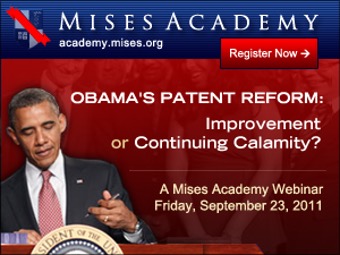
And so, after about six years of gestation and special-interest wrangling, the America Invents Act was signed into law on Sept. 16 by President Obama. Below I summarize my take on this law. (For elaboration, see the slides and audio I presented in Mises Academy Webinar a week after its signing, appended below; see also my Mises Daily article, Obama’s Patent Reform: Improvement or Continuing Calamity? (archived comments) and The America Invents Act and Patent Reform: The Good, the Meh, and the Ugly)

1. Patent Law versus Private Property and the Free Market

Despite the received wisdom that patent rights are a type of property right, they are in fact simply state-granted monopoly privileges that allow patentees to use state force to squelch competition. See, e.g.:

Patent law should be repealed completely and immediately. That is the optimal, pro-property, pro-capitalist, libertarian solution.

2. What Real Patent Reform would Look Like

Real patent reform is repeal of the US patent law. Short of that, any legislative, executive, or judicial reform that significantly reduces the scope and impact–and thus cost–of patent law, is to be welcome. As I laid out in Radical Patent Reform Is Not on the Way and How to Improve Patent, Copyright, and Trademark Law, significant reform would include things like: [continue reading…]

  1. See Chorus Of Mainstream Press Saying The Patent System Is Broken Gets Louder; Bill Gates’ 1991 Comments on Patents ; Even The OECD Is Noting How Dreadful Patent Quality Is Negatively Impacting Innovation. []
Share
{ 9 comments }

The Patent Pledge

Interesting strategy from one Paul Graham:

The Patent Pledge
No first use of software patents against companies with less than 25 people.

It may be possible to fix a subset of the patent problem without waiting for the government. If companies voluntarily renounce certain uses of patents, we can make patent law a moot point in such cases. [Learn More.]

These companies have agreed to be the first to publicly renounce aggressive use of software patents on small companies. Please join them!

Share
{ 0 comments }

On This Week in Law Today

I’ll be a guest in an hour or so This Week in Law with Denise Howell. The live cast starts at 11 a.m. Pacific.

Share
{ 0 comments }

From the “it never ends” department: Mike Masnick: Is Getty Guilty Of Trademark Infringement For Every Photo It Has That Shows A Trademark?.

Share
{ 0 comments }

MisesWiki: Envisioning a World Without IP

The Mises Wiki is a fantastic resource. Check out, for example, it’s nice overview of Austrian and libertarian views on the intellectual property issue (Intellectual Property) and this extremely useful article: Without Intellectual Property, which discusses “How would the world look like without Intellectual Property? What are the current success stories and possible alternatives if some or all forms of IP were repealed (or became unenforceable)?”

Share
{ 0 comments }

Mainstream opinion seems to be changing on IP. In the post linked below Glyn Moody at ComputerWorld calls Microsoft on its mainstream assumption that IP in general benefits innovation.

Microsoft’s Subtle Knife Through the Heart of EU Software Industry

One of the striking changes at Microsoft over the last twenty years is how savvy it has become in terms of lobbying and influencing political opinion. There was a time when, like most serious tech companies, it regarded this kind of sneaky activity as beneath it – something that only tobacco companies would stoop to. No more; today, it bombards everyone and anyone with a constant stream of carefully-crafted policy papers and posts designed to achieve its goals.

Here’s the latest one. It comes form the “Positions” page of Microsoft’s Digital Policy site in Europe. It’s called simply “Intellectual Property”, and is written in a deceptively simple style, as if it were some non-contentious statement of truths universally acknowledged.

For example, it begins by stating baldly:

IP benefits innovation, companies and society.

Well, no actually. As the lawyer Stephan Kinsella puts it in a post that links to dozens of academic papers supporting his view:

it is striking that there seems to be no empirical studies or analyses providing conclusive evidence that an IP system is indeed worth the cost. Every study I have ever seen is either neutral or ambivalent, or ends up condemning part or all of IP systems.

In particular, studies have shown how intellectual monopolies actually hold back innovation, because they remove the incentive to invent once patents have been obtained that can be used to sue competitors into submission. James Watt is the classic example of the stultifying effects of intellectual monopolies on a field’s subsequent development.

Moreover, the book “Patent Failure” shows that for industries like software, patents don’t even benefit companies that own them: on balance they actually lose billions of dollars every year as a result.

Society certainly doesn’t benefit from the added costs that this inefficient system adds. That can be seen from the Microsoft tax that HTC has to pay on its Android phones – a cost that will inevitably be passed on to the customer, but for no additional benefit.

The next section of the Microsoft post is actually the key one, since it contains these apparently unremarkable sentences:

Read more>>

Share
{ 0 comments }

In “Difference Engine: Programmed nonsense,” the regularly-confused and shill for the regime The Economist magazine–obstinately and stupidly still called a “newspaper”–writes:

IF PATENTS are a measure of inventiveness, Americans have a long pedigree of inventing better mousetraps. With around 350 international patents granted per million population, they rank alongside the savvy Swedes—though neither can hold a candle to the ingenious Japanese or Swiss (with 1,200 and 500 patents per million respectively). Congress hopes to boost America’s ranking in the innovation stakes by overhauling the country’s patent system—and thereby create millions of new jobs in the process. The America Invents Act, the most sweeping reform of the United States Patent and Trademark Office (USPTO) in over 200 years, was signed into law by President Barack Obama on September 16th.

The sole reason countries have for granting patents is to promote innovation—in short, to create local jobs and national prosperity. Patents seek to do this by requiring the inventor to make prompt and full disclosure of the money-making idea in question, so others can see and benefit from it—either by devising a legitmate way around the patent or by buying a licence to use it. In exchange, the inventor is granted the monopoly right to exploit the idea for 20 years or so.

The deal has worked well for centuries, creating wealth, jobs and economic growth in the process. Patents have fostered conditions for drug-makers to produce medicines that have improved people’s lot no end. Likewise, patents have allowed chip-makers to deliver a torrent of goods that amplify the public’s ability to work, learn and play in unprecedented ways.

These supine, craven idiots, pretenders to economic wisdom, spout these consequentialist conclusions without a shred of proof. There is no reason to think that the patent system has ever “worked well” or “created jobs and wealth” etc. See Yet Another Study Finds Patents Do Not Encourage Innovation.

Share
{ 0 comments }

From Mike Masnick at Techdirt: Beyonce May Get Sued For Copyright Infringement Because Of The Way She Danced. Again, what else is there to say? Res ipsa loquitur.

Share
{ 0 comments }

Taiwan’s Defensive “Patent Bank”

Update: See the Rational Patent Exchange’s (RPX) Defensive Patent Aggregation Service.

In my post The Patent Defense League and Defensive Patent Pooling, I suggested that some companies or industries might be able to form a “patent defense league” where patents are pooled and made available to members for defensive reasons–for example, to ward off patent aggression from competitors.

It appears that Taiwan is now considering a variant on this approach, by means of quasi-governmental “patent banks” to help defend Taiwanese companies from patent suits by foreign companies and patent trolls:

The quasi-government agency, the Industrial Technology Research Institute (ITRI), announced plans for the IP bank on 1 September, saying that it could be similar to existing defensive patent aggregators such as RPX Corp. and Allied Security Trust. Such patent-aggregation companies aim to buy out all the patents that might be asserted against their members.

According to Xiangsheng Xie, director of ITRI, the IP bank will assist Taiwanese manufacturers with the creation of patent portfolios and patenting strategies during the manufacturers’ R&D periods and later assist in defending them from suits and in expanding their market share. Should a Taiwanese firm face a patent-infringement lawsuit filed by its competitor or a patent troll, it can turn to the IP bank for either useful patents for its defensive actions or other strategies. In addition, the company, by way of the ITRI, can use other funds to tap into the intellectual property of Taiwan’s universities and research institutes as the industry’s backup.

This approach was inspired by similar

actions of other Asian nations. Intellectual Discovery, in South Korea, was established in 2010 to help protect domestic manufacturers against foreign patent trolls. Intellectual Discovery buys out patents that might be asserted against Korean firms, and it is creating a fund to help universities and research institutes generate patents and file patent applications overseas. ITRI also looked to Japan, which formed the Innovation Network Corporation of Japan (INCJ), a public-private partnership, in 2009 to provide similar services to Japanese firms.

It is unclear to me how such a patent bank can help defend local firms from suits by trolls, since usually the troll cannot be hit with a patent infringement countersuit since it does not manufacture any products. As I noted in my previous post:

One problem is that the PDL’s pool would be useless against patent trolls. However, patent trolls usually just want money. So they just serve as a kind of tax. But competitors often want to get an injunction to shut down the product lines of their competitors. Having to pay a “tax” to a troll is usually less of an existential threat to a company than is the patent injunction threat from a competitor. So if the PDL deters this kind of patent injunction threat, that is a huge benefit.

The IEEE post says “Should a Taiwanese firm face a patent-infringement lawsuit filed by its competitor or a patent troll, it can turn to the IP bank for either useful patents for its defensive actions or other strategies”–it is not clear what the “other strategies” could be in responding to the troll–perhaps the idea is that if a troll threatens a Taiwanese company and tries to shake the company down for royalties, it could be offered licenses to some patents in the “patent bank” to reduce or offset those royalties, but this strategy doesn’t make much sense for me. Still, even if the patent bank mainly deters anti-competitive patent aggression from competitors, it could serve some useful purpose. Of course, this is all so wasteful. Why do we have patents, again?

[Mises]

Share
{ 2 comments }

From Cory Doctorow. What else is there to say? WIPO boss: the Web would have been better if it was patented and its users had to pay license fees

Share
{ 0 comments }

As I noted in the blogposts collected in Are anti-IP patent attorneys hypocrites?, if you buck the IP system you can expect to get extra scrutiny, especially if you are part of the system–i.e., if you have any credibility. In a recent situation, reported on Techdirt, Judge Makes Company Pay More For Infringement Because The CEO Complained Publicly About The Patent System, merely expressing disagreement with the existing fascist IP regime penalizes those bucking it.

Share
{ 0 comments }