≡ Menu

This is a truly amazing talk about copyright. And waaaay back in 2006! Truly amazing. From Karl Fogel at QuestionCopyright.org. What is truly impressive is how prescient Fogel is, and how he comes at this not from a libertarian angle but still gets it right on every major theme, and without being anti-free market.

[See also Fogel’s article The Surprising History of Copyright and The Promise of a Post-Copyright World.]

See also other interviews, videos, and talks on QuestionCopyright’s Speakers Bureau page, including:

Image from Brian Lehrer Show
“Brian Lehrer Live (NYC) interviews Nina Paley and Karl Fogel” In May 2010, QCO’s Executive Director, Karl Fogel, and artist-in-residence, Nina Paley appeared on the CUNY TV show presented by renowned WNYC radio host Brian Lehrer.

Image from Art Brodsky show
“We Are Creators Too” Art Brodsky of Public Knowledge Interviews QCO Artist-In-Residence Nina Paley

Still composite from street interviews, Chicago, 2006
“The Public Perception of Copyright” To document the public perception of copyright today, we went around Chicago with a video camera over two days…


“History of Copyright and Information Ownership” Talk by Karl Fogel at the Stanford University Library; about 90 minutes, with Q&A.

Share
{ 2 comments }

The Patent Office vs. the Copyright Office!

Haha. The USPTO says it’s “fair use” for patent attorneys to submit copies of copyrighted articles as “prior art.” If it was not, then it would undermine the patent lawyer and patent applicant’s ethical and legal obligation to submit all material prior art to the PTO when filing a patent office. If only the Copyright Office and Patent Office could have a big fight, each one knocking out the other with a killing blow, that would be sooo sweet.

From Glyn Moody at Techdirt:

USPTO Says Copies Of Academic Articles Submitted As Prior Art Are Covered By Fair Use

from the wanna-fight? dept

With all the heat that publishers are starting to feel from the academic community, you might have thought that they’d avoid upsetting anyone else. But it seems that some publishers have decided to go after lawyers who make patent applications that include copies of academic articles as prior art. As the PatentlyO blog explains:

A number of scientific journals have begun to threaten law firms and their clients for submitting copies of journal articles to the USPTO. The typical cease & desist letter that I’ve seen says something like the following:

“We’ve been trolling through USPTO records and found that you submitted a copy of one of our articles articles to the USPTO and we suspect that you maintained other copies in your files and distributed additional copies within your organization. These actions constitute copyright infringement and are not fair use. We will sue you unless you come into compliance with our CCC licensing scheme.”

In a way, that’s strange: you would think that academic publishers would want to encourage this kind of use, since it establishes their titles as a kind of “gold standard” for prior art. Obviously the prospect of making some easy money proved irresistible.

Surprisingly, perhaps, the USPTO has waded in to this squabble and offered its opinion in a statement (pdf):

Patent applicants or their attorneys sometimes make copies of copyrighted NPL [non-patent literature] and submit those copies to the USPTO, pursuant to the USPTO’s disclosure requirements. The USPTO considers this copying to be protected by the doctrine of fair use.

In the rest of its eight-page document, the USPTO goes on to explain the legal reasoning that led it to come to that conclusion.


It’s rather remarkable to see the main US body responsible for promoting one kind of intellectual monopoly — patents — asserting that another — copyright — doesn’t apply. And it will be interesting to see whether publishers want to raise the stakes by taking on the USPTO as well as lawyers, inventors and angry academics.

However, since the USPTO says that it takes “no position on whether additional copies of NPL made during the course of patent prosecution (e.g. for the client, for other attorneys, for the inventors, or for the law firm’s future reference) qualify as fair use”, publishers would probably do better to concentrate on pursuing licensing fees for that instead.

Follow me @glynmoody on Twitter or identi.ca, and on Google+

Share
{ 0 comments }


The Public’s Perception of Copyright — Video Interviews with Randomly-Selected People in Chicago

by Karl Fogel on 14 Aug 2006
Still composite from street interviews, Chicago, 2006

In order to document the public perception of copyright today, we went around Chicago with a video camera over two days in the summer of 2006, asking strangers what they think copyright is for, how it got started, how they feel about filesharing, and for any other thoughts they have on copyright. We didn’t tell the interviewees about this website or the nature of our project until after each interview was over.

The points that showed up consistently were:

  1. Most people felt that copyright is mainly about credit, that is, about preventing plagiarism.
  2. Everyone was on the artist’s side — everyone wants to feel that they’re treating the artists right. Over and over again, we heard the sentiment that when someone goes to a concert they’ll buy the CD “to support the band”, even if they already have all those songs on their computer already.
  3. Many people felt that copyright was about giving creators the means to make a living, but that in recent times it’s been abused and corrupted by corporate interests.
  4. No one — not even the interviewee who had just read a book on copyright — knew where copyright comes from. Most people had the feeling it had been around for a while, though estimates varied widely on how long. One interviewee knew of the Constitutional clause that is the legal basis for copyright in the United States, but wasn’t familiar with the history leading up to that clause.
  5. People were ambivalent about filesharing. They don’t feel like it hurts anyone, except perhaps the music distributors, but they still feel some residual guilt about it anyway.

You can view the video at the Internet Archive. It is also available at Google Video and YouTube.

The video is in the public domain; all participants signed a release form permitting their footage to be used. Many thanks to Ben Collins-Sussman and Brian Fitzpatrick for their help filming, and to Ben for huge amounts of help with editing.

Share
{ 1 comment }

From Jason Hensley at Policymic:

Facebook Success Shows Why Intellectual Property Laws Are Stifling

PolicyMic

Last week, social media site Facebook finally filed its IPO in a bid to raise $5 billion and begin selling stocks later this spring. Facebook’s success has been based on fulfilling a consumer demand by providing a social networking site that is user friendly and has a generally broad appeal to both younger and older audiences. Freedom to use and expand upon other older ideas is what has helped launch Facebook to a status never seen by Friendster, Myspace, or many other social networks that existed before it.

All of the site’s success comes despite current intellectual property law, and the site is a shining example of why we should be against intellectual property (IP) laws. IP laws stifle the market by giving monopoly privilege to the “owner” of the idea(s) for an arbitrary number of years and distorting real property ownership.

IP laws are designed to ensure some individual would be the sole financial profiteer of his or her “own” idea; otherwise, we would prosecute every time someone used another’s protected idea. (Ex: Every time you hum your favorite tune, you would be fined.) I would argue that Facebook, the entertainment industry, and companies alike would still be successful without IP protections from the government. In the case of Facebook, people chose it over the other options. Facebook was a better product; it built better upon ideas and provided what consumers wanted in a higher quantity than did any competitor. If the real story is anything like the movie, The Social Network, then Mark Zuckerberg made a better product than the Winklevoss twins — even if it was “their idea” first.

As one IP expert Stephan Kinsella says, “First, even if a given policy could increase ‘net’ wealth by redistributing property from A to B, that does not justify the policy. The goal of law is justice, not wealth maximization. B may be helped ‘more’ than A is harmed by redistribution, but how does this justify the harm done to A?”

As Kinsella says, the goal of law is justice and not wealth maximization to certain individuals.  An objector may say that the goal of law is to protect property. I agree. However, IP laws distort property ownership. IP laws give someone the power to dictate what I can or cannot do with my own real world property.

It is with the case of some IP laws that since someone owns the concept, no one else can therefore use it. Why not? Are they at any loss if I organize my property in the same way they did? If I own a piece of wood, paint brushes, and the paint, why could I not paint the pattern I wish into it? If I really own my property, I should do with it as I please so long as it harms no one, and there is no harm done by my painting a pattern on my piece of wood.

If IP laws are really so important and are, in fact, real property, then why do they last for arbitrary numbers of years? Some last for seven years, some for 99 years. Why not have real permanent ownership if someone really can own an idea?

With government using IP laws to severely restrict our liberties — especially on the internet (SOPA/PIPA/ACTA) — it is time the intellectual property debate is opened to the masses. The success of groups like Facebook building off older social network models, the desire for the liberty to sing a karaoke version of our favorite song on YouTube, and the protection of our property are all at stake. We need a free market of ideas because ideas are the only way to drive social and economic progress. To achieve this free market of ideas, we need to dismiss the very idea of intellectual property.

Photo Credit: adihrespati

Share
{ 0 comments }

My Libertarian Standard post SOPA is the Symptom, Copyright is the Disease: The SOPA wakeup call to ABOLISH COPYRIGHT has been translated into Romanian and posted financial weekly, finantistii.ro (SOPA este simptomul, boala este Copyright: apel pentru abolirea copyright-ului), and o Mises Institute Romania’s site here.

Share
{ 3 comments }

Great piece in Forbes:

You Will Never Kill Piracy, and Piracy Will Never Kill You

Now that the SOPA and PIPA fights have died down, and Hollywood prepares their next salvo against internet freedom with ACTA and PCIP, it’s worth pausing to consider how the war on piracy could actually be won.

It can’t, is the short answer, and one these companies do not want to hear as they put their fingers in their ears and start yelling. As technology continues to evolve, the battle between pirates and copyright holders is going to escalate, and pirates are always, always going to be one step ahead. To be clear, this is in no way meant to be a “pro-piracy” piece, it is merely attempting to show the inescapable realities of piracy that media companies refuse to acknowledge.

What’s clear is that legislation is not the answer. Piracy is already illegal in the US, and most places around the world, yet it persists underground, but more often in plain sight. Short of passing a law that allows the actual blacklisting of websites like China and Iran, there is no legislative solution.  That’s what SOPA and PIPA were attempting to do, but it so obviously trampled on the First Amendment, it was laughed out of existence as the entire internet protested it. The only other thing you could get the internet to agree on was if they tried to institute a ban on cat pictures.

Read more>>

Share
{ 0 comments }

White House Petition Demands TPP Process Be Open & Transparent

From Mike Masnick at Techdirt:

White House Petition Demands TPP Process Be Open & Transparent

from the yeah,-like-that-will-happen dept

It seems that, with every issue that comes up around here, people are quickly putting together White House petitions on the White House’s “We The People” site. The latest, in response to all of these stories about secrecy concerning the negotiations on the Trans Pacific Partnership (TPP), is a petition demanding that the process be more open and transparent.

The USTR needs to be more transparent and inclusive in the Trans-Pacific Partnership treaty. The public should be informed by regular drafts of language released and open for comment. Members of Technological and on line civil rights groups should be invited to the negotiations.

It doesn’t have many signatures yet, but perhaps we can help change that…

Of course, as I was finishing up this post, I discovered that there’s actually another, similar petition that probably should be signed as well. This one asks the White House to stop participating in the TPP negotiations, which is a much stronger request, and unlikely to actually get agreement from the White House (it also has some silly stuff about “the 1%” which is kinda off topic). I think the more straightforward request that any negotiation actually be open makes a lot more sense. But, either way, it’s good to see more people recognizing that the TPP is the next big problem when it comes to Hollywood expanding copyright laws against the will of the public that it will impact. Help make sure the White House knows this is a concern by signing one or both of these petitions.

Share
{ 0 comments }

Anonymous Declares War on Patent and Copyright

And on IPolice State acronyms: from a tweet by Anonymous (I suppose):

@AnonyOps
Anonymous
Down with copyright! Down with patents! End false property now! #AcronymWar #SOPA #PIPA #ACTA #TPP #OPEN #PCIP #C11 #RWA #SOPAIreland

Share
{ 0 comments }

Politicians as Pirates

This whole copyright enforcement business is getting so crazy that Republicans can’t find music for their rallies. I’ll just say it: the complaining rock bands are entirely in the wrong from a moral and ethical point of view. A song is part of the culture, a gift. If you want to control how it is used, don’t let anyone hear it. There is a reason why use the term “release” – as in release a song.

Share
{ 0 comments }

Falkvinge: “The US as an ‘idea’ is dying.”

Post below from Falkvinge.net. Money quote: “The US as an ‘idea’ is dying. The country that used to pride itself on free speech, democracy, and being ‘the last remaining superpower’, is now apparently drunk on its own power.”


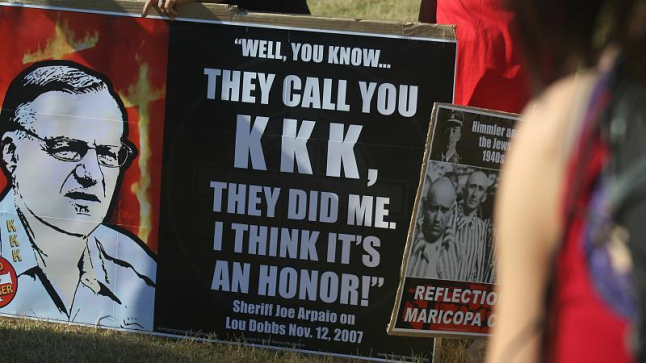
A poster of Joe Arpaio proud of being associated with the KKK. CC-BY-NC-ND by katerkate
0
+20

Freedom of Speech – Andrew Norton

Freedom of Speech – Andrew Norton

The US as an ‘idea’ is dying. The country that used to pride itself on free speech, democracy, and being ‘the last remaining superpower’, is now apparently drunk on its own power. With unchecked powers expanding at every turn, and terror laden missives booming out from government departments, the country seems to be taking a counterbalancing position from those who embraced freedom in the Arab Spring of last year, and is actively cracking down on freedoms previously embraced as a national advert.

The US likes to be known as the land of freedom and integrity; indeed the first verse of the US National Anthem – the Star Spangled Banner – ends:

O! say does that star-spangled banner yet wave,
O’er the land of the free and the home of the brave?

Over the last ten years, the answer has turned into a resounding NO!

Over the last ten years there have been many laws passed ostensibly about ‘fighting terrorism’, but which boil down to naked fear. A fear from the populace that some nebulous ‘terrorist attack’ will kill them all (despite the fact you’re more than 70x more likely to be just plain ‘murdered’ and 150x more likely to die on America’s increasingly poor quality roads than be present at a terrorist attack) which has supported a government that is increasingly spineless and cowardly. Nowhere is that more apparent than in the many instances over the last few months involving the uses of the police, when it comes to the First Amendment. [continue reading…]

Share
{ 0 comments }

Falkvinge on ACTA Censorship


In an inadvertent slip, the European Commission reveals that ACTA will indeed bring censorship to the Internet. As usual, they say this in the calmest soothing tone of voice.

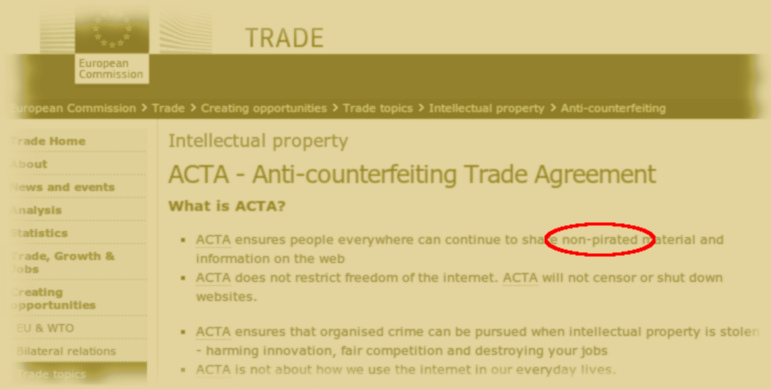
The European Commission, which is sort of the Administration in the EU, published a rebuttal to “rumors on the net about ACTA” and tries to set the record straight. Note the two first points: “ACTA ensures people everywhere can continue to share non-pirated material and information on the web. ACTA does not restrict freedom of the internet. ACTA will not censor or shut down websites.”

There is one word on their web page that stands out and reveals so much more about the nature of ACTA:
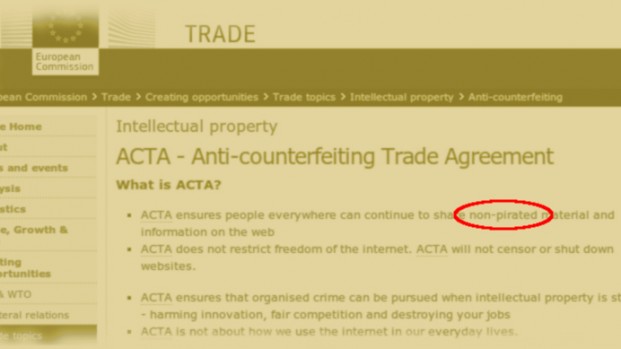
“Non-pirated”. Everybody will be free to share “non-pirated” material. All of a sudden, there is a qualifier  to what information we are able to share on the net; this qualifier has never been there before. We have always been able to send whatever we like, and possibly answer for it afterwards.

This is very, very serious. For what it says here is that the net will only be usable for government-approved communications; the government takes itself the right to determine what the net is usable for and what it isn’t usable for. To 250 million Europeans who share culture and don’t see anything wrong with defying an immoral monopoly, this is an arrogant slap in the face, but it’s more  than that and worse  than that. Any qualifier  to what can be communicated — “non-pirated” in this case — always means “government-approved”, that only governmentally approved communications may take place.

And this is serious for the deepest of democratic reasons: Any communications technology must be compatible with dissent.

At the same time as the government takes itself the right to determine what can be communicated and what cannot, a communications technology stops being compatible with dissent.

Now, the prudent question here would be if it isn’t true that some information has never been free to share, and that you can get prosecuted for doing so? This would be a very relevant observation.

There are many things you’re not allowed to share in terms of information. Military secrets, medical journals, libel/slander, ongoing criminal investigations, just to name a few. All of these have always been possible to share on the net, but if caught doing so, you can be hauled off to court for it. After the fact.  The postal service has always still been usable  to share this information.

And yet, the one single thing listed as impossible to share over the net is violations of the copyright monopoly. If the Commission really was referring to things that you were legally  unable to share, you’d expect military secrets to come first, followed by governmental hush-hushy documents. But no.

This is an obvious slip trying to calm people into saying that everything will be as before, but the forced factual correctness of it reveals that we are indeed talking about censorship.

Another objection here would be that the language requiring ISPs to police the net was taken out of ACTA. That is… not quite so. The specific phrase requiring that was taken out in one revision, yes. But in the same revision, the same thing was re-inserted in another place. Specifically, this text was inserted:

Desiring to promote cooperation between service providers and rights holders to address relevant infringements in the digital environment;

It looks fairly innocent, like most legal text where you don’t have the full context. To fully appreciate the impact of this text, one needs to know the background leading up to it and the negotiations. Hax writes a bit about it here (in Swedish). The gist of it is that it’s enforcement of extrajudicial censorship, plain and simple, through threats of third-party liability.

ACTA will bring censorship. Extrajudicial censorship. At the request of a bloody entertainment  industry. That is shameful.

Tomorrow, Saturday February 4, large-scale rallies against ACTA take place. I will be at the rally in Stockholm, Sweden at Plattan at noon.


Share
{ 3 comments }

History of Copyright, part 1: Black Death

From Falkvinge.net:

Painting of Black Death from 1411. Copyright has expired.
22
+338

Copyright Monopoly

Copyright Monopoly

In this seven-part series, I will look at the history of copyright from 1350 until present day. The story of the history books differs quite strongly from what you usually hear from the copyright industry.

We’re starting with the advent of the Black Death in Western Europe in the 1350s. Like all other places, Europe was hit hard: people fled westward from the Byzantine Empire and brought with them both the plague and scientific writings. It would take Europe 150 years to recover politically, economically and socially.

The religious institutions were the ones to recover the slowest. Not only were they hit hard because of the dense congregation of monks and nuns, but they were also the last to be repopulated, as parents needed every available child in the family’s economy, agriculture, et cetera, in the decades following the Plague.

This is relevant because monks and nuns were the ones making books in this time. When you wanted a book copied, you would go to a scribe at a monastery, and they would copy it for you. By hand. No copy would be perfect; every scribe would fix spelling and grammatical errors while making the copy, as well as introduce some new ones.

Also, since all scribes were employed (read controlled) by the Catholic Church, there was quite some limitation to what books would be produced. Not only was the monetary cost of a single book astronomical — one copy of The Bible required 170 calfskins or 300 sheepskins (!!) — but there was also a limit to what teachings would be reproduced by a person of the clergy. Nothing contradicting the Vatican was even remotely conceivable.

By 1450, the monasteries were still not repopulated, and the major cost of having a book copied was the services of the scribe, an undersupplied craft still in high demand. This puts things in proportion, given the astronomical cost of the raw materials and that they were a minor cost in ordering a book. In 1451, Gutenberg perfected the combination of the squeeze press, metal movable type, oil based print inks and block printing. At the same time, a new type of paper had been copied from the Chinese, a paper which was cheap to make and plentiful. This made scribecraft obsolete more or less overnight.

The printing press revolutionized society by creating the ability to spread information cheaply, quickly and accurately.

The Catholic Church, which had previously controlled all information (and particularly held a cornered market on the scarcity of information), went on a rampage. They could no longer control what information would be reproduced, could no longer control what people knew, and lobbied kings across Europe for a ban on this technology which wrestled control of the populace from them.

Many arguments were used to justify this effort, trying to win the hearts of the people for going back to the old order. One notable argument was “How will the monks get paid?”.

The Catholic Church would eventually fail in this endeavor, paving the way for the Renaissance and the Protestant movement, but not before much blood had been spilled in trying to prevent the accurate, cheap and quick distribution of ideas, knowledge and culture.

This attempt culminated in France on January 13, 1535, when a law was enacted at the request of the Catholic Church, a law which forced the closure of all bookshops and stipulated death penalty by hanging for anybody using a printing press.

This law was utterly ineffective. Pirate print shops lined the country’s borders like a pearl necklace and pirate literature poured into France through contraband distribution channels built by ordinary people hungry for more things to read.

Next: England and a vengeful daughter.

Share
{ 1 comment }

From Falkvinge.net:

A recreation (not copy) of the image found infringing on the copyright monopoly.

Copyright Monopoly Goes Insane: Non-Copy Judged As Infringing

54
+696

Copyright Monopoly

Copyright Monopoly

In a shock ruling in the UK this Tuesday, a photo was found to be in violation of the copyright monopoly of another photographer. There’s only one hitch with this ruling: the infringing copy was not a copy at all, but another original with a similar composition.

Read more>>

Share
{ 0 comments }

Daily Reckoning: How Piracy Works Against an Unnatural Monopoly

Nice piece from The Daily Reckoning:

How Piracy Works Against an Unnatural Monopoly

By Joel Bowman

leadimage02/02/12 Buenos Aires, Argentina – What the market giveth, the state rises to taketh away.

One of the more striking features of this whole modern spectacle must surely be the stark contrast between the state and the free markets that exist stubbornly, gloriously, in spite of its best efforts. Wherever evidence presents itself, it appears to do so with the sole purpose of expressing this juxtaposition in ever-higher relief.

This is no mere coincidence, Fellow Reckoner. The two entities are day and night…white and black…truth and government statistic. To the extent that the former exists, the latter does not. One produces; the other consumes. One adds value and meaning to peoples’ lives; the other subtracts value and feeds on the self-worth of those it engulfs. One is dynamic, responsive, nimble and creative; the other is brittle, deaf, lethargic and breathtakingly inelegant in all its forms. One serves customers, the other serves sentences.

It might well be said that, while the free market bends over backwards to serve the needs and desires of individuals, the state merely bends individuals over backwards.

The latest battle between these diametrically opposed nemeses is today being played out in the theater of intellectual property rights. Thanks to shared, copied articles, you’ve no doubt read all about it here and elsewhere. (In addition to some excellent commentary in these very pages, we would further refer interested Reckoners to this piece, penned by Mr. Stephan Kinsella, a man many consider the libertarian expert on this most important subject).

To be sure, the IP skirmish is just one of many such political hot spots, but it may well be one of the most important.

Free individuals’ ability to copy and learn from each other (without denying anyone else a single atom of realized, tangible or even “ownable” property in the process) is an important — arguably vital — tool in our ongoing struggle against the oppression of the state. It is an advantage, in other words, of immeasurable importance and one we surrender at our peril.

To illustrate the point, here is an excerpt from an excellent article by Kevin Carson that appeared on the Center for a Stateless Society website earlier this week:

Because local nodes in self-organized networks are free to take action or innovate without waiting for permission from an administrative apparatus, and every other node in the network is similarly free to learn by example and adopt the innovations without permission, they fully exploit agility advantages of networked communications in ways that authoritarian hierarchies are unequipped to.

[And here is a link to the full article, which we are happy to share with you without permission from the author, in case you’re interested: Why the State Will Fail.]

By larding itself with bureaucracy, inefficiency and structural rigidity — all designed to serve the privileged, politically-connected looter class working the machine behind the curtain — the state positions itself at a considerable disadvantage with respect to the free markets — the self-organized networks — that it seeks to crush.

Happily, we don’t have to follow this path by subscribing to the state’s sinister web of dysphemisms and doublespeak. We can, instead, reject its definition of sharing and learning and emulating as “pirating,” and as something, therefore, to be outlawed. We can likewise reject the state’s logically-circular notion that ideas — non-scarce, un-ownable patterns of knowledge — ought to enjoy violence-backed protection against “aggression”…from a violence-based institution that exists only because of aggression.

Most private citizens would have the decency to feel embarrassed if they had to defend this warped sort of logic. The state, on the other hand, revels in its position…but only because it doesn’t have to defend it. It simply claims the right to enforce it. A big difference, you’ll surely agree.

But here, too, the state’s designs to undo all that humanity has come to enjoy as a result of said copying, emulating and learning from each other comes unstuck. How, exactly, does one grant — much less enforce — an unnatural monopoly on intangible, infinitely reproducible concepts? How does one erect a protective circle around things that have no physical properties?

The state’s strategic efforts (SOPA, PIPA, ACTA and the like) to crack down on the spread of ideas ultimately amount to little more than a woeful, modern day adaptation of the mystical dream snare. Fortunately for us, ideas (and dreams) cannot simply be “caught” in a net…just as they won’t be caught on the net. The brave individuals who daily resist this tyranny ingeniously find workarounds to the state’s feeble-minded aggressions. And bravo to them!

Continues Mr. Carson:

We saw this recently with the development of Firefox’s DeSopa circumvention utility before SOPA even came up for a vote, and Anonymous’s massive same-day DDOS attack in response to a federal takedown of MegaUpload that had been months in the planning. Last summer Tor developers released a workaround the very same day Iranian authorities thought they’d shut down the encrypted router network.

The second the state constructs a wall, 2…4…8…10,000 copies of the very idea it was built to contain emerge on the other side. They are like ornery little neutrinos, seemingly popping in and out of existence as if only to mock the government’s Neanderthalic, cinder block goals.

Fortunately for us, good ideas don’t need or seek protection, nor do they exist to serve any one master. They are non-scarce entities and, as such, are here to serve us all.

On that last note, if you would like to share, copy or “pirate” any article you see appear in The Daily Reckoning, we’re making it as easy as possible. You can:

1) Go to our website and forward the link to your favorite articles to friends or,
2) Find and “like” us on Facebook, where you can share our articles or,
3) Do likewise by following us on Twitter.

As the author Paulo Coelho recently wrote in a fantastic blog post (which you are free to read here):

“Pirates of the world, unite and pirate everything I’ve ever written!”

Joel Bowman
for The Daily Reckoning

Share
{ 0 comments }