≡ Menu

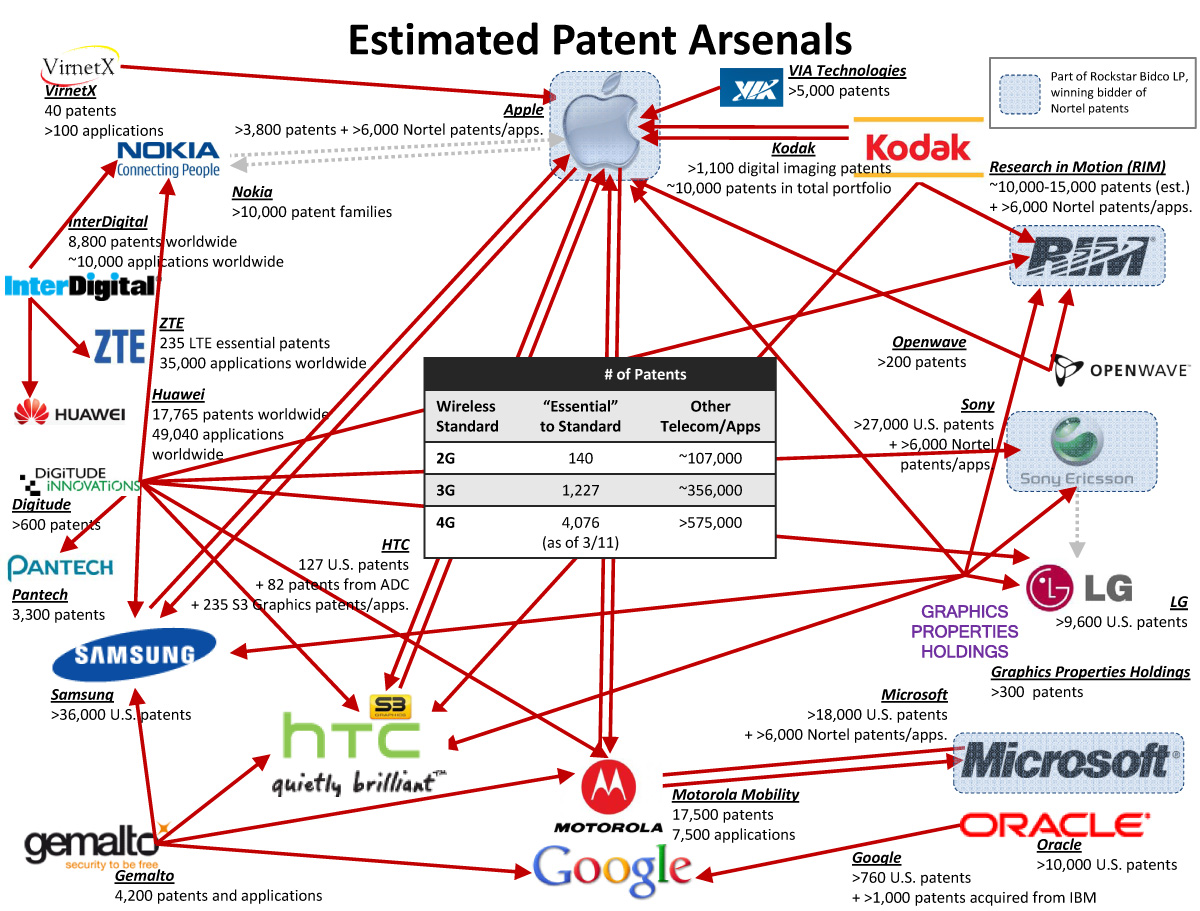
Web of Tech Patent Lawsuits [INFOGRAPHIC]

From Droid Life (via PCMag):

Web of Tech Patent Lawsuits [Infographic]

by: | posted 01.24.12 | News

It seems every other day that we hear Company A is suing Company B over patent infringement. Thanks to PCMag, we can keep track of them all through a set of infographics. These graphs give us a solid representation of the amount of firepower each company holds with their number of patents. As we can see, a lot of these companies have in the tens of thousands of patents – how they keep track of them all, don’t ask us. In the above chart, there are the major filings along with their dates, but we sort of wish they also had the outcome. We love a good Fortune 500 drama, but can’t we all just get along?

Via: PCMag

Other charts and graphics at Intellectual Property Charts, Graphs, Graphics, Diagrams.

Share
{ 2 comments }

I was interviewed Feb. 23, 2012, by Fabrizio Sitzia of the Italian libertarian group LibertariaNation.org. It was posted today on YouTube. We discussed intellectual property and related issues such as SOPA, plagiarism, IP-by-contract, and other libertarian issues such as prospects for liberty in the future; the importance of technology, the Internet, and globalism; Ron Paul and electoral politics; and libertarian sentiments and receptiveness among today’s young people. The audio file is here, and streamed below. (See also Italian Libertarian IP Debate.)

[podcast]http://www.stephankinsella.com/wp-content/uploads/media/interview-kinsella-libertarianation-2012-03.mp3[/podcast]

More info at the LibertariaNation post Intervista a Stephan Kinsella (English translation from Google translate).

[TLS]

Now at KOL162.

Share
{ 1 comment }

Nice post:

The Use of Free Software as Anti-Copyright Libertarian Activism

By  | Published: MARCH 29, 2012

Image is Copyright © 2005 Nicolas Rougier. Used with permission.For the sake of the simplicity of this blog post, I am going to assume all of my readers have at least a basic familiarity with both the ideas of free software advocates like Richard Stallman and Eben Moglen (though I try to link extensively to references within the post). For most of my libertarian readers, understanding the free software movement is very likely going to require a bit of reading unless you are a GNU/Linux geek. The page on the philosophy of the GNU project and Richard Stallman’s Wikipedia page are good places to start. Note that while free software and open source software have significant overlaps, they are not the same thing. For now, I’m going to focus on free software rather than open source to avoid further complicating this post.

I am also going to take as an assumption of my argument that the libertarian position is to be opposed to the existence of copyright. For some background on that argument see just aboutany of the work by Stephan Kinsella on the subject or for a more utilitarian approach seeAgainst Intellectual Monopoly by Boldrine and Levine.

Libertarian activist strategies range from on the most extreme, the idea of practicing full scale rejecting the system agorism as advocated by Samuel Konkin to the within the system political activism that ranges from full scale anarcho-capitalism a la Murray Rothbard to the stringently principled minarchism of those like Ron Paul to the steps in the right direction coming from more moderate or pragmatic libertarians. Efforts can range from education to campaigning to the actual act of voting.

Outside of the political system, there are few things other than education – which is usually just the means to a political ends – that a libertarian can do to create a more libertarian world. However, I believe that one relatively easy, and becoming easier by the day, thing that nearly everyone with some basic computer knowledge and a couple hours to spend can do to actively curtail the influence of copyright law is to start using free software.

Drawing on Stephan Kinsella’s ideas on the best copyright license for written work, the best software license is one that places as few restrictions on the end user as possible. The problems associated with removing all requirements or dedicated it the public domain means that only requiring acknowledgement of the author is the best solution. I don’t think it is a far stretch from his arguments the criteria that makes the fewest restrictions the best license can also be used to argue that fewer restrictions make a better license. In the context of discussing which license to issue your own work under, only determining the best license is necessary, however picking which software written by others to use doesn’t offer the same freedom and thus better rather than best will often have to suffice.

Starting with the assumption that everyone needs to use a computer with basic capabilities such as web browsing, word processing and the occasional game that they can operate without needing a computer science degree, there are really only 3 operating systems that are viable options, Windows, Mac OS X and Linux (well really GNU/Linux). With either Windows or OS X, using them merely consists of paying for the ability to use the software on one computer for your own personal use and not much more. They both leverage the full weight of copyright law to prevent you from doing basically anything beyond the bare minimum. It’s essentially the all rights reserved of the software world.

In contrast, Linux is licensed (mostly) under the GNU General Public License (GNU is a recursive acronym that stands for GNU’s Not Unix) is designed around preserving the four essential freedoms for software user (being computer geeks their numbering of course starts at 0):

(0) to run the program,
(1) to study and change the program in source code form,
(2) to redistribute exact copies, and
(3) to distribute modified versions.

In order to enable any user to do these things clearly this license is much less restrictive than the licenses under which you are permitted to run Microsoft or Apple software. The GNU GPL is not however a libertarian license and from a libertarian perspective is more restrictive than the software equivalent of the CC-BY license recommended by Kinsella for written work in two important ways through the power of copyright law.

First, that under certain it requires the release of the source code for software if an executable version is released which is a requirement of all free software. Secondly, that it is a copyleft license, which means that it requires programs that modify the code to also license those programs under the GNU GPL and is therefore less libertarian. In order to qualify as free software according to the Free Software Foundation, copyleft licenses are not necessary, but are encouraged.

There are examples of non-copyleft free software licenses that are more libertarian than the GNU GPL, such as the BSD license, and there are operating systems that largely use such licenses, I believe the most popular is FreeBSD. However, the community of Linux users is much more widespread and as a result the online support and information is much better. Plus, Canonical has spent millions of dollars working on a Linux distribution, Ubuntu, targeted specifically at non-technical users and from all accounts the next release, 12.04 due out next month, includes a much better version of the new Unity interface aimed at those users.

Shifting gears to discuss the implications of using Linux on copyright, there are impacts that switching to Linux has on the entire software market. First, the less that you use proprietary software, the less money that ends up in the pockets of proprietary software developers. Secondly, using free software creates a user base for that software which in turn makes that software more widely used for a number of reasons. For example, more users means that more software will be supported and developed for GNU/Linux operating systems allowing users who need or want access to certain critical programs like Adobe software or Netflix streaming to make a complete switch. A wer user base also facilitates the development of the documentation and help resources necessary for less advanced users.

As a closing point, it is important to note that while free software is more libertarian than proprietary software, for the bulk of free software advocates such as Richard Stallman and Eben Moglen are most definitely not libertarians. Their approach to copyright and politics in general is based much more in a leftist ideology than a libertarian one. See Stephan Kinsella on the topic here and here and Moglen on the subject here.

I realize this post inadequately covers a huge range of issues, but when I first thought of the idea for this post and began to research it, I realized that some of this is starting to break new ground from a libertarian perspective. As can be seen from many of the links above, Kinsella’s works which constitute by far the most numerous and in depth writings on the subject, focus mostly on the foundation of libertarian opposition to intellectual property and doesn’t get very far into applying it to software beyond basic discussions of the free software movement and the copyleft nature of the GNU GPL.

My hope is that this blog post will be the starting point for some feedback, more blog posts and hopefully eventually a longer more thought out essay, like the one I wrote on Ron Paul and libertarian history.

Share
{ 2 comments }

Patent Lawyers Who Don’t Toe the Line Should Be Punished!

Update: See Are anti-IP patent attorneys hypocrites?, collecting various posts about this topic.

***

A few older posts:

Update: see also Rothbard on Lawyers, Accountants, Locks and Safes–and patent lawyers?

Patent Lawyers Who Don’t Toe the Line Should Be Punished!

In his post Reality Check: Anti-Patent Patent Musings Simply Bizarre, patent attorney Gene Quinn is baffled that any patent attorney would openly oppose the patent system–or be hired by anyone. He writes, in part:

But what has me really wondering is how and why a patent attorney who is openly hostile to the patent system can get any work in the industry? Why would any inventor or company want an anti-patent patent attorney like Stephan Kinsella, who seems to be the genesis of this story, and so many other anti-patent patent stories.

Why would anyone hire me? I’ve prosecuted hundreds of patents. I’ve taught computer law as an adjunct law professor, I’ve published a great deal of legal scholarship including IP law, such as the Oxford University Press legal treatise Trademark Practice and Forms. I believe that given the patent system, tech companies have no choice but to arm themselves with patents, if only for defensive purposes. If someone went after one of my clients for patent infringement, I’d pull out all the stops to defend them from this state-backed threat. Maybe some clients like a patent attorney looking out for their interests.Apparently Quinn thinks ideological conformity is a requirement for job competence. If you have the wrong politics, you’re out. (I just hope I don’t have the wrong religion, gender, or race.) But think about it: would you hire only oncologists who were pro-cancer? Is it outlandish to think of hiring a tax attorney to defend you from the IRS who thinks the income tax is immoral and should be abolished? Is it required of a patent attorney to be in favor of the patent system? Yes, we patent attorneys learn the patent law and how to navigate the system. Does that mean we receive special education–or is it propaganda–as to the justifiability of IP? If so, where is it? Sure, we are taught in law school that the stated purpose of the patent system is to encourage innovation, and public disclosure of inventions. Okay. So what? How does knowing the state’s line for a given law prove that it is justified?

The truth is most patent attorneys are in favor of patent law. Why is this? They have no special knowledge about its normative validity. Rather, they are self-interested, and have been subjected to positivist, statist, empiricist propaganda in law school. Quinn tries to turn this defect into an advantage by hogging to the biased patent profession the right to pronounce on these matters–and then ejecting from the profession anyone who bucks the union line. The patent bar of course lobbies for the system that butters their bread. They claim special knowledge to pronounce that the system is “necessary” for innovation, even though they have no proof of this. (See below.) They marginalize non-lawyers as not having enough expertise to weigh in. And anyone who does have expertise is ostracized if they point out that the emperor is wearing no clothes. They remind of leftists who will not tolerate an African American who opposes affirmative action–they impose their supposed “benefit” on him by force, which is bad enough, and then use this imposed “benefit” to silence his criticisms of it. Terrible. (See An Anti-Patent Patent Attorney? Oh my Gawd!.) [continue reading…]

Share
{ 7 comments }

The Most Visited Libertarian Websites

The Capital Free Press has compiled a list of the top ranked “libertarian websites based on the number of unique visitors in the most recent month according to the data compiled by Compete.” The post is pasted below. Not surprisingly, LewRockwell.com is the most visited libertarian site. Four of my own sites made the list: StephanKinsella.com (#84), Libertarian Papers (#100), The Libertarian Standard (#75), and Center for the Study of Innovative Freedom (C4SIF, #78).


The Most Visited Libertarian Websites

This is a ranking of the top libertarian websites based on the number of unique visitors in the most recent month according to the data compiled by Compete. They only compile data for domains and subdomains, so perhaps this list is more accurately described as the most visited libertarian domains rather than websites. It is compiled through calls to Compete’s API, so it will automatically update when they release new data each month. For more information on this list, see the blog post introducing it.

Automating everything means that adding a new website is as simple as plugging a new url into my list, so you have any suggestions for a website to add, please email me at [email protected].

Due to the restrictions on the free use of the Compete API, there is a chance that I could run out of API calls in a 24 hour period (resets at midnight EST). The way that I compile this list and the terms and conditions on the use of their API prevent me from displaying the number of unique visitors for each website in the chart, though that information and more can be accessed via the link I have provided. [continue reading…]

Share
{ 2 comments }

How much is that patent lawsuit going to cost you?

From Cnet:

How much is that patent lawsuit going to cost you?

While the tech industry’s elite are fighting it out with their whopper patent portfolios, a recent survey shows just how scary one lawsuit can be for a small company.

by


So you’re facing a patent lawsuit. Or maybe you want to sue someone. Get out your checkbook, because this isn’t going to be cheap.

Read more>>

Share
{ 0 comments }

The Organization for Transformative Work

Geoff Plauche called to my attention a groups called the Organization for Transformative Work, “a nonprofit organization run by and for fans to provide access to and preserve the history of fanworks and fan cultures”. See its “beliefs” statement below, which “envision[s] a future in which all fannish works are recognized as legal and transformative and are accepted as a legitimate creative activity.” This laudable goal would require modifying copyright law’s “derivative work” provision.

What We Believe

Our Mission

The Organization for Transformative Works (OTW) is a nonprofit organization established by fans to serve the interests of fans by providing access to and preserving the history of fanworks and fan culture in its myriad forms. We believe that fanworks are transformative and that transformative works are legitimate.

The OTW represents a practice of transformative fanwork historically rooted in a primarily female culture. The OTW will preserve the record of that history as we pursue our mission while encouraging new and non-mainstream expressions of cultural identity within fandom.

Our Vision

We envision a future in which all fannish works are recognized as legal and transformative and are accepted as a legitimate creative activity. We are proactive and innovative in protecting and defending our work from commercial exploitation and legal challenge. We preserve our fannish economy, values, and creative expression by protecting and nurturing our fellow fans, our work, our commentary, our history, and our identity while providing the broadest possible access to fannish activity for all fans.

Our Values

  1. We value transformative fanworks and the innovative communities from which they have arisen, including media, real person fiction, anime, comics, music, and vidding.
  2. We value our identity as a predominantly female community with a rich history of creativity and commentary.
  3. We value our volunteer-based infrastructure and the fannish gift economy that recognizes and celebrates worth in myriad and diverse activities.
  4. We value making fannish activities as accessible as possible to all those who wish to participate.
  5. We value infinite diversity in infinite combinations. We value all fans engaged in transformative work: fans of any race, gender, culture, sexual identity, or ability. We value the unhindered cross-pollination and exchange of fannish ideas and cultures while seeking to avoid the homogenization or centralization of fandom.

Our Goals

During our first two years, the OTW has laid the groundwork for a vibrant and creative organization by:

  • Establishing the OTW as an IRS-recognized nonprofit organization.
  • Creating infrastructure for OTW by establishing a board and creating committees, soliciting membership and donations, forming alliances, and holding elections.
  • Encouraging community interaction and input via the OTW’s Web site and across the online and offline spaces where fans congregate.
  • Designing, programming, and launching the Archive of Our Own, a Web archive to host transformative fanworks.
  • Exploring ways to make fanworks as accessible as possible.
  • Establishing a legal advocacy project and forming alliances to defend fanworks from legal challenge.
  • Creating a fan wiki to preserve the history of transformative fanworks and the fandoms from which they have arisen.
  • Establishing a refereed academic journal to promote scholarship on fanworks and fan practices.
  • Developing a long-term plan for the organization.
  • Undertaking additional projects relevant to transformative fandom, such as the preservation of fan history and fanworks, building and maintaining infrastructure for use by fans, and sponsoring academic scholarship on fandom.
Share
{ 0 comments }

Italian Libertarian IP Debate

My Interview on IP and libertarianism (with Fabrizio Sitzia) is forthcoming at LibertariaNation.org (Italy) (recorded Feb. 23, 2012). In the meantime the group has a post up about the IP issue with a vigorous series of pro- and con-comments in the thread. Italian libertarians are arguing about this just like Americans are.

The original post is Non proprietà intellettuale?; the automatic Google translation, Not Intellectual Property?, is surprisingly good.

Share
{ 2 comments }

Writing Without Copyright

In the 22 years I’ve been writing seriously, I’ve never registered a copyright with the US Copyright Office. In the beginning, I thought it was wonderful that once I wrote something, it was protected. Somewhere in that first year of writing, though, I learned that I didn’t stand much of a chance in winning a copyright case in court without registering a copyright with the US Copyright Office.

In my first year of serious writing, I made what averaged out to a couple hundred dollars a month writing independent (i.e., creator owned) comic books, short stories, and the occasional article. The $20 fee to register copyright for each substantial work — when I was producing, in some months, close to a dozen substantial works — was more than I could afford. So I took my chances and never registered a copyright.

I never really thought about it until a friend asked me how I’d view a world without copyright as a writer. My first thought was a knee-jerk reaction: “That would be terrible — we need copyright protection!” But when I thought about how I’ve never had to enforce a copyright in all my years writing, I came to this conclusion: copyright really benefits those who use it to coerce writers, artists, musicians, consumers, and others.

In the News

In much the same way that if somebody tells me to look for purple things throughout my day I will notice purple more than usual, I started noticing articles about copyright abuse: musicians producing original work being accused of stealing sounds; writers receiving cease and desist letters for writing parodies; independent filmmakers willing to offer what they were doing for free via bit torrents seeing their means of distribution shut down because some people used the same services to share movies. Just a few weeks ago, my wife loaded a video on YouTube that was flagged because she used a Creative Commons Haydn piano sonata. And just yesterday, I came home and read this on BoingBoing.net.

Add to that how it seems a handful of years can’t pass by when one doesn’t read about Disney — a company that largely exists from creating derivative works — claiming others are creating derivative works of their derivative works. If it weren’t so stifling, it would almost be humorous.

Fortunately, innovation often outpaces coercion, and there are now other ways for musicians and filmmakers to get their work out there. But at the time of Napster and the beginning of bit torrents, there were people offering their art and having their means of distribution shut down by corporations, organizations, and the government — all in the name of copyright protection.

The Writer’s Turn

Just as musicians and filmmakers have had to deal with the suppression of their rights to create and distribute their work by non-traditional means in recent years, writers are now getting their turn. Books weren’t the easiest thing to copy in the past; it was easier to just buy or borrow a book than to copy War and Peace one page at a time on a Xerox machine. Because of this (and many other reasons), publishing has always been a slow industry with gatekeepers deciding who got in…and who stayed out.

With the rise of e-books, novels are now like albums — something that can be copied, shared, and read on computers, tablets, and smart phones. Even with early demand, publishers were slow to catch on. At a 2009 South by Southwest panel called “New Think for Old Publishers,” publishers walked away looking like a lonely middle aged guy desperately trying to convince a bunch of 20-year-olds that he’s still hip. It wasn’t until Amazon pushed for e-books that people really paid attention.

The Big River (Apparently Full of Piranha)

Amazon quickly made the e-book a viable thing through the innovation of the Kindle and the means by which they were able to distribute e-books. While other e-readers existed, it’s safe to say it took Amazon to make the e-book an everyday thing. And with that quick success (Amazon making the market and then claiming 90%), came the cries that Amazon wasn’t playing fair. They were a monopoly with aggressive tactics — that was the claim by some companies angry that they didn’t think of it all first!

It’s hard to feel bad for Barnes and Noble — a company that aggressively targeted small booksellers in an effort to drive them out of business — crying foul when they are on the receiving end of similar tactics they once used. It’s kind of like seeing a playground bully bested in battle by a crafty, tough nerd.

I’ve heard people say “Amazon is a monopoly! They own the market share of e-books!” Why shouldn’t Amazon have the biggest share when they were the ones who thought, “Let’s make publishing easy and give indie publishers a 35% royalty on anything between $.99 – $1.99, and a 70% royalty on anything more than $1.99.”?

A seventy percent royalty is unheard of! Why wouldn’t writers consider self-publishing e-books when traditional royalties on hardbacks are considerably less than Amazon’s low end of 35%. When I self published comic books back in the 90s and got 40% for each book sold through the direct market, I thought it was the greatest deal in the world! And now I can do that with novels that cost next to nothing to produce.

The “Evils” of Amazon’s “Monopoly”

Amazon no longer has a 90% share of the e-book market; in large part because their aggressive tactics and “stranglehold” on the industry opened the door for other booksellers, publishers, and e-reader/tablet manufacturers. The Nook, in part, owes its life to the Kindle — and Barnes and Noble followed Amazon’s lead with an online store and e-book sales. Barnes and Noble and other companies are all benefiting from Amazon’s innovation.

But there are still those who think otherwise. My favorite Internet battle in recent weeks has been J.A. Konrath and Barry Eisler’s challenge to Author’s Guild president, Scott Turow. (More about that here and here.) The quick version: Scott Turow came out in support of the agency pricing model in publishing, and in the process, attacked the way Amazon does business. Instead of siding with the interests of the writers he’s supposed to support, he sided with the pricing model used by major publishers that puts a smaller percent of royalties in writers’ pockets.

If you’re not familiar with Konrath and Eisler, they are midlist writers who broke away from traditional publishing and did it on their own, using e-books as their main product. Konrath was unsuccessful at convincing his then publisher to re-release his out-of-print books. He was told it wasn’t worth it. He fought for the rights, released them as e-books, and they’ve pulled in decent 6-figure totals. Eisler, seeing Konrath’s success, walked away from a 2-book, $500,000 publishing deal to do it himself. (He says it was more than worth it.)

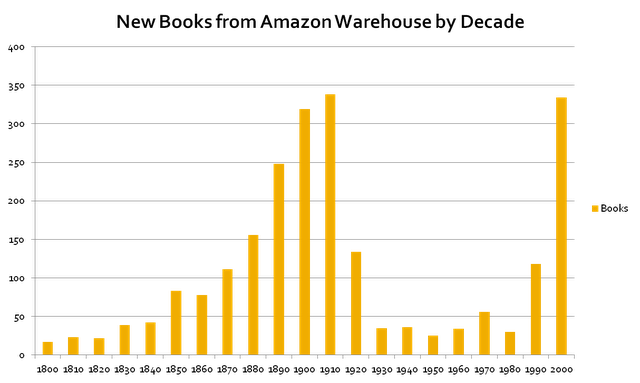
When the same friend who challenged me to imagine a world without copyright sent me the graph featured by Stephan here last Saturday, I was not at all surprised to see Amazon moving more books in the public domain — and then since the rise of print-on-demand technology and e-books. The dip in the numbers of books released during times of industry coercion through copyright claims says it all.

The Traditional Way

I’m lucky enough to be friends with a handful of writers much more successful than me. A few of those writers — and a couple writers I follow online — have made no secret that they would love to see fewer writers being published. Fewer writers being published means more for them. In some ways, I find it hard to totally fault them; they are writers who came up in a time of gatekeepers. Once invited to that side of the wall, they want to cling to what they have — even if they are the same writers who once complained about gatekeepers holding them back.

Should one believe I’m bitter because I’m not on that side of the wall, I am not opposed to going the traditional publishing route. While genre fiction has seen e-book successes like Amanda Hocking and John Locke, upmarket and literary fiction doesn’t have a similar kind of e-book success story. Despite getting rejections letters that amount to, “Loved this–you’re a talented writer, but…it’s too quirky and I don’t know how I’d market this,” I still try to find success the traditional way with some stories. But I’m also a fan of e-books. I’m an even bigger fan of having so many options!

Where I Stand

I offer some of my writing for free, and some for $.99 – $2.99 in the hope that people will buy it instead of copying and distributing it themselves. But if people want to copy and share my writing (everything I offer is DRM-free), I’m fine with that. While I want nothing more than to write full time, I am not owed a career as a writer.

There seems to be a belief that if one works hard at a creative pursuit that it’s somehow more noble than the person making a widget or other product. (And having to fight patent law like some writers fight copyright law.) I love what I do, but it’s no more special or requiring extra protection than a guy who loves making bars of soap.

To those who say we need at least some kind of IP law to protect me, since the night a friend challenged me to imagine a world without copyright, I’ve realized that if I’m doing my job right, you know who I am. If you don’t know who I am (and most people don’t), I need to work harder to generate excitement about what I do so people come to me for my writing — not go to others. But even if others released my writing, I find it hard to lay claim to your interpretation of the stories I write as you see them in your heads.

In addition to being paid to write, I’ve been paid for photographs accompanying travel articles I’ve written. I have a hard time believing that I should be extended copyright for those photos, when all I’ve done is capture what’s already there. If I do my job as a writer — like a photograph — I’m simply capturing what’s already there around me. And I find it quite arrogant — even bordering on hostile — to lay claim to my surroundings.

* * *

About Christopher Gronlund

Christopher Gronlund is a writer living in Texas. His first novel, Hell Comes with Wood Paneled Doors, can easily be seen as a derivative of National Lampoon’s Vacation, Stephen King’s Christine, and TV’s Wonder Years. He blogs at thejugglingwriter.com.

Share
{ 10 comments }

From the notes to this Youtube video Singer/Songwriter

Daria Musk knew her global audience was out there, somewhere — and she found it on Google+. google.com/+/business

Before joining Google+, Daria was, as she likes to say, “singing for the trees.” She’d played gigs but hadn’t been able to build her following. Now, with her entrepreneurial streak and global-sized heart, she’s utilizing Google+ to put her career in fast-forward.

As the post from Google’s blog below notes, she used a Google+ Hangout to do a live concert, and drew an astounding audience of 200,000. Wow!

Put your business in fast forward with Google+

Wednesday, March 28, 2012 | 9:50 AM

Today, we’re thrilled to share with you the story of musician and Google+ breakout star Daria Musk.

We often get asked for examples of how to use Google+ to engage with users. Lighting up Google+ with live concerts, as Daria’s done, can seem a song apart from selling wares such as designer laptop cases, hotel rooms or even car insurance — but the principles of building an engaged Google+ community ring true across industries. Daria’s story is a shining example of what working with an active audience can look like.

Be authentic and committed

On March 13, Daria crossed the amazing milestone of having more than one million followers. That means more than one million Google+ users have added Daria to their circles, all in the space of about eight months.

Daria was looking for those listeners when she joined Google+. “I was dreaming maybe there’s this wider world that I can sing for,” she said. “Maybe my people are out there somewhere.”
Through posts and Hangouts, Daria has kept her fans engaged. Keys to success, Daria said, include starting with enthusiasm and authenticity. “Right now if you get on Google+ and you show that you’re doing something remarkable, they’ll notice you,” she said.
Being remarkable, Daria coached, includes being yourself and avoiding canned-message posts. Users can tell if you’re trying to make a real connection. Be genuinely excited to connect with them and they’ll connect back.
When users do notice you, make sure you commit enough time to connect back. Taking just 10 to 15 minutes to respond to comments can keep the conversation going.
Share
{ 1 comment }

This is amazing, and sad and tragic. This is a little recap by Brian Doherty on Reason’s Hit & Run. (One wonders how the heroic Doherty still waffles on IP despite all this.)

How Copyright Seems to Keep Books Unavailable and Unexploited: A Graph

| March 30, 2012

Via the “Offsetting Behavior” blog from Eric Crampton:

Crampton explains:

Recall that books published through 1922 are in the public domain in the US; those published since then are covered by copyright…..

So any arguments about underexploitation of unprotected works seem untenable.

If this were a moving wall, maybe it wouldn’t be so bad: eventually, books would come out of copyright and be released in new editions. But Disney does keep going back and insisting that nothing can ever be returned to the Commons from which they so liberally drew, and Congress loves Disney; we might reasonably expect another copyright term extension act to keep the wall fairly rigid.

I do not, by the way, blog this as a confirmed anti-IP libertarian, but as data about how copyright contributes to the actual access to and use of old books, I found it interesting.

Jesse Walker wrote on how IP enforcement can hobble cultural production in his March 2000 Reason classic “Copy Catfight.”

Share
{ 5 comments }

Kinsella on The Corbett Report

I was a guest tonight (Mar. 28, 2012, Houston time; Mar. 29 Japan time) on The Corbett Report, with host James Corbett (from Japan), discussing IP. Here’s the audio (local MP3).

[podcast]http://www.stephankinsella.com/wp-content/uploads/media/corbett-report-099.mp3[/podcast]

Writer, thinker, lawyer and Austro-anarchist libertarian legal theorist Stephan Kinsella joins us to discuss his writing on intellectual property. We discuss the philosophical roots of property rights, how IP differs from those concepts, and how alternative models of making money from creative work are being pioneered in the age of the internet.

Share
{ 0 comments }

Kinsella on Liberty Conspiracy

I was a guest on Mar. 26 on Liberty Conspiracy, with host Gardner Goldsmith, discussing IP and related libertarian matters. Here’s the audio (local MP3).

Share
{ 0 comments }

Patents Threaten To Silence A Little Girl, Literally

By Leigh Beadon on Techdirt, a horrible story. It’s another example of how patents can lead to censorship. It’s not only copyrights that censor, as I note in Copyright and Free Trade; Patents and Censorship.


Patents Threaten To Silence A Little Girl, Literally

from the profit-motives dept


Slashdot points us to a sad story from blogger Dana Nieder, providing yet more evidence of how patent monopolies can hold back innovation and do very real damage to people’s lives in the process—and how people are interested in progress, not patents. As Dana says in her post, she understandably doesn’t give a damn about legal details when something as important as her daughter’s ability to communicate is at stake:

My daughter, Maya, will turn four in May and she can’t speak. The only word that she can consistently say with 100% clarity is “done”—which, while helpful, isn’t really enough to functionally communicate. When Maya was two and a half we introduced her to the iPad, and we’ve danced with AAC (augmentative and alternative communication) ever since. We experimented with a few communication apps, but nothing was a perfect fit. After an extensive search for the perfect app, we found it: Speak for Yourself. Simple and brilliant, we saw that it had the potential to serve Maya into adulthood, but was also simple enough for her to start using immediately.

And she liked it. And it worked. And I started to have little flashes of the future, in which she could rapidly tap out phrases and ideas and tell me more and more of the secret thoughts that fill her head—the ones that I’m hungry to hear and she’s dying to share but her uncooperative mouth just can’t get out.

My kid is learning how to “talk.” It’s breathtaking.

But now Speak for Yourself in under fire, and from a surprising (to an AAC outsider) or not-so-surprising (to an AAC insider) source. They’re being sued by Semantic Compaction Systems and Prentke Romich Company, big names in the AAC world. SCS and PRC allege that Speak for Yourself is infringing on their patents. I’m going to be honest: I don’t know about patents and infringement, and I’m not going to get into debates about the legal merits of the case, because that’s a conversation in which I would quickly drown.

Dana explains that her defense of the app isn’t arbitrary. Before discovering Speak For Yourself, she explored dedicated speech devices from the big AAC companies, including Prentke Romich. None of their options were suited to her daughter, and they all carried hefty price tags—as in $7,000+ hefty. She began asking around to see if PRC or any of the other big companies were planning on releasing an iPad app, and learned that although many customers were clamoring for one, the companies had no intention of meeting their demands. They didn’t want an affordable option out there reducing sales of their expensive systems.

Whenever the incumbents of any industry are ignoring the demands of their customers, you can bet that someone else is paying attention. In this case, it was speech-language pathologists Heidi LoStracco and Renee Collender, the pair behind Speak For Yourself. The app’s website explainshow it came about:

Mrs. LoStracco and Mrs. Collender began to see a shift in the field when the iPad was released. Mrs. Collender says, “Districts and parents were buying an iPad with an ‘AAC’ app on it and saying, ‘Make this work.’ We would try to reprogram the applications with the language that the children needed, but it took forever and it was never really ‘right.'” Heidi and Renee say that it got to the point that someone was asking them about iPad applications for AAC every day, and they decided that they needed a better answer. Heidi says, “We would tell them, there’s not really an effective AAC app out there yet, but when there, is, we’ll be the first to tell you about it.” Then we started thinking that we could create something that followed motor learning principles and gave individuals access to the language they needed to communicate effectively, and that’s when we designed Speak for Yourself.” Renee says, “We’ve always believed that communication is a basic human right, and the only AAC pre-requisite skill that a nonverbal person needs is a pulse.”

Dana points out that PRC’s mission statement begins “We Believe Everyone Deserves A Voice” and that their refusal to create an affordable iPad app, and now their attempts to crush a competitor who did, clearly runs counter to that mission. For her, that’s basically where the discussion ends: a company is trying to take away the only thing that has been able to give her daughter a voice, and she couldn’t care less whether or not they have the legal right to do so.

It’s hard not to sympathize with her position, even though the lawsuit and the patent in question, #5,920,303, both appear to be solid. As Dana’s story gains traction, we can only hope that it will increase social pressure on PRC and possibly shame them into allowing Speak For Yourself to survive by offering them an affordable license, or at least releasing their own iPad app at a similar price point—but as we’ve seen with pharmaceutical companies, the holders of life-saving and life-changing patents often don’t seem too bothered about withholding them no matter what it does to their public image.

Ultimately, this is more evidence that in today’s world of rapid innovation, tech monopolies are increasingly untenable. Big companies that have dominated niche markets for years—and have long since paid off their R&D costs by charging monopoly rates—are being disrupted by nimbler competitors. As we’ve seen with media and software piracy, this happens whether or not the competitors are “legitimate” under intellectual property law. Can there be any doubt that, if Speak For Yourself is shut down and the app eliminated, Dana will seek out a way to keep it running on her daughter’s iPad? Since her story is running on Slashdot, she’s already received comments with advice on how to do so, and suggestions that she contact Speak For Yourself and convince them to release their source code on github. At the moment, it looks like she just plans on turning off all connectivity on the iPad so that it will no longer sync and the app will remain even if it is removed from the iTunes store. Can anyone blame her? The simple fact is that markets always eventually find a way to meet demands—and if companies (especially those in industries that seriously affect people’s lives) use their intellectual property to block powerful market forces, that control will eventually be wrested from them, one way or another.

Share
{ 4 comments }