≡ Menu

The Social NetworkThere are some good commentaries up on the superb Facebook movie, The Social Network: The Daily Caller’s ‘The Social Network’ and the case against intellectual property rights and Jeff Tucker’s A Movie That Gets It Right, as  well as Robert Wenzel’s The Social Network: The Movie that Could Save Us All.

In my view, the movie fails in its apparent attempt to show the Zuckerberg character as an asshole (I don’t know how true to life the character is), other than the way he treated his girlfriend in the beginning. It’s also hard to tell if the movie intended to show how ridiculous some intellectual property claims are, but as argued very well in the Daily Caller post, the movie does show this. One part of the plot concerns twins Tyler and Cameron Winklevoss, whose plans for an exclusive Harvard student network were upstaged by Zuckerberg, leading them to complain that he “stole” their idea. As the Daily Caller post notes:

“If you had invented Facebook, you would have invented Facebook,” Zuckerberg sneers, dismissing the Winklevoss twins’ contribution to the existence of Facebook. Yet it’s indisputable that the networking site the twins envisioned at least partly inspired Zuckerberg, who gave them the run around for weeks while quietly launching a rival site.

Dubious as Zuckerberg’s tactics may have been, “The Social Network” does not consider him a criminal. Audiences shouldn’t, either.

… In an age where websites like Facebook have made it easier than ever for people around the world to interact and share their ideas, laws shouldn’t stand in the way of the free flow of information and innovation.

During a legal hearing, Zuckerberg makes the ultimate statement against intellectual property rights, asking, “Does a guy who makes a really good chair owe money to anyone who ever made a chair?” If people value Facebook and the system that made its development possible, the answer should be a resounding no.

Share
{ 16 comments }

The Economist on Patents and Innovation in China

From Innovation in China: Patents, yes; ideas, maybe: Chinese firms are filing lots of patents. How many represent good ideas?The Economist (Oct. 14, 2010)

Innovation in China

Patents, yes; ideas, maybe

Chinese firms are filing lots of patents. How many represent good ideas?

Oct 14th 2010 | HONG KONG

NO PATENT law existed in China until 1985, and the country has a deserved reputation for trampling on intellectual-property rights. But that could be changing. Anxious to promote domestic innovation, the Chinese government has created an ecosystem of incentives for its people to file patents.

Professors who do so are more likely to win tenure. Workers and students who file patents are more likely to earn a hukou (residence permit) to live in a desirable city. For some patents the government pays cash bonuses; for others it covers the substantial cost of filing. Corporate income tax can be cut from 25% to 15% for firms that file many patents. They are also more likely to win lucrative government contracts. Many companies therefore offer incentives to their employees to come up with patentable ideas. Huawei, a telecoms-equipment manufacturer that craves both government contracts and global recognition, pays patent-related bonuses of 10,000-100,000 yuan ($1,500-15,000).

Such incentives produce results. In 2008 Huawei filed more international patents than any other firm in the world. China’s overall patent filings grew by 26% a year between 2003 and 2009, says a new report from Thomson Reuters, an information service. Growth was much slower elsewhere: 6% in America, 5% in South Korea, 4% in Europe and 1% in Japan.

Read more>>

See also my posts Don’t Bet on China, Intellectual Property Imperialism, and Kinsella: How Intellectual Property Hampers Capitalism (Transcript):

We have America and its lackey, the World Trade Organization, pressuring other countries, like Russia, India, China, to adopt our draconian IP laws.

China is now actually coming into shape a little bit.  They’re now third in place, behind Japan and America in terms of patent filings which is a radical change from five to ten  years ago, due to American pressure.  We have diplomatic pressure being exerted on Canada right now to adopt some of our copyright provisions that are in our Digital Millennium Copyright Act which make IP law much worse and more draconian.

Even worse, right now pending, is the secret anti-counterfeiting trade agreement or ACTA.  It’s a treaty that’s being negotiated right now.  I suspect it will pass, probably this year, and it’s going to be horrible.  It’s going to impose patent and copyright type protections around the world, including Digital Millennium Copyright Act, or DMCA type provisions.  As science fiction author Corey Doctorow observed, the act is a “radical rewriting of the world’s Internet laws taking place in secret without public input.”

Share
{ 1 comment }

Intellectual Property Imperialism

Update: Masnick’s post USTR Releases Ridiculous ‘Naughty’ Special 301 List For Countries Who Don’t Pass Silly Laws Hollywood Wants.

Also discussed in LFFS, ch. 15, at n.19 and accompanying text.

From StephanKinsella.com (see also my post Examples of American Imperialism Disguised as Spreading “Free Market” Ideas):

Intellectual Property Imperialism

by STEPHAN KINSELLA on SEPTEMBER 16, 2010

Collecting previous posts and other links about IP imperialism (efforts by the US and other western countries to strongarm developing or other nations into adopting US-style IP laws:

Share
{ 10 comments }

Mises Academy: Stephan Kinsella teaches Rethinking Intellectual Property: History, Theory, and EconomicsMy article, Rethinking Intellectual Property: History, Theory, and Economics, was published today (Oct, 22, 2010) on Mises Daily. It details the content and purpose of my upcoming Mises Academy course, “Rethinking Intellectual Property: History, Theory, and Economics,” Mises Academy (Nov.-Dec. 2011) (discussed on the Mises Blog in Study with Kinsella Online). Sign up!

Share
{ 1 comment }

In Praise of Copying (Marcus Boon)

From The Chronicle of Higher Education

October 17, 2010

Play It Again, Professor

By Tom Bartlett

Play It Again, Professor 1

At a reading in Toronto for his new book, In Praise of Copying, Marcus Boon (reflected in mirror) treated listeners to words from other writers.

Marcus Boon gave a reading recently to promote his new book. It took place at Spoonbill & Sugartown, a bookstore in Brooklyn. About 40 or 50 people showed up. But they didn’t hear a single word written by Mr. Boon.

Instead, he read from a 1960s sex manual, an Italian cookbook, and Bob Dylan’s memoir, among others. He had grabbed those books, more or less at random, from the store’s shelves an hour before the event. So why not read from the book he actually wrote? “I didn’t see a need to,” says Mr. Boon, an associate professor of English at York University, in Toronto. That’s because, he says, the same concepts could be found elsewhere, albeit in slightly altered form.

Not coincidentally, that’s the case he makes in his book, In Praise of Copying (Harvard University Press). Mr. Boon argues that originality is more complicated than it seems, and that imitation may be the sincerest form of being human. He writes: “I came to recognize that many of the boundaries we have set up between activities we call ‘copying’ and those we call ‘not copying’ are false, and that, objectively, phenomena that involve copying are everywhere around us.”

He read from the cookbook because recipes aren’t protected by copyright law (unless they contain a “substantial literary expression,” according to the U.S. Copyright Office). He read from the memoir because of Dylan’s liberal borrowings from traditional folk music. And he read from the sex manual because, well, sex is all about reproduction, isn’t it?

At one point during the evening, Mr. Boon seemed to be reading from his own book. In fact, he had slipped his dust jacket over a copy of Common as Air: Revolution, Art, and Ownership (Farrar, Straus, and Giroux), a new book by Lewis Hyde. Mr. Hyde, a professor of creative writing at Kenyon College and author of the much-lauded books The Gift and Trickster Makes This World, touches on many of the same themes as Mr. Boon, extolling “that vast store of unowned ideas, inventions, and works of art we have inherited from the past and continue to enrich.”

Read more>>

Share
{ 0 comments }

Benjamin Franklin, the first IP pirate?

From arstechnica:

Benjamin Franklin, the first IP pirate?

By Matthew Lasar | Last updated about a month ago

There are few professions in American society that haven’t claimed Benjamin Franklin as one of their own. Inventors and scientists chime in first, followed by newspaper editors, typographers, postal workers, astronomers, engineers, diplomats, civil rights advocates, libertarians, socialists, and revolutionaries of all flavors.

Mr. Franklin has also picked up some fans among hedonists and voluptuaries of late, especially after the Parisian bathtub scene in the recent HBO series John Adams, which tweaked a rediscovery of his interesting essay on how to choose a mistress.

We thought the great man had been carved up into as many occupational and philosophical pieces as possible. But then we stumbled across Lewis Hyde’s diverting new book Common as Air: Revolution, Art, and Ownership, which includes a chapter titled, “Benjamin Franklin, Founding Pirate.”

In his essays, letters, and actions, Franklin was a “commonwealth man in the style of Jefferson,” Hyde writes. He understood the United States Constitution’s copyright language “as a balance between a short-term monopoly and a long-term grant to the public. That the clause might become the ground for creating a perpetual property right for individuals and private corporations would have astounded him.”

Benjamin Franklin rebelled against knowledge as eternal property through his whole life. Hyde gives us a portrait of him that reveals this in his writings and works.

Continue reading…

Share
{ 1 comment }

From Cory Doctorow:

Virginia school AP History class bans curiousity, independent study, Internet

Cory Doctorow at 10:00 PM Wednesday, Oct 20, 2010 

Fairfax County, VA’s Westfield High has a curious set of requirements in three of its AP History class:

“You are only allowed to use your OWN knowledge, your OWN class notes, class handouts, your OWN class homework, or The Earth and Its Peoples textbook to complete assignments and assessments UNLESS specifically informed otherwise by your instructor.”That was not all. Students could not use anything they found on the Internet. They were not permitted even to discuss their assignments with friends, classmates, neighbors, parents, relatives or siblings.

What about complete strangers? The teachers had thought of that. “You may not discuss/mention/chat/hand signal/smoke signal/Facebook/IM/text/email to a complete stranger ANY answers/ideas/questions/thoughts/opinions/hints/instructions.” The words were playful, but the teachers were serious. Any violations, they said, would mean a zero on the assignment and an honor code referral.

Fundamentally, these teachers have prohibited doing any kind of outside work, having any productive discussion with your friends and family that might connect the history you’re learning with the world you’re living in. They have reduced education to absorbing and regurgitating a specific set of facts, divorcing it from any kind of critical thinking, synthesis, or intellectual rigor.

Parents have complained to the principal, who “will decide soon whether these rules are okay.”

Curiosity is banned at Westfield High (Thanks, Promethean Sky, via Submitterator!)

Share
{ 2 comments }

From Mike Masnick at Techdirt

The Rise Of A New Intellectual Property Category, Ripe For Trolling: Publicity Rights

from the free-speech-isn’t-free-when-a-celebrity’s-involved dept

Recently, we’ve been highlighting more and more publicity rights lawsuits, because they’re becoming quite popular these days. Eriq Gardner has an excellent, long and detailed article all about publicity rights, going over the history of it: which involved some common law/case law rulings, and now (more and more) is being driven by state laws (which are often pushed and passed by the industries who are cashing in on these claims). Basically, these are a form of “intellectual property rights” on almost any aspect of a person — their likeness, appearance, voice, mannerisms, gestures, etc. — used for “commercial use,” (which we’ve noted recently is such an ambiguous term these days).

Gardner does a good job highlighting folks on all sides of the publicity rights debate, starting with a lawyer who’s made quite a career out of it, who admits to trolling the internet for anyone using a client’s name on their website in a way that he might claim they’re getting an unfair commercial advantage. That same lawyer, at the end of the article, admits that there’s probably a big First Amendment “slippery slope” problem, but he doesn’t seem too bothered by it.

But those First Amendment issues are pretty big. As publicity rights claims have become more popular, they’re constantly being stretched and expanded:

Most especially, practitioners believe this area has grown hot because of a lack of acknowledged boundaries. A combination of generous laws, ambitious plaintiffs and no consistent bright-line defenses against claims means that attorneys are free to take rights conferred, find jurisdictions where the protections are most generous, and make a claim.

“The sky’s the limit,” says Indiana University law professor Marshall Leaffer. “Over the years, we’ve seen publicity rights claims being made on someone’s voice, on a golfer’s swing, even on a sports car identified with a particular racer. A person’s likeness covers a lot. Rights of publicity claims are seemingly impeded only by a lawyer’s imagination.”

And when something is impeded only by a lawyer’s imagination, serious problems come up, leading to all sorts of wacky lawsuits:

Over the years, there have been a number of famous envelope-pushing cases: In a 1985 case, Woody Allen sued over a look-alike in a commercial; Bette Midler later sued over a sound-alike in a commercial; Vanna White brought a VCR manufacturer to court in 1991 after it depicted in a commercial a futuristic Wheel of Fortune host as a robot in a blond wig; in 1993 the actors who played Norm and Cliff in Cheers sued Paramount Pictures for licensing look-alike robots at airport bars around the world; in 2001, the estate of the Three Stooges won a suit filed against a celebrity lithographer for depicting them as “art” on T-shirts; and in 2007, Major League Baseball lost a suit against a provider of fantasy sports games over the use of names and statistics of its ballplayers.

In recent months, the group No Doubt sued video game publisher Activision because it was troubled that game-players could make lead singer Gwen Stefani’s avatar do obnoxious theatrics–like singing about sleeping with prostitutes. The rapper 50 Cent sued Taco Bell over an unlicensed promotion where the fast-food chain asked him to change his name for one day to 79 Cent, 89 Cent or 99 Cent–the cost of its menu items. And, perhaps most infamously, Lindsay Lohan sued E-Trade over a Super Bowl commercial that depicted a “milkaholic” baby named Lindsay, who the actress claimed had been based on news of her troubles with the law.

Of course, a big part of the problem is judges willing to decide these cases with questionably weak First Amendment reviews, such as the recent ruling by a judge in Tennessee saying that a film about a public figure “isn’t necessarily protected under the First Amendment.”

And, of course, you can’t forget the lawyers who are clearly in this to make a quick buck:

Just as important, in many states such as California, defendants often must pay attorney fees to the plaintiff if a claim is successful.

“That’s pretty delicious,” says Neville Johnson, an entertainment lawyer in Beverly Hills…. “The more you fight us, the more you’ll have to dig into your pocketbook. This certainly represents a growth area for our firm.”

There’s a ton more in the article, including how some are using publicity rights claims to effectively “hide” other types of cases (defamation, trademark, etc.) that have much more solid legal boundaries, where those actual claims wouldn’t succeed, but with this wide open field…

If you’re interested in these issues, and believe in the First Amendment, Gardner’s full article is well worth reading. It’s certainly another area of so-called “intellectual property” stepping in and interfering with the basics of free expression.

Share
{ 0 comments }

Understanding IP: An Interview with Stephan Kinsella

From Mises blog. Jeffrey Tucker interviews Stephan Kinsella, instructor of the Mises Academy’s forthcoming course, “Rethinking Intellectual Property: History, Theory, and Economics.” Audio of the original interview, recorded October 9, 2010, is available in Mises Media.

Understanding IP: An Interview with Stephan Kinsella

October 21, 2010 by Mises Daily

“Finally, everything fell into place, primarily from Rothbard and Misesian theory. I found that this issue is difficult, but once you see it, it’s one of these issues that sets peoples’ minds on fire. It frees you to think about other things in different ways.” FULL INTERVIEW with Jeffrey Tucker

Share
{ 0 comments }

Creative Commons’ Branding Confusion

the bane of my existence

About a year and a half ago I released my film Sita Sings the Blues under a Creative Commons Attribution-ShareAlike license. That license allows truly free distribution, including commercial use, as long as the free license remains in place.  But my experience is that most people see the words “Creative Commons” and simply assume the license is Non-Commercial – because the majority of Creative Commons licenses they’ve seen elsewhere have been Non-Commercial.

This is a real problem. Some artists have re-released Sita remixes under Creative Commons Non-Commercial licenses. Many bloggers and journalists assume the non-commercial restrictions, even when the license is correctly named:

The film was made available under a Creative Commons Attribution-Share Alike License, allowing third parties to share the creative content for non-commercial purposes freely as long as the author of the content is attributed as the creator of the work. –from Frontline, India’s National Magazine

Initially I tried to explain what “ShareAlike” means to CC-NC remixers of “Sita”, and asked them to please switch to ShareAlike, per the terms of the ShareAlike license under which I released it. I felt like an ass; I don’t want to be a licensing cop. After a while, mis-identifications of the project’s license became so widespread I gave up trying to correct them. “Creative Commons” means “Non-Commercial” to most people. Fighting it is a sisyphean task.

So I’m stuck with a branding problem. As long as I use any Creative Commons license, most people will think it prohibits commercial use. Hardly anyone seems to register, let alone understand, CC-SA.  Worse, those who do notice the ShareAlike marker combine it with Non-Commercial restrictions on their re-releases, which compounds the confusion (CC-NC-SA is the worst license I can imagine).

ShareAlike is an imperfect solution to copyright restrictions, as it imposes one restriction of its own: a restriction against imposing any further restrictions. It’s an attempt to use copyright against itself. As long as we live in a  world wherein everything is copyrighted by default, I will use ShareAlike or some other Copyleft equivalent to attempt to maintain a “copyright-free zone” around my works. In a better world, there would be no automatic copyright and thus no need for me to use any license at all. Should that Utopia come about, I will remove all licenses from all my work. Meanwhile I attempt to limit other peoples’ freedom to limit other peoples’ freedom.

It would be nice if the Creative Commons organization did something to address this branding confusion. We suggested re-branding ShareAlike licenses as CC-PRO, but given that Creative Commons’ largest constituency is users of Non-Commercial licenses, it seems unlikely (but not impossible!) that they would distinguish their true Copyleft license with a “pro” brand.

If only Creative Commons offered this!

It would also be nice if everyone, including representatives of Creative Commons, referred to their licenses by their names, instead of just “Creative Commons.” “Thank you for using a Creative Commons license,” they tell me. You’re welcome; I would thank you for calling it a ShareAlike license. Almost every journalist refers to all 7 licenses as simply “Creative Commons licenses.” And so in the popular imagination, my ShareAlike license is no different from a Non-Commercial, No-Derivatives license.

This branding crisis came to a head recently when the Canadian Broadcasting Corporation banned all Creative Commons licensed music in its shows:

The issue with our use of Creative Commons music is that a lot of our content is readily available on a multitude of platforms, some of which are deemed to be ‘commercial’ in nature (e.g. streaming with pre-roll ads, or pay for download on iTunes) and currently the vast majority of the music available under a Creative Commons license prohibits commercial use.


In order to ensure that we continue to be in line with current Canadian copyright laws, and given the lack of a wide range of music that has a Creative Commons license allowing for commercial use, we made a decision to use music from our production library in our podcasts as this music has the proper usage rights attached.
link

The Creative Commons organization wants to get the CBC to separate out its different licenses.  They could help by calling their licenses by their different names. If the Creative Commons organization itself calls them all “Creative Commons Licenses,” how can they expect others to distinguish the licenses from each other?

Perhaps Creative Commons should only offer the Non-Commercial/No Derivatives licenses everyone associates with the name. Then they could create a new name/brand for their Free licenses. FreeCommons? CultureSource? CopyLove?

Meanwhile, I’m wondering how to clearly communicate my work is COPYLEFT. In addition to the CC-SA license, if there’s room I write “COPYLEFT, ALL WRONGS REVERSED”. Unfortunately, the term “Copyleft” is growing increasingly meaningless as well. For example, Brett Gaylor’s mostly excellent film RIP: A Remix Manifesto gets a lot of things right, but it misunderstands and misuses the term “copyleft”. Copyleft actually means this:

the right to distribute copies and modified versions of a work and requiring that the same rights be preserved in modified versions of the work. In other words, copyleft is a general method for making a program (or other work) free, and requiring all modified and extended versions of the program to be free as well. -Wikipedia

But in RIP it means this:

Non-Commercial restrictions are NOT Copyleft!

WTF, RIP?

See that dollar sign with the slash in it? That means Non-Commercial restrictions, which are most definitely NOT Copyleft.
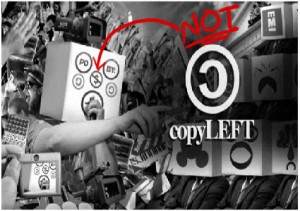
WTF, RIP?NC stands for Not Copyleft

Anyone introduced to the word “Copyleft” in that film won’t know what Copyleft actually means in terms of licenses.

I need a license that people understand. I’m tempted by the WTFPL but I would have to fork it to add a copyleft provision. The Do Whatever You Want And Don’t Restrict Others From Doing Whatever They Want Public License? WTFDROPL?

Are there any other useable Copyleft licenses out there that aren’t associated with non-commercial restrictions? I’m open to suggestions.

[Cross-posted from Ninapaley.com]

Share
{ 4 comments }

The Eagle Is Grounded

From Wired, Issue 12.02, February 2004

The Eagle Is Grounded

While America works to protect intellectual property, everyone else is innovating.

By Thomas Goetz

In the late 1960s, the US cargo shipping industry was in trouble. The 2,000-vessel fleet that ruled the seas after World War II had dwindled to fewer than 900. New technologies – containers, automated loading – were taking hold on foreign ships while America clung to old methods. As a result, other countries were transporting nearly 80 percent of worldwide traffic.

So the government threw a lifeline: the Merchant Marine Act of 1970, which provided new protections and massive subsidies for the industry. As President Richard Nixon described it, the act would “replace the drift and neglect of recent years and restore this country to a proud position in the shipping lanes of the world.”

Nathan Fox
Nathan Fox


It didn’t work. Today, US carriers handle barely 2 percent of international cargo. The industry is dominated by nations like Panama and Liberia, so-called flags of convenience, where regulations are lighter and costs lower.

The US fleet was a classic victim of the efforts to save it. Rather than adapt to new economics, the American industry suffocated under overregulation and protectionism. Now the job gets done – goods move efficiently from place to place – but it’s a rogue’s business, rife with ne’er-do-wells and pirates.

The US is in danger of repeating the mistake, this time with intellectual property. In the face of new technologies and competition, the US is toughening patent and copyright protections. It’s leaning on other countries – and its own citizens – to play by ever tighter rules. But if it’s not careful, the US will drive its intellectual property offshore into a shadow world that, like shipping, is replete with piracy and rogue states.

That world is fast approaching. As the thicket of protections for IP industries – primarily agriculture, pharmaceuticals, media, and software – grows in the US, alternative ways of thinking are flourishing overseas. Researchers in Australia and India are sidestepping agriculture patents held by the likes of Monsanto and DuPont to develop competitive technologies and foods (such as a high-protein potato) that are, by design, open and unrestricted. In pharmaceuticals, India is skirting patents to create generic AIDS drugs that are orders of magnitude cheaper than those made by the transnational drug companies (see Lawrence Lessig’s column on page 83). Media industries, meanwhile, are besieged by millions of MP3 traders and DVD bootleggers in open revolt against copyright protections.

And then there’s software. Entire nations are making the leap to Linux. Last year, China began installing the open source operating system on 500,000 computers, with perhaps 200 million more machines on the way. That’s bad for Microsoft but good for Linux, as China’s vast pool of programming talent turns to developing the software further. (As a monopoly, Microsoft has the same market effect as a spurious patent or overregulation – reducing innovation and increasing prices.)

Taken together, these developments demonstrate how an alternative culture is arising in our midst – or rather, outside it. They reflect the gulf between IP owners, with their rigid sense of controls, and those who would seek to use that intellectual property with all the flexibility afforded by technology – the Internet, in particular. And that’s not just a difference of opinion, it’s a technological generation gap. As Intel chair Andy Grove recently told The Washington Post, the US needs to reassess its conception of intellectual property “for an era that is the information age as compared to the industrial age.”

But so far, IP owners are doing all they can to lock in their old entitlements, pushing for increasingly restrictive laws and enforcement. The result: laughably broad patents (Monsanto claims to have rights to any and all genetic modifications to soybeans, for instance); the Digital Millennium Copyright Act (for five years used as a club to ward off technological innovations in software and media); and lately, patents awarded for software (even though it is already protected by copyright law). The MPAA and RIAA are even seeking permanent antitrust exemptions from Congress to more effectively defend against technology’s inevitable progress. The shipping industry tried that one, too.

This conflict sets the stage for a trade war on an unprecedented scale. Last fall’s World Trade Organization talks at Cancún failed in part because poor countries walked out in protest over US and EU intransigence on agriculture and drug patent issues. That’s just a sign of the strife ahead; those poorer nations could become the next flags of convenience for a more liberal conception of intellectual property.

There’s still time to avoid the shipping industry’s fate: American IP owners can stop demanding maximum and extreme protections. The US Patent and Trademark Office can stop taking a head-in-the-sand approach – last summer it strong-armed the World Intellectual Property Organization into canceling a discussion on open source projects – and instead use the WIPO to forge a global policy that works for all nations.

By taking a flexible approach to IP, companies could capitalize on the next wave of innovation rather than shirk from it. But wait too long and this ship will have sailed.


Thomas Goetz ([email protected]) is the articles editor at Wired.

Share
{ 0 comments }

Can Moral Rights Expire by Law?

From the Mises Blog

Can Moral Rights Expire by Law?


October 18, 2010 by Jeffrey Tucker

A Norwegian blogger has written what he believes to be a sweeping defense of “intellectual property” rooted in moral claims and natural rights. I always enjoy reading these pieces, if only for sport: it is interesting to see where the argument begins to fall apart, as it necessarily must. And this is because IP is a state-created right that cannot exist in purely voluntary exchange. It is a bit like a claim that the Post Office has the natural right to deliver mail: at some point in the argument for such a position, the writer will have to address the obvious reality that such a “right” cannot exist or be enforced apart from the use of bureaucracies, coercion, and the aggressive hampering of market competition.

The blogger’s hand is tipped only in the penultimate paragraph:

The limitation of such a declaratory law is that with time a work of fiction or a patent becomes so diffused into the culture that it is impossible to avoid them, and therefore all intellectual property rights must be time limited and expire.

No further elaboration on this point, but here you see the crucial issue. It makes no sense to limit a natural right or a moral right. If IP were a moral right, it should last forever. Otherwise, it would be like saying, I have no right to kill you unless you have lived far too long for you own good. Or: you have inviolable property rights unless you own too much stuff. There is a right or there is not. To approve term limits on IP gives the game away.

This blogger defends the statutory time limit on IP on grounds that once a “work” becomes “diffused into the culture,” there is probably no longer any point to IP enforcement (at least I think that is what he is saying) but the only way this could actually happen, according to the blogger’s own theory, would be through the mass violation of the rights of the creator, who, presumably, ought to be able to carefully track and account for all instances in which his intellectual property is permitted to be used by others, which is to say, he ought to be able to control the manner in which his idea/property becomes diffuse in the first place. A real owner would never lose control of his or her property in a way that which elicit a sanguine response. This would be like a person who said, well, this used to be my house some ten years ago, but now there are so many squatters and people living here, I might as well bail out and that’s fine!

Another intriguing aspect of this diffusion argument is that if we are to use this as a standard, the time limit on IP ought to be growing ever shorter over time with the development of communication technology. Perhaps it took 5 to 10 years in the 19th century for a work to become diffuse in the culture, so IP should only last that long. But the statutory term limit keeps growing longer, not shorter. Today, statutory claims on copyright can extend to as much as 170 years, whereas with existing communication technology, an idea can become globally diffuse in a day or even in a matter of minutes. Why shouldn’t term limits on IP, then, be reduced to only a few hours? [continue reading…]

Share
{ 5 comments }

A Thought Experiment about Patents and Taxes

In Reducing the Cost of IP Law, I argued that one improvement to the patent system (short of abolition) would be to eliminate injunctions and provie for a compulsory licensing system. As I noted there, the compulsory licensing approach is not new. Some countries impose compulsory licensing on patentees who do not adequately “work” the patent. I discussed provisions in US patent law that do permit compulsory licenses already in some situations.1 I was reminded of this when discussing with some friends a comment to this blogpost, Pirated Software Could Bring Down Predator Drones. The commentor stated: “Just declare the IP a state secret. The market value is then zero, as the company cant sell it legally. Buy it from the company for 1 cent. Then classify the contract as top secret. If the company complains, send the people to jail or gitmo.”

As I noted in the previous posts, the feds have the authority to license third parties to manufacture patented articles, without patent infringement liability; this was threatened in the Cipro anthrax drug a couple years ago. The feds then have to pay “compensation” to the patent holder. Something similar happens if the some federal agency issues a “secrecy order” for military or other reasons for a pending patent.2

It occurs to me that the very notion of a compulsory license for IP can help to illustrate how IP is an obvious transfer of wealth. Consider: under current law, the state grants a patent monopoly to some applicant. Then, the state can declare a compulsory monopoly (or issue a secrecy order), and pay you some compensation for this “taking”. Obviously this payment comes from tax payers. So the IP step can be seen as just an intermediate step to justify transferring money from everyone else to the patentee. It’s as if you tell the state you have an idea and the state takes money from others and gives it to you. Come to think of it, this is exactly the idea behind proposals for tax-funded “innovation” awards–proposed even by some libertarians (!).3 The point is that even when the state does not issue the compulsory license, they are simply deputizing the patentee to go out and extort the money himself; it’s like taxation.

(Incidentally, in An Objectivist IP Argument for Taxation, I provide another argument for why IP could be used to justify taxes.)

  1. See Ciprofloxacin: the Dispute over Compulsory Licenses; Tom Jacobs, Bayer, U.S. Deal on Anthrax Drug, Motley Fool (Oct. 25, 2001); Compulsory Licensing in the US. See also Kinsella, Brazil and Compulsory Licenses, Mises Blog (June 8, 2007); Kinsella, Condemning Patents, Mises Blog (Feb. 27, 2005). []
  2. See The Secrecy Order Program in the United States Patent & Trademark Office; 35 USC ch. 17 §§ 181, 183. []
  3. See my posts What’s Worse: $80 Billion or $30 Million?; Libertarian Favors $80 Billion Annual Tax-Funded “Medical Innovation Prize Fund”; $30 Billion Taxfunded Innovation Contracts: The “Progressive-Libertarian” Solution; Re: Patents and Utilitarian Thinking Redux: Stiglitz on using Prizes to Stimulate Innovation, Mises Blog (Dec. 28, 2006) and Patents and Utilitarian Thinking Redux: Stiglitz on using Prizes to Stimulate Innovation (Sept. 19, 2006). []
Share
{ 1 comment }

The following is a lightly-edited transcript of my speech, “How Intellectual Property Hampers Capitalism,” presented at the Mises Institute Supporters’ Summit 2010 (Oct. 8-9 2010, Auburn Alabama) (audio and video).

Share
{ 1 comment }