
[PFS Blog cross-post]
 I have occasionally corresponded with Deirdre McCloskey, and met the good doctor in person at FreedomFest in Rapid City, South Dakota (with my buddy Juan Carpio) in July 2021.
I have noted before McCloskey is weak on IP, being: “somewhat skeptical of patent and copyright, but not in favor of abolition and expresses no principled or coherent view.”1
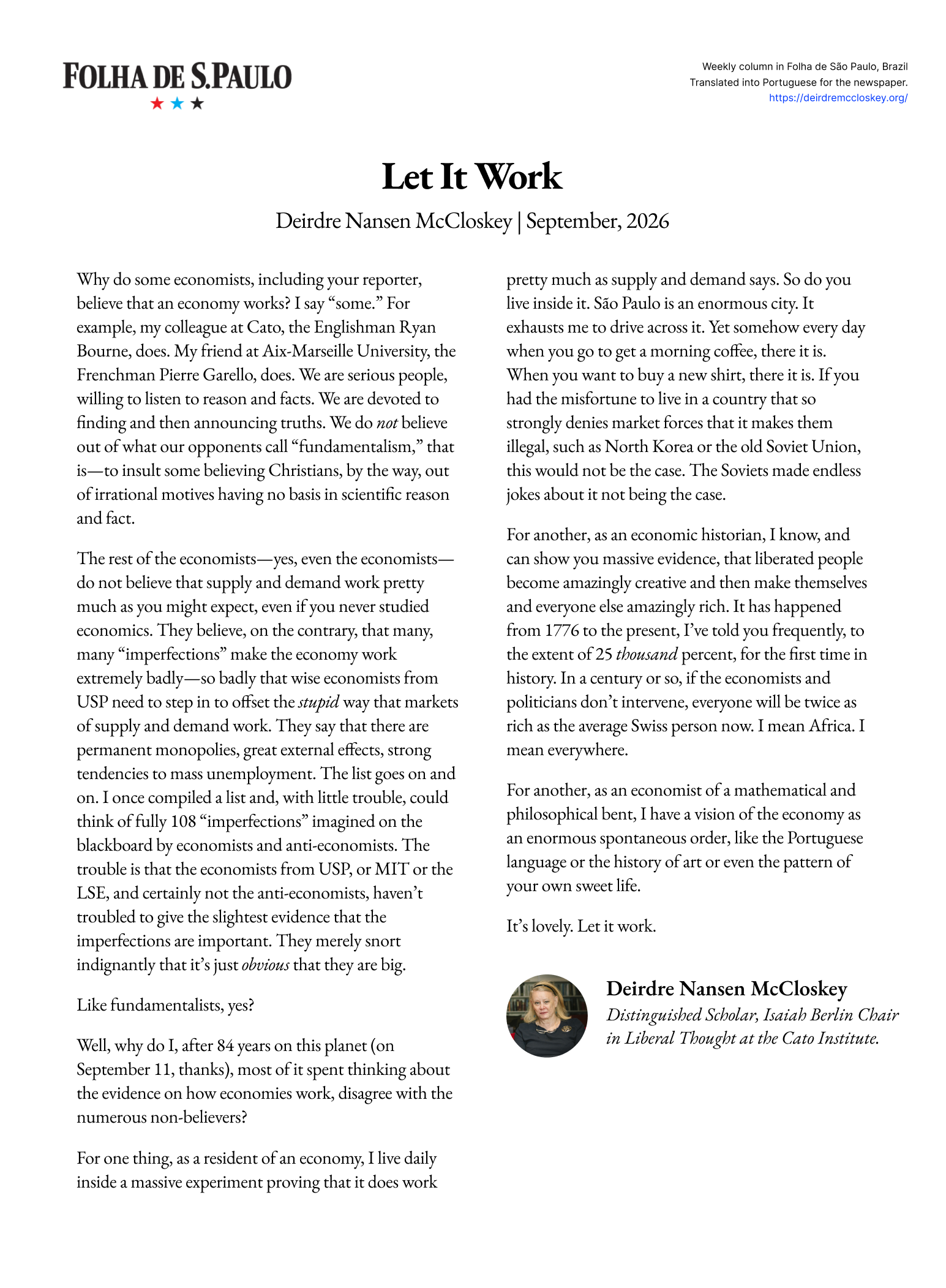 I sent this email the other day after seeing column above posted on Twitter. I got no response (as expected) so post my email here.
Related
- Email to Richard Epstein: Tension Between Takings Framework and IP Views
- IP Law and “Market Failure”
- Intellectual Property Advocates Hate Competition
- Libertarian and IP Answer Man: Artificial Intelligence and IP
- Whereupon Grok admits it (and AI) is severely gimped by copyright law.
- Tabarrok: Patent Policy on the Back of a Napkin
- Optimal Patent and Copyright Term Length
- Yaron Brook on the Appropriate Copyright Term
- Tom Bell on copyright reform; the Hayekian knowledge problem and copyright terms
- The China Stealing IP Myth
- The Overwhelming Empirical Case Against Patent and Copyright
- Classical Liberals, Libertarians, Anarchists and Others on Intellectual Property
- McCloskey, “Quit Worrying and Learn To Love Trade With China: Fretting over deficits and intellectual property will do no good and much harm.,” Reason (April 2019)
Subject: IP and market failure query
Deirdre,
I saw your recent column
https://x.com/DeirdreMcClosk/
You write:
“The rest of the economists—yes, even the economists— do not believe that supply and demand work pretty much as you might expect, even if you never studied economics. They believe, on the contrary, that many, many “imperfections” make the economy work extremely badly—so badly that wise economists from USP need to step in to offset the stupid way that markets of supply and demand work. They say that there are permanent monopolies, great external effects, strong tendencies to mass unemployment. The list goes on and on. I once compiled a list and, with little trouble, could think of fully 108 “imperfections” imagined on the blackboard by economists and anti-economists. The trouble is that the economists from USP, or MIT or the LSE, and certainly not the anti-economists, haven’t troubled to give the slightest evidence that the imperfections are important. They merely snort indignantly that it’s just obvious that they are big.”
You are right here. These economists basically believe in market failure and that the state can jump in to patch the market to make it more optimal. You are right to criticize this.
But in my view the same is true of the theories of “free market” economists in favor of intellectual property law. Its proponents believe that the free market fails and leads to an underproduction of intellectual goods, and that the state can address this “problem,” it can “patch” it by adding patent and copyright. The theory goes that it’s too hard to compete against competitors of such goods, too hard to make a profit, so there will under production, i.e. market failure; so let’s issue IP law to make it harder to compete with sellers of patented inventions or copyrighted works; and thus enable these producers to temporarily charge monopoly prices, and thus reduce the underproduction of such goods.
Isn’t this the same fallacy you are criticizing? See “IP Law and “Market Failure”; Intellectual Property Advocates Hate Competition.
Shouldn’t you come out more forcefully against IP instead of thinking you see a market failure or imperfection that needs to be “patched” by artificial state-issued monopoly IP privileges? I have in mind here where you are critical of strong IP law but still favor some version of it. You write:
Economists would be satisfied with a rough-and-ready rule of, say, a 10-year monopoly. But asserting an expansive right to intellectual property, which Congress then regularly extends in order to preserve the privileges of drug companies and the Walt Disney Corporation, is no solution.
Yes, their expansive right to IP is no solution—and there is no market failure for these patches to “solve.” But your 10 year “rough-and-ready” rule, while not as bad as their ~17 year rough-and-ready patent term, is also no solution for this non-problem.
(Incidentally, I think you conflate patent and copyright, which is one reason the economist should be cautious endorsing socialistic regulatory schemes one does not fully understand. You write:
“Economists would be satisfied with a rough-and-ready rule of, say, a 10-year monopoly. But asserting an expansive right to intellectual property, which Congress then regularly extends in order to preserve the privileges of drug companies and the Walt Disney Corporation, is no solution.”
This is confused because you had been talking about pharma and thus drug patents. The patent term is approximately 17 years; you are calling for 10 for some reason, which is a bit shorter but not much. It can be extended by up to 5 years for time lost due to the FDA delays. This is based on the Hatch-Waxman Act of 1984. The patent law has been about 14-17 years since the beginning of the country and is still about that, albeit with a possible 5 year extension. You write “which Congress then regularly extends in order to preserve the privileges of drug companies and the Walt Disney Corporation, is no solution”–you are mixing patent and copyright together. The copyright term was originally 14, renewable once; now it is life of the author plus 70 years, for over 100 years in most cases. It was previously life + 50 but was extended thanks to Sonny Bono when Mickey Mouse’s copyright was about to expire. I actually doubt it will be extended any more; they have shot their wad, esp. now that IP is threatening AI. See Libertarian and IP Answer Man: Artificial Intelligence and IP; Whereupon Grok admits it (and AI) is severely gimped by copyright law.)
There is no optimal patent or copyright term—other than zero. Nevermind Tabarrok’s baseless assertions. See “Tabarrok: Patent Policy on the Back of a Napkin”; Optimal Patent and Copyright Term Length; Yaron Brook on the Appropriate Copyright Term; Tom Bell on copyright reform; the Hayekian knowledge problem and copyright terms.
Incidentally, the “China is stealing our IP” is so tedious and wrong. See The China Stealing IP Myth.
Deidre, I think you really know all this. You know that there is no basis whatsoever for this versus that patent or copyright term. You know that people who favor IP have no good arguments for it. You know they just repeat the same slogans and conflate “innovation is good” with “thus we need IP law.” You know that they think that because the Constitution allows IP law, it must be good. But you know that it’s all bullshit and that the arguments for it are shallow and dishonest and incoherent and insincere. I really believe you know this by now.
I think you would be doing a great service for liberty if you would come out for once and for all against all IP law, or at least retract your call for a 10 year patent term and call for zero instead. There is not even any empirical evidence in favor of any patent term at all. See The Overwhelming Empirical Case Against Patent and Copyright.
What say ye?
- Kinsella, Classical Liberals, Libertarians, Anarchists and Others on Intellectual Property, referring to Deirdre Nansen McCloskey, “Quit Worrying and Learn To Love Trade With China: Fretting over deficits and intellectual property will do no good and much harm.,” Reason (April 2019). [↩]