≡ Menu

Anti-Piracy Lawyers Accuse Blind Man of Downloading Films

As reported on Slashdot (h/t Peter Surda):

Anti-Piracy Lawyers Accuse Blind Man of Downloading Films

Posted by Soulskill
souravzzz writes “As the mass-lawsuits against BitTorrent users in the United States drag on, detail on the collateral damage this extortion-like scheme is costing becomes clear. It is likely that thousands of people have been wrongfully accused of sharing copyrighted material, yet they see no other option than to pay up. One of the cases that stands out is that of a California man who’s incapable of watching the adult film he is accused of sharing because he is legally blind.”
Share
{ 0 comments }

Motorola: Enemy or Friend of Google?

Masnick's Smartphone Lawsuit Diagram

Masnick's Smartphone Lawsuit Diagram

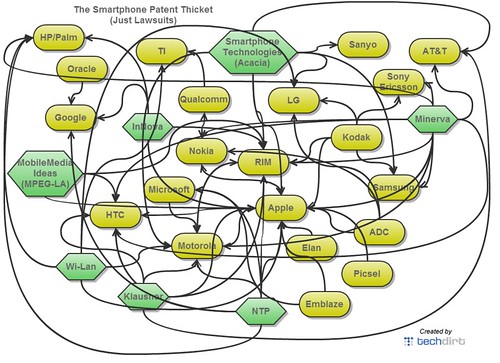
So try to follow the bouncing ball of this gargantuan patent-caused waste of energy and resources.

First, Google’s Android smartphone platform is under attack from a number of competitors, all using patents against Android–including competitors Apple (iPhone), Microsoft (Windows phone), RIM (Blackberry), and Motorola, as well as Samsung.1 (The diagram above right is an improved version, by Mike Masnick, of earlier, flawed diagrams depicting patent lawsuits in the smartphone space, shown in miniature below.)
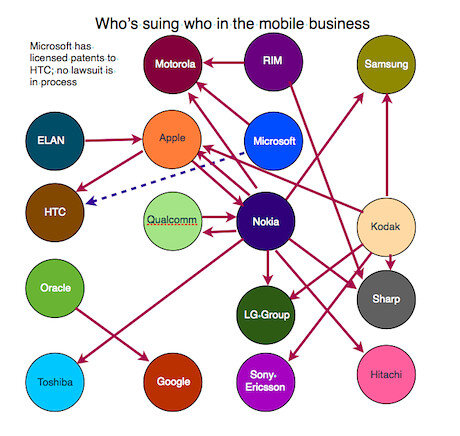
Who's suing who in the mobile business--TechdirtNow the Samsung part is a mess: apparently Apple sued Samsung for patent infringement, as part of its attack on the Android platform. It seems Apple needs the state’s help to fight off competition. And then Samsung strikes back against Apple with its own patent infringement claims. And at the same time, another division of Samsung is one of Apple’s key suppliers of SSD drives, memory chips, and displays. Got it? Apple sues its key supplier, to stop Android competition; its key supplier sues it back; and yet the arrangement between Apple and the Samsung division supplying it with these components continues on. Wow.

Meanwhile, Apple is also at the receiving end of patent aggression, e.g. the lawsuits by Lodsys, the Intellectual Ventures-connected patent troll, who is suing Apple’s iOS developers, and the recent suit by HTC.

As for Microsoft, which is also attacking Android with patent threats and suits, it has also been on the receiving end of patent attacks, recently losing a $300 million patent judgment against i4i.2

Google, so far reluctant to go on the patent offensive, has been trying to acquire more patents to defend itself from the onslaught of suits by its competitors. If it has enough patents in its arsenal, then Apple and Microsoft might lay off suing Google, for fear of a counter-patent suit. Which is why Google’s $3 billion bid was not enough to acquire bankrupt Nortel’s 6000 patents: a “consortium” (hello, FTC!) of its competitors, including Apple, Microsoft, and RIM, obtained the Nortel patents for $4.5 billion.3 (RIM, apparently now seeking to use patents to hammer the Android competitor, of course was previously forced to pay $600M to NTP for patent infringement; and it has recently made a licensing deal with Intellectual Ventures for 30,000 IP assets–whether this is defensive, or for offensive purposes, I can no longer keep track.)

Source: New York Times

Back to the subject of this post. A recent entry into the patent club using the club of patents to hammer Google’s Android platform is Motorola.4 And yet today it’s reported that Google is buying Motorola Mobility for $12.5 Billion. Yet another enemy-friend deal. The WSJ says that the purpose of the acquisition is to “make Google more competitive in the mobile-computing market.” Yet, can it be doubted that a major reason for this huge purchase is to “give Google control of Motorola Mobility’s attractive patent portfolio after the Internet giant recently missed out on a bid for Nortel Networks Corp.’s portfolio”? This follows on the heels of Google’s purchase of 1,000 patents from IBM, and its possible acquisition of Interdigital patents.5 (Apple Apple has also sued Motorola for patent infringement.)

So let’s get this straight. Apple and Samsung are suing each other, while Apple relies on another division of Samsung for key parts. Apple and Microsoft–and apparently RIM–are using patents aggressively to stop competition, despite each having been hammered hard by others (including patent trolls) for patent infringement. Google, who seems to want patents for defensive purposes, lost out on the Nortel patent shield (acquired by its competitors Apple, RIM, Microsoft, etc.), but has paid billions of dollars now for patents from IBM and even from Motorola (recently its patent enemy), and may pay more for Interdigital’s patents–in a continuing escalation of the patent war in the smartphone segment of the market.

Which, of course, is just one part of the market. Similar battles are being fought all the time, on all different fronts. I wonder if this is what the Founders had in mind when they put that unfortunate patent clause in the US Constitution?

[mises]

  1. Android in trouble; Samsung strikes back at Apple with ten patent infringement claims; Apple sues Samsung over Galaxy products; Microsoft Demands Samsung Pay $15 Royalties For Every Android Phone It Sells; Android Patent Trouble Worsens: Motorola Considers Collecting IP Royalties; see also other posts about the Android mess here. []
  2. Microsoft Demands Samsung Pay $15 Royalties For Every Android Phone It Sells; i4i recently won $300M from Microsoft. []
  3. Apple, Microsoft, Sony, RIM et al. won for $4.5B. []
  4. Android Patent Trouble Worsens: Motorola Considers Collecting IP Royalties []
  5. Google buying more patents to defend itself. []
Share
{ 3 comments }

The Great Dr. Pepper Feud (Trademark)

From Jeff Tucker, at the Mises Blog:

A number of stories online chronicle the fight between headquarters and the Dr. Pepper plant in Dublin, Texas, over whether this local plant can market its own drink made not with corn syrup but sugar. See this story, for example. But correspondent David Blackstone gets it right: this is really a story of the injustice of “intellectual property”; it is threatening the way of life of people in this small town (I’ve driven through many times). It is also an interesting and unusual case. Usually the issue with trademark is how a company can beat back impersonators. But what happens when the company itself becomes the impersonator and its franchises want to stick to the real thing?

One of the most beautiful treasures of Texas is being threatened. I’m talking about Dublin Dr Pepper, the national soda of Texas, made in tiny little Dublin, TX, a beautiful town of Texas heritage. Dublin’s main industry is its 120-year-old Dr Pepper bottling plant.

Thanks to government intervention, like a steep tariff on sugar, almost all soda in America is now sweetened with high fructose corn syrup instead of cane sugar. A side by side comparison shows that the taste is absolutely not the same. Corn syrup “burns”; sugar is “smooth.” Old-timers remember sodas tasting different in years gone by because the sodas were different. And devoted aficionados know how to get “the real thing”: you can purchase Mexican or Passover Coke to get cane sugar Coca-Cola; PepsiCo recently created “Mountain Dew Throwback” and “Pepsi Throwback,” and for years the Dr Pepper bottling plant of Dublin, TX has built a devoted following.

When all other bottlers were switching to high fructose corn syrup due to cost, the owners of the Dublin Dr Pepper plant stubbornly stuck by cane sugar. It meant they would make less money on each can or bottle sold, but they felt that the way forward was to not compromise quality. Unfortunately the century-old agreement for the Dublin plant limited their distribution to a small area of just a few counties, but for years retailers from outside of the territory would acquire the product and sell it to their customers. Even the Dr Pepper main company itself promoted Dublin Dr Pepper, as the original formula.

The town of Dublin throws a blowout party for Dublin Dr Pepper every year in June. For a week the town’s name is legally changed to “Dr Pepper, TX” and road signs are changed to read “Dr Pepper, Texas Population: 1024? This year the plant observed its 120th birthday at the party.

But shortly afterward, the main Dr Pepper corporation filed a lawsuit against Dublin Dr Pepper. They seek to use the courts to force the Dublin plant to: stop selling outside of their six county territory, accept corporate labeling and packaging for their product, and cease use of the name “Dublin Dr Pepper” (even though corporate Dr Pepper has been using and promoting this name for years!).

Of course, were it not for the ridiculous and immoral idea of “intellectual property,” the Dublin Dr Pepper bottling plant would have the right to make whatever they want, call it whatever they want, package it however they want, and sell it wherever they want.

My family adores Dublin Dr Pepper and are incensed to see its producers aggressed against. Just one more beautiful treasure whose existence is threatened by government intervention.

Share
{ 0 comments }

Y Combinator co-founder Paul Graham’s 2006 essay “Are Software Patents Evil?” opens with “if you’re against software patents, you’re against patents in general.”

Yep.

Share
{ 3 comments }

Intellectual Property and Economic Development (Video)

My Mises University 2011 lecture, Intellectual Property and Economic Development (July 27, 2011), is now available in video. Slides and audio available here.

Share
{ 0 comments }

Sent to me by Allen Lewis, CFA, a post from Financial Advisor magazine about a financial planning patent. Who says software patents or patent trolls are the main problem in the patent system, or that business method patents are dead?

Business method patents were approved in the 1998 case State Street Bank & Trust Co. v. Signature Financial Group Inc., which I wrote about in “A New Traffic Cop at Intersection of Patents and Financial Inventions” (Duane Morris website version), The Legal Intelligencer [Philadelphia], Thurs., Sept. 3, 1998. As I wrote then:

As a result of this decision, more innovations of economists, accountants, bankers and the like will be protectable by patent. Thus, the financial services and related industries will start to adopt some of the patent-related practices of the electronics industry and other technology-intensive industries.

For example, proposed new financial products and customer services will be reviewed for potential patentability, and will be the subject of patent applications. Financial services companies will be in the position of reviewing employment agreements with their creative employees to ensure that patent rights are properly vested in the company.

New developments will also be reviewed for possible infringement of existing patents. Patent licensing and infringement litigation will likely become commonplace.

Yep.

However, in 2010 the Supreme Court’s Bilski decision, while not explicitly overruling State Street and business method patents, Bilski rejected State Street‘s “useful-concrete-tangible test,” arguably causing many or mostbusiness method patents to be invalid. So, expect the defendants here to rely heavily on Bilski in arguing that the patents asserted against them are no longer valid.

Here’s an excerpt from the post:

Lawsuit Against UBS Has Far-Reaching Implications For Advisors

UBS Financial Services Inc. is being sued for two patent infringements in a case some experts say could affect the entire financial planning industry.

Wealthcare Capital Management, which serves individual investors, financial advisors and institutions, filed suit against UBS in U.S. District Court in the Southern District of New York for using what it contends are its own  proprietary processes for financial planning.

The two patented processes involved in the suit assess a client’s long-term financial goals and then use a capital-market modeling technique to determine how these goals can be achieved.

Wealthcare has offered in the past to license the company’s advisory system to UBS, but the Switzerland-based UBS has declined, says David B. Loeper, founder and chief investment officer of Wealthcare Capital Management. Loeper is chairman of Financeware Inc., the parent company for Wealthcare and its intellectual property rights arm, Wealthcare Capital Management LP LLC.

The suit seeks monetary damages and an injunction banning UBS from using the financial advising systems that are part of programs, including MoneyGuidePro.

Read more>>

Share
{ 0 comments }

From Jeff Tucker at Mises blog:


It was a close call, but “A court on Wednesday refused to grant a preliminary injunction requested by the Christian Louboutin company against Yves Saint Laurent, alleging trademark infringement on shoes that featured red soles suspiciously similar to those of Louboutin. The decision not only cleared the way for YSL to continue producing its shoes, but also seemed to give coverage to other shoe manufacturers who may want to add a scarlet underpinning to their own future models”

Of course under strict IP model, the court would have granted the injunction. No one could emulate another and commercially profit. One business could not directly compete with another that had any idea first. The government would protect all thoughts as owned ideas and prohibit learning and competition through the whole of society. We would all be mandatory sealed off as isolated idea owners, clinging to what we could think up on our own, refusing to pass on those ideas for fear of theft, and carefully refusing to look at anything or listen to anything for fear that we might be influenced in someway. There would be true property rights in ideas. Then free enterprise as we know it would collapse, and society along with it.

Share
{ 0 comments }

What If Tim Berners-Lee Had Patented The Web?

Great–and scary–alternate history from Mike Masnick at Techdirt:

What If Tim Berners-Lee Had Patented The Web?

from the it-would-be-quite-different dept

You may have seen the stories a week or so ago about how it was the 20th anniversary of Tim Berners-Lee putting up the first web page. While many, many people still confuse “the web” with “the internet,” Berners-Lee’s creation really did help take what was mostly a system used by a few nerds (myself include) and add the elements that made it possible to go mainstream in a big, big, big way. And while many folks are talking about just how amazingly far we’ve come in just 20 years, Marco Arment (the InstaPaper guy) reminds us that if Berners-Lee had sought and received a patent for the web, it would just now be coming out of patent coverage.

That sets up an interesting thought experiment. Where do you think the world would be today if the World Wide Web had been patented? Here are a few guesses:

  • Rather than an open World Wide Web, most people would have remained on proprietary, walled gardens, like AOL, Compuserve, Prodigy and Delphi. While those might have eventually run afoul of the patents, since they were large companies or backed by large companies, those would have been the few willing to pay the licensing fee.
  • The innovation level in terms of the web would have been drastically limited. Concepts like AJAX, real time info, etc. would not be present or would be in their infancy. The only companies “innovating” on these issues would be those few large players, and they wouldn’t even think of the value of such things.
  • No Google. Search would be dismal, and limited to only the proprietary system you were on.
  • Most people’s use of online services would be more about “consumption” than “communication.” There would still be chat rooms and such, but there wouldn’t be massive public communication developments like blogs and Twitter. There might be some social networking elements, but they would be very rudimentary within the walled garden.
  • No iPhone. While some might see this as separate from the web, I disagree. I don’t think we’d see quite the same interest or rise in smartphones without the web. Would we see limited proprietary “AOL phones?” Possibly, but with a fragmented market and not as much value, I doubt there’s the necessary ecosystem to go as far as the iPhone.
  • Open internet limited by lawsuit. There would still be an open internet, and things like gopher and Usenet would have grown and been able to do a little innovation. However, if gopher tried to expand to be more web like, we would have seen a legal fight that not only delayed innovation, but limited the arenas in which we innovated.

What else do people think might have happened? I’d also argue that Berners-Lee himself would hardly be a name that most people knew about. When you think about just how limiting a world this would have been compared to what we have today… and then begin to wonder about what “web-like” invention of today is now locked up under patents, it really makes you wonder just how much we’ve held back innovation in this arena.

Share
{ 0 comments }

Mike Masnick notes in If You Have To License The Software You Claim Infringes On Your Patent, How Is Your Patent Valid? that:

It’s certainly beginning to feel like we’re hitting something of an inflection point in getting people to realize just how incredibly broken the patent system is. There has been a flurry of mostly excellent news stories from a variety of sources picking up on this and detailing specific cases of a broken patent system. The This American Life episode certainly helped kick off a lot of attention, but it’s definitely been growing in other areas as well. The latest entrant into the field is an excellent article from Ben Popper over at The Observer’s BetaBeat site, which focuses on one specific smaller patent troll, a company called IQ Biometrix, and what it’s done over the years… which is basically nothing productive. However, it does have two hugely questionable patents: 7,289,647 for a “system and method for creating and displaying a composite facial image” and 6,731,302 for a “method and apparatus for creating facial images.”

The patent proponents do indeed seem to be on the ropes. This is acknowledged by one guy offering a pathetic, tepid defense of the patent system, in Everybody’s Angry About Patents, But They’re Actually A Good Thing, which asserts, groundlessly:

it’s easy to lose sight of what patents actually do: they force inventors to disclose information about an invention to the public. In exchange, they get a time-limited monopoly on that invention.

The end result is MORE innovation, not less. There’s no reason to throw the whole system out just because we don’t like the way some companies are using it today.

As I commented there,

I’m a practicing patent attorney, and I can assure you that your comment: “The end result is MORE innovation, not less” is completely without merit. I provide extensive quotes from various papers in this post, https://c4sif.org/2011/05/the-economist-on-the-american-patent-system/ — there is no evidence at all that patents result in “more innovation”. In fact, the evidence is TO THE CONTRARY: it is clear that patents reduce innovation.

And this ought to be obvious: patents are nothing but a monopoly privilege granted by an inefficient, bureaucratic state agency to protect the lucky recipients from competition. They are anticompetitive. The entire patent system should be abolished, as I argue in various articles collected at https://c4sif.org/resources/

See also the various studies collected here http://blog.mises.org/10217/yet-another-study-finds-patents-do-not-encourage-innovation Yet Another Study Finds Patents Do Not Encourage Innovation.
Share
{ 0 comments }

Millions and Millions of Patents: Oh, the Humanity!

2mIn a nausea-inducing post, the US Patent and Trademark Office is trumpeting on its website the millions of patents it has issued. As the short version states: “The USPTO has issued millions of patents over the years. Number 1,000,000 was issued 100 years ago this month. Number 2,000,000 was issued in 1935. Take a closer look at these “million milestones” from patent history.” This disgusting puff-piece, of course, ignores the horrible cost of the patent system, and naturally, conflates innovation and invention, with patenting.

Incidentally, the PTO issues new patents every Tuesday–5,120 little state grants of anti-competitive monopoly privilege were issued this week, two days ago, with the latest being 7,996,916 for Process verification, claim 1 of which grants some Reno, NV company, IGT, a monopoly on this process:

1. A method of verifying the authenticity of gaming software stored in RAM of a gaming device, said gaming device having a gaming controller for executing gaming software programs at the gaming device, the method comprising: identifying a first gaming software program currently stored in the gaming device RAM, wherein the first gaming software includes a first portion of executable code stored in the gaming device RAM; determining a first identifier associated with the first portion of executable code; identifying, using the first identifier, a second gaming software program stored on a file storage device, wherein the second gaming software program has associated therewith an identifier which matches the first identifier, and wherein the second gaming software program includes a second portion of executable code; verifying an authenticity of the first gaming software program, wherein verification of the authenticity of the first gaming software program includes comparing bits of the first portion of executable code to bits of the second portion of executable code, and determining whether any portion of the second portion of executable code matches the first portion of executable code; and generating an error event if it is determined that no compared portion of the second portion of executable code matches the first portion of executable code.

With the PTO granting about 5000 patents a week, and given that we are only 3,084 patents away from 8,000,000, expect that number to be hit next Tuesday, Aug. 15, 2011.

Incidentally, in case you are wondering, here are the other million-patent milestones since the first two the PTO highlights:

Notice the time to issue another million patents is decreasing: about 110 years for the first million, 24 years for the second million, then 26, 15, 8, 7, and 5. So you can see that, just the flood of legislation and regulations (including a mountain of IP law and treaties), we can expect to be increasingly inundated with a flood of patents (especially with economically confused patent shills arguing for a “Patent Stimulus Plan” to get the economy roaring–calling for President Obama to “issue an Executive Order directing the Patent Office to start allowing patents”. Who knows. Maybe we are headed for an IP singularity instead of the technological one.

Anyway, here is the full puff piece–if you can stand it:

Millions of Patents

The United States issues patents by the millions. Our patent system was created to support intellectual property, which is recognized in our Constitution: “To promote the Progress of Science and useful Arts, by securing for limited Times to Authors and Inventors the exclusive Right to their respective Writings and Discoveries.”

Under the current numbering system for patents, number 1 was issued in 1836. A million patents later, number 1,000,000 was issued by the United States in 1911. The U.S. Patent and Trademark office will issue patent number 8,000,000 in 2011. In the coming weeks we’ll take a look at some of these “milestone millions” from over the years.

Patent no. 1,000,000 – August 8, 1911

Patent number 1,000,000 was issued to Francis H. Holton of Akron, Ohio for his improvement in vehicle tires to make them more durable and puncture resistant. Click on the patent drawing below to see a larger version. Or to read the complete patent, click on the description to open a pdf file.

Drawing of Patent no. 1,000,000 First page of patent no. 1,000,000

[continue reading…]

Share
{ 0 comments }

Techcrunch: Android Patent Trouble Worsens: Motorola Considers Collecting IP Royalties. (h/t Rob Wicks) Yet another patent threat (in addition to those from Apple and Microsoft and who knows who else) to Android. I sure love my iPhone but I’m feeling ickier and ickier using it, since part of its success and lack of competition is Apple’s use of patents, instead of superior products, prices, and service, to crush its competition.

Share
{ 1 comment }

El secreto de Coca-Cola, Google e Inditex

Nice piece by Manuel Llamas at Instituto Juan de Mariana, El secreto de Coca-Cola, Google e Inditex (in Spanish), about the illegitimacy of patent and copyright, and how it is unnecessary, using the case of Coca-Cola’s secret formula and Google’s business strategy as illustrative ejemplos. An interview with a Coca-Cola Company executive shows that even trade secret law is not really needed, since even if the secret leaked out the company has other advantages–distribution, reputation, advertising, other products, etc. (Plus, it appears the secret has already leaked out.)

Share
{ 0 comments }

Death Penalty for Pirating Fabric Designs in France

Breaking on the wheel for violating King-granted monopoly privileges of his cronies

Jeff Tucker has a Mises blog post up (see below) about how the death penalty was imposed in pre-revolution France a few centuries ago. As Tucker explains, “Some [fabric] patterns were more popular than others, and to get some additional revenue to the crown’s tax coffers, the King sold a monopoly on these patterns to selected members of the nobility, who in turn could charge an arm and a leg for them (and did so).”

As noted here, the penalty for unauthorized copying was literally torture and death–e.g., breaking on the wheel.

In today’s world, the failure and injustice of modern IP law has led to more and more piracy, and, like the failed drug war, in escalating penalties — bans from the Internet, draconian damage awards, even jail terms, and so on (see, e.g., The Ominous PROTECT IP Act and the End of Internet Freedom). How long before the death penalty is imposed in a futile attempt to stop people from freely using knowledge, learning, emulating, and competing?

And, ominously, the fashion industry is urging the re-imposition of a type of copyright in fashion design. I guess this is all a disproof of the Whig theory of history…

Here’s Tucker’s post:

Most people assume that tougher penalties deter crime, but there is reason to doubt it.

Here is a case from before the French Revolution.

The copy monopoly in those days concerned fabric patterns. It was in France, prior to the revolution. Some patterns were more popular than others, and to get some additional revenue to the crown’s tax coffers, the King sold a monopoly on these patterns to selected members of the nobility, who in turn could charge an arm and a leg for them (and did so).

But the peasants and commoners could produce these patterns themselves. They could produce pirated copies of the fabrics, outside of the nobility’s monopoly. So the nobility went to the King and demanded that the monopoly they had bought with good money should be upheld by the King’s force.

The King responded by introducing penalties for pirating these fabrics. Light punishments at first, then gradually tougher. Towards the end, the penalty was death by public torture, drawn out over several days. And it wasn’t just a few poor sods who were made into public examples: sixteen thousand people, almost entirely common folk, died by execution or in the violent clashes that surrounded the monopoly. In practice, everybody knew somebody who had been horribly executed for pirating.

Here’s the fascinating part:

Capital punishment didn’t even make a dent in the pirating of the fabrics. Despite the fact that some villages had been so ravaged that everybody knew somebody personally who had been executed by public torture, the copying continued unabated at the same level.

I have doubts about these numbers. In any case, A.R.J. Turgot wrote the following in praise Gournay: “He could not see why this piece of cloth, for failing to conform to certain regulations, should be cut up into fragments of three ells in length, and why the unfortunate man who had made it should be ordered to pay a penalty, enough to reduce him and his family to poverty. He could not conceive why a workman, when making a piece of cloth, should be exposed to risks and expenses from which an idle man was exempt. He could not see of what use it might be that a manufactured piece of cloth should involve legal procedures and tedious discussions in order to establish whether it conformed to an extensive system of regulation, often difficult to understand, nor did he think that such discussions ought to be held between a manufacturer who cannot read and an inspector who cannot manufacture, nor that that inspector should yet be the final judge of the fortune of the unlucky man, etc.”

Share
{ 2 comments }

Mises Academy Course: “Libertarian Controversies”

Next month I’ll be teaching a new Mises Academy course,”Libertarian Controversies.” This is my fourth Mises Academy course (the previous three are Libertarian Legal Theory, Rethinking Intellectual Property: History, Theory, and Economics, and The Social Theory of Hoppe), and my fifth time teaching there (I have reprised the IP course once).

From the course page:

Modern libertarianism is a young, developing and vibrant science. Variants includes classical liberalism, minarchism, and, in its most rigorous form, anarcho-Austrian libertarianism. Libertarians of various stripes are influenced by utilitarian, pragmatic and natural law theories, and by thinkers including Ayn Rand, Hayek, Rothbard, Mises, and others. For decades there has been vigorous debate among different camps of libertarians about a host of controversial issues, from the foundation of rights to the nature of government, and about concrete issues such as abortion, strategy and activism, living in an unfree world, anarchy v. minarchy, punishment and restitution, and so on. In this course, libertarian legal theorist Stephan Kinsella will explore a variety of libertarian misconceptions and controversies, from an Austro-libertarian perspective.

In the discussion about misconceptions, Kinsella will identify a number of common libertarian mistakes, confusions, fallacies or flawed reasoning and propose a solution or more consistent approach. Issues to be discussed include: creation as a source of property rights; labor as being owned; unintentional equivocation (harm, authority, hierarchy, etc.); alienability and voluntary slavery; [continue reading…]

Share
{ 0 comments }