 I’ve been alerted to the fact that several of yesterday’s SOPA blackout pages had links to the audio book version(narrated by Jock Coats) of my book Against Intellectual Property, such as the site for Mars Explorer.
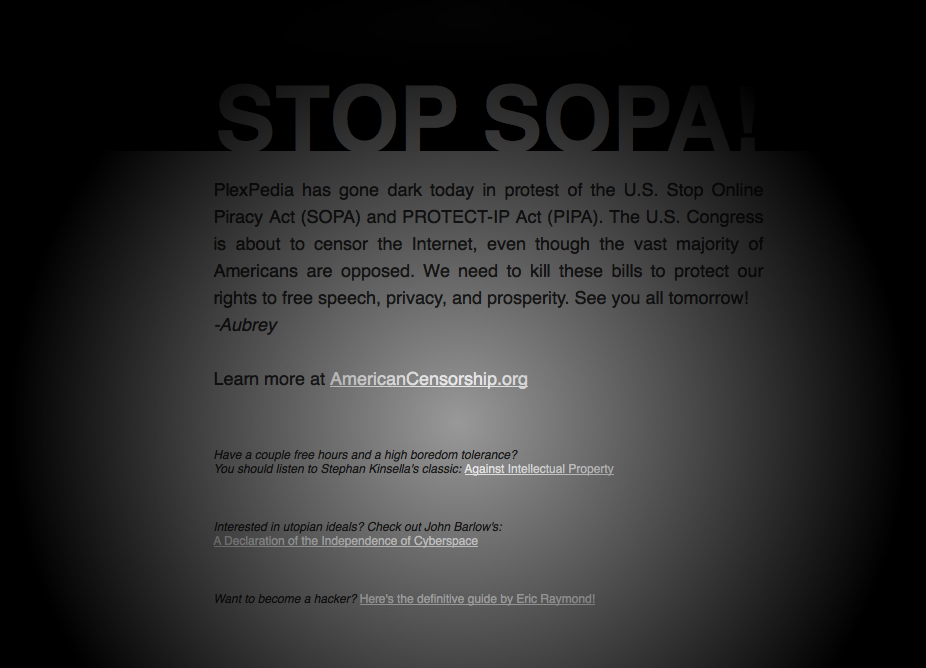

I’ve been alerted to the fact that several of yesterday’s SOPA blackout pages had links to the audio book version(narrated by Jock Coats) of my book Against Intellectual Property, such as the site for Mars Explorer.
Sheldon Richman has a really fantastic, concise, well-written and tightly reasoned essay in The American Conservative explaining why intellectual property — patent and copyright — is illegitimate, and “enforces a monopoly over the mind.” From the Jan. 1, 2012 issue:
Intellectual property enforces a monopoly over the mind.By Sheldon Richman | January 18, 2012
Staunch advocates of private property might be expected to support “intellectual property rights”—patents and copyrights—but these days that expectation is more than likely to be wrong. IP has come in for a thrashing from libertarians, among others, in the last few years, and it may be all over but the funeral.
The issue can be viewed from three vantage points: moral, economic, and political. The pro-IP lobby tends to conflate the first two, moving back and forth between assertions about justice and economic incentives. Their case is something of a moving target, so let’s break it down.
The moral claim is that an inventor has an exclusive, enforceable right to his useful, novel application of an idea, while an author or composer has such a right to his original work or expression. IP specialists insist that what is owned is not an idea per se, but it’s hard to make sense of that assertion since an application or expression of an idea is itself an idea. IP really is about the ownership of ideas, and therein lies the problem.
Why should an inventor or author have an exclusive right, whether in perpetuity or for a finite period? Ayn Rand, the late novelist-philosopher who vigorously defended intellectual property, replied, “Patents and copyrights are the legal implementation of the base of all property rights: a man’s right to the product of his mind. Every type of productive work involves a combination of mental and physical effort…” Patent and copyright laws “protect the mind’s contribution in its purest form.” In this view, all property is ultimately intellectual property. As the 19th-century free-market anarchist Lysander Spooner wrote, an individual’s “right of property, in ideas, is intrinsically the same as, and stands on identically the same grounds with his right of property in material things … no distinction of principle, exists between the two cases.” (Not all 19th- and 20th-century libertarians agreed—a notable counterexample being the individualist anarchist Benjamin Tucker, who thought patents were a pillar of plutocracy.)
Great post by Jeff Tucker over at Whiskey and Gunpowder (what a great name for a pro-liberty blog) about the recent Internet blackouts and other protests against SOPA and PIPA. One interesting point Jeff makes is:
And who and what started all of this? Strikingly and notably, it was the “conservatives” — or even the “libertarians” — who continued to be oddly confused by the whole topic. It was the “civil libertarians” and people associated with what is commonly called the “left” that became the machine behind the protest. This is a beautiful demonstration that you never really know for sure where to find the true friends of liberty.
Most libertarians that paid attention or spoke out about this eventually joined the opposition to SOPA and PIPA, but many of them somewhat reluctantly, from a pro-IP perspective where they favor copyright and oppose piracy, but think these laws just go “too far.” They are left “balancing” free speech rights against intellectual “property” rights, like some confused, unprincipled, pragmatic statist. An exception to this would be the left-libertarians, and the Austro-libertarians, who oppose copyright on principle.
In any case, here’s Tucker’s post:
***
Protesting Government Digitally
By Jeffrey Tucker Jan 18th, 2012T
here’s been a long debate over digital technology. Does it help or harm the cause of liberty, individualism and human rights? People who say it has hurt point out that government has been able to use the products of private innovation for its own purposes. The government can watch us as never before. It assembles data on the population as never before. It can spy, intimidate, tax, regulate, control trade and even inflate ever more efficiently using the tools of the digital age.
All of this is true. But what Black Wednesday demonstrated is exactly the opposite point. Major parts of the Web withdrew their consent in protest against legislation in Congress that would have a devastating effect on how the Internet functions. Instead of being a sanctuary from power and control in which information is freely produced and distributed, it would become a delivery system for government/corporate-approved content not unlike the radio of 1930s or the television of the 1950s.
This legislation would transform our lives. The Internet declared its opposition with conviction. The institutions rose up by posting blackout notices, banner ads and messages of open defiance. It was a peaceful protest not unlike those of the past, but with a gigantic difference. Instead of being limited by geography and, therefore, easily ignored or broken up by police, the digital protest was global, impossible to ignore and could not be stopped. It applied to the English-speaking world, but all language groups become involved because the effects of the legislation would be truly universal.
It is always a risky venture to stand up to power. You face loss of commercial traffic. You face the possibility of reprisal, even violence. You face the real possibility of losing the fight and, therefore, not being declared a hero, but rather a fool. And if we look at the sweep of history, we can easily see that the odds of winning against power are extremely low. Liberty is a rarity in history for a reason. Despotism has ruled the day in most times and most places. People who chose to fight the power have to begin with this understanding.
It is only when a few people of conviction stand up to power and their protest is backed by some level of public consensus that the difference is made. It has happened rarely, but look at the effects. The liberty won through withdrawing consent built the modern world. Everything we use to better our lives is a product of this liberty. Our health, education, material prosperity, arts, faith, music and philanthropy all owe their greatest debt to liberty, not to government.
A convenient marker to signal the beginning of the digital age is the invention and popularization of the Web browser in 1995 — at least this is the way I tend to think of it. That means that we’ve had 17 years of seeing what free information flows can produce, and it is nothing short of astounding. We take it all for granted day to day, but when you step back to look, the transformation seems like miracle.
Anyone can communicate in real-time video at a near-zero price with anyone else in the world. At our fingertips, we have all the world’s great literature, music, poetry and science. It is the key to our social networks, to educational efforts, to healing and cooking and every other life activity you can think of. And it all traces to that amazing thing: the ability to share and exchange ideas in whatever form.
Most of the time, people take for granted the products of freedom once they come into being and never stop to imagine an alternative. People go about their daily lives enjoying amazing blessings unaware of what made them possible, and they do not imagine a world in which it could all be taken away.
Even today, in former socialist countries, the young generation has little appreciation of the fact that only a generation ago, the shelves were empty and the life was grim and without hope. In the U.S., we just expect and anticipate — almost as a human right — the newest digital toys, the latest upgrades, the ever-more bug-free environment of software lives. We saunter around stores and pick and choose from among the world’s bounty and think nothing of it.
This is a serious problem because liberty requires awareness of its blessing to survive. Somehow, and against all odds, the debate over the technical details of the enforcement of intellectual property has sparked some degree of awareness. The protest has been cast as one against censorship, and it is indeed that. It is good to think about the counterfactual reality of a world of information gone dark.
But actually, there is more at stake than that. Information is the essential building block of what we call civilization, of all the things that improve the human condition. It is about more than what we can see and what we can read; it is about the human right to share and exchange ideas that makes progress itself possible.
The anti-SOPA movement has been one of the most exciting protests I’ve seen in my life. It seemingly came from nowhere. It was built over the course of just a couple of months. The tipping point came when Wikipedia announced that it would join the protest. Then it seemed like everyone got involved, and over the course of just a few days. Programmers wrote applications to block out websites. Millions changed their Facebook profile pictures (hey, it’s a lot easier than a hunger strike!). Congress was flooded with messages of opposition as never before.
And who and what started all of this? Strikingly and notably, it was the “conservatives” — or even the “libertarians” — who continued to be oddly confused by the whole topic. It was the “civil libertarians” and people associated with what is commonly called the “left” that became the machine behind the protest. This is a beautiful demonstration that you never really know for sure where to find the true friends of liberty.
People have asked for my speculations on the future of this legislation. My guess is that this protest will effectively kill the current versions of the bills in Congress. They will be tabled, and the corporate interest groups pushing them will quiet down. Then in the summer and fall, it will all start up again with less-objectionable legislation that claims to remove the offending powers, but, in reality, does largely the same. Will the protesters sit this one out, or will they see that eternal vigilance is the price of liberty? In the end, the freedom of the Internet can be guaranteed, not just by stopping new legislation, but by repealing old legislation. In this respect, this protest represents not an end, but a beginning.
Regards,
Jeffrey Tucker
Executive editor,
Laissez Faire Books
Anti-SOPA and anti-IP post by Chris Besescheck at Every Day Liberty:
Chris January 19, 2012 0

Yesterday was national block SOPA day. Websites all across the Internet “blocked” out their pages in order to protest. Of course we took down everydayliberty.com in order to protest the idea of someone controlling and regulating something that is not tangible. For those of you who are unaware SOPA is the Stop Online Piracy Act (House Bill 3261 or H.R. 3261) that was before congress today. The bill aimed at further regulations over copyright and counterfeit goods over the Internet. Introduced in October, the SOPA bill would be detrimental to society and knowledge as a whole. In order to examine SOPA let’s break down a few points.
Let us first examine Intellectual Property otherwise known as IP. IP is considered to be any creation of the mind that is then protected by law i.e., copyrights. As one can conclude this is illogical and not possible. Simply put, one cannot own something that is not tangible; therefore one cannot own ideas, words, songs, or the Internet. In other words, you cannot claim ownership to something that is not physical and tangible. To make a claim to something that does not exist is not logical since ownership implies that something can be owned, and in order to be owned one must be able to physically posses it. One may own a book, but not the words; one may own a CD but not the music on it. Even the one whom creates the music cannot own the music, just the tangible CD’s until he sells them, that physical property (CD) is transferred to the person who exchanges money for it. Whatever this person does with this CD is totally up to them since they now own the physical good. The same goes for books, magazines, newspapers, and the Internet. Therefore one cannot legislate law on property they cannot touch or hold. One cannot claim to own air since it is not tangible, and the idea of someone owning and being able to patent, or copyright, the air is ridiculous and silly. Yet it is the same logic and principle as IP laws and regulation on goods not of this physical world.
Now, let’s take a look at counterfeit goods. What is a counterfeit good? Is it a copy of something that exists? Is it a stolen logo placed on a different product? No. Counterfeit goods are simply goods that are produced to look like other goods at a cheaper cost for the consumer. Goods are “protected” by patents, which much like copyright laws make it illegal, or regulate the ability of one to mimic a good. Again, one cannot own a logo or design just simply the physical good. For example, if a man invents a tool that can be used to fix anything, yet he patents it and makes it so no one else can use it, it would cause great disparity. If we can fix anything but one man’s design is protected by a forceful agency, the State, no one else can use or improve his design to its fullest ability since no one else has the ability to create the sane tool since one man has the “legal” rights to the design of the tool and the only copy in existence. The physical good, in this case the too, is his and he has the right to do with it as he will. However, if someone creates the same tool, that man has no right to it, only his own.If one can make the tool cheaper and improved, which is the tendency of innovation, the more every individual would prosper.
Both of these issues irritate governments and their corporate cronies alike, but why? The answer to this is simple. In a free market there is no regulation; that is no government regulation. The market is self-regulating, that is that the capitalist is constantly trying to bring a product to the consumer for the best and cheapest possible means. In order to achieve this the entrepreneur will go through ideas of where he can fit into the market and what he has to offer. In order to get ideas he simply copies, or elaborates, an idea already in place but does it better and cheaper. This means that over time goods would be brought to market using the best possible allocation of resources at a low price with the best possible quality based on market demand.
So, where does this get all blurry? This seems to be logical, and it is. It is vital to society that the individual is able to copy, create, improve, and elaborate on ideas, inventions, products, goods, etc. This is not the same as the theft of a tangible good as nothing was actually physically stolen, just a word or a logo. What if you received a bill every time you sang a lyric to a song, or said a word from the dictionary; it’s preposterous. Being able to do the above is the heart of competition and innovation; the capitalist competes for resources to bring the most demanded products to the consumer at the most affordable price while allocating resources in the best way based on market demand based on the wants and needs of individuals. In order to appeal to the consumer greater, one must bring the best, cheapest, and most appealing product to the consumer, this is what drives competition and therefore leads to massive innovation, innovation that can only come from the ability to elaborate and improve goods and ideas to bring to the consumer. Through innovation society greatly benefits in every aspect of life since new products are commonly developed from the modification of others.
However, a free market and capitalism cannot exist in the realm where government does. The state is inherently anti-capitalist since it could only exist on regulating the liberty of the market and the individual. How? In this regard it is through IP laws. IP laws are laws that are legislated by the State in favor of protecting Intellectual Property. This is bad because large corporations lobby the State to enact legislation such as patent laws. These laws then make it illegal for any form of competition in that specific market. Therefore if Company A is a large corporation protected by their government buddies, then they can obtain patents to keep company B from developing something that they may have the means to already do. This causes a serious issue with the development of everything from technology to medical cures. Innovation is dramatically reduced; and therefore so is every other economic factor that is important to the liberty and prosperity of the individual.
In conclusion, SOPA is nothing more than a large IP law that regulates something that doesn’t physically exist. Why? Sure, to shovel more money to their corporate buddies; however, more importantly it cuts off the communication one has to the world as well as the vast amount of information that can and is detrimental to the State; in other words, censorship. The Internet is a vast array of connections, where one can talk to any one in the world and research anything they wish to research. This means that the States status quo is constantly challenged by a more prevalent truth. Much like the enlightenment that scared the Church, the technological age scares the State. It allows us to uncover the truth; as well as find out that others, who we were told were much different and inferior to us, aren’t that different regardless of borders, gods, race, creed etc. Thanks to the ability of the Internet to connect with anyone in the world at any given time. The State will do everything to keep its bondage over humanity, and cutting off the Internet is like cutting off the printing press of this generation. Help stop SOPA and protect liberty, truth, and the future of humanity.
From Dennis Yang on Techdirt:
Needless to say, there’s a pretty big protest going on right now against SOPA, with many sites either shuttering fully or making obvious changes in support of the protests. Leading the charge are Wikipedia, Reddit and Google. Sites like SOPA STRIKE and SOPA Blackout disseminated code to allow sites to easily join the blackout, but many sites have actually decided to take the time to tailor their protests for their own sites, which is amazing to see. It is this creative energy that drives the Internet and makes it what it is (for better or worse), and it is this very energy that legislation like SOPA and PIPA threaten to extinguish.
I’ve created a gallery of SOPA blackout screencaps, but here are some of my favorite takes on the protest today:
Reddit’s blackout is probably the most complete; all URLs, including deep links, on Reddit lead to the blackout page, which is very impressive for such a largely trafficked site. For Redditor’s going through Reddit-withdrawal today, they feature a handy countdown timer on their blackout page.
Wikipedia’s blackout encompasses all of the English site, and as evidenced by @herpderpedia (who is collecting various angry Tweets about the Wikipedia blackout), it is certainly causing some frustration (and hopefully some awareness). That said, Wikipedia’s blackout is very, very, very easy to thwart (just hit the ESC key before the page fully loads), so there’s an easy escape valve for those that are in dire need of its content. In that same vein, Craigslist’s full blackout also has a release valve that gracefully loads after a few seconds.
Google promised that it would do “something,” and followed suit with a Google Doodle, essentially blacking out its logo in protest. Several sites followed suit, including Hacker News, 4chan’s /b/ (link to a SFW screenshot), and TwitPic. [continue reading…]
From arstechnica:

Members of the Senate are rushing for the exits in the wake of the Internet’s unprecedented protest of the Protect IP Act (PIPA). At least 13 members of the upper chamber announced their opposition on Wednesday. In a particularly severe blow from Hollywood, at least five of the newly-opposed Senators were previously sponsors of the Protect IP Act.
The newly-opposed Senators are skewed strongly to the Republican side of the aisle. An Ars Technica survey of Senators’ positions on PIPA turned up only two Democrats, Ben Cardin (D-MD) and Jeff Merkley (D-OR), who announced their opposition on Wednesday. The other 11 Senators who announced their opposition on Wednesday were all Republicans. These 13 join a handful of others, including Jerry Moran (R-KS), Rand Paul (R-KY), Mark Warner (D-VA), and Ron Wyden (D-OR), who have already announced their opposition.
Marco Rubio, a freshman Republican Senator from Florida who some consider to be a rising star, withdrew his sponsorship of the bill, citing “legitimate concerns about the impact the bill could have on access to the Internet and about a potentially unreasonable expansion of the federal government’s power to impact the Internet.” He urged the Senate to “avoid rushing through a bill that could have many unintended consequences.”
Another co-sponsor, Sen. Roy Blunt (R-MO) echoed that sentiment. He blamed Senate Majority Leader Harry Reid (D-NV) for “pushing forward w/ a flawed bill that still needs much work.”
Sen. Orrin Hatch (R-UT), one of the chamber’s longest-serving members and another sponsor, described the Protect IP Act as “simply not ready for prime time.”
The partisan slant of the defections is surprising because copyright has not traditionally been considered a partisan issue. Before Wednesday’s protests, PIPA had 16 Republican co-sponsors and 23 Democratic ones. The bill lost a quarter of its Republican sponsors on Wednesday, while we know of only one Democrat, Ben Cardin (D-MD), who dropped his support.
Those who dropped their support were most likely bolstered by strong opposition from conservative think tanks and blogs. On Tuesday, the influential Heritage Foundation announced that it would include SOPA and PIPA as a key issue on its voter scorecard. And the popular conservative blog redstate.com, whose founder threatened to mount primary challengers to SOPA supporters last month, has been hailing Senators who come out in opposition.
Nice piece by Sean Malone from The Daily Caller:
Should copyright laws exist at all?
Whenever politicians get especially excited in naming a piece of legislation, it’s a pretty safe bet that the bill will do the opposite of whatever the name says.
With a bill as gratuitously titled as the “Preventing Real Online Threats to Economic Creativity and Theft of Intellectual Property Act” (otherwise known as PIPA), you can be certain that the only “economic creativity” being protected here is that of the special interests pushing the bill.
In this case, the special interests behind PIPA, and the equally disturbing “Stop Online Piracy Act” (SOPA), are mostly media and entertainment industry giants like the Motion Picture Association of America and the Recording Industry Association of America.
But contrary to the industry claims, these bills do nothing to protect artists and creators like me and actually make it harder for us to innovate and generate new works.
I’ve spent my entire adult life in the media and entertainment industries — as a composer and musician, as a writer and as a video producer. Yet every year as I see more and more examples of cronyism where big media companies work with politicians to squash small producers and consumer freedoms, I grow increasingly skeptical of the very idea of “intellectual property.”
Copyright and patent protections and anti-piracy laws are always couched in language of property rights and fighting “theft.” As a libertarian working in the field of libertarian activism, it’s probably fair to say that no one believes in private property rights more than I do. But there are two big problems with this framework when applied to IP.
First, copying isn’t theft. If I steal your bicycle, the harm done to you is not that I now have a bicycle to ride, but that you don’t and all the time you took working to earn money to acquire that bicycle is gone too. But if I copy your bicycle, we both have something to ride.
In economic terms, copying increases the supply of a good that’s available to consumers whereas theft is only redistributive. That’s a big distinction conveniently glossed over by the IP laws’ supporters, who generally want you to believe that copying an MP3 and stealing a CD are the same thing.
The second major problem is that you can’t actually “own” an idea unless it stays in your head.
The minute you share an idea with anyone, it’s no longer “yours” in any meaningful sense. Ideas replicate, mutate and evolve when they’re shared from one person to the next. This is what Matt Ridley (author of “The Rational Optimist”) calls “ideas having sex,” and this is exactly what has taken human culture and material wealth out of the Stone Age and produced the amazing standards of living we all enjoy today. New ideas in art, music, science and technology — or in any other field — don’t come fully formed out of nothing; they’re incrementally built on the shoulders of previous inventors and creators.
So when you try to stop people from sharing ideas (which is exactly what SOPA and PIPA would do), you’re putting a damper on the spontaneously ordered innovation that will make our lives even better in the future.
You’re also setting up incentives for some creators to spend more time and money suing people ($31 billion a year, according to Stephan Kinsella) than they spend producing better-quality products. In this way IP law stifles creativity and keeps potential innovators chained down.
If you want an example of this, go check out “Beauty and the Beast in 3D,” which is in theaters now.
Sean W. Malone produces media for a libertarian think tank in Washington, D.C. and for his own company, CitizenA Media. All opinions expressed are his own.
Read more: http://dailycaller.com/2012/01/18/should-copyright-laws-exist-at-all/#ixzz1jrtzdYVb
January 18, 2012 Leave a Comment
It seems like the Internet is up in arms today, protesting SOPA and PIPA. Wikipedia is going on a 24-hour blackout, and even WordPress here seems to have put up “censored” versions of peoples’ blogs. I’m all for it, frankly. Protest the heck out of this thing. I can’t decide whether or not SOPA/PIPA is really about intellectual property issues, or whether it’s about control. I suspect the latter, but the government seems to be touting it as a blow in favor of the former. I thought you all might appreciate a post on intellectual property and why it might not be such a great idea, given the current goings-on.
Most all libertarians espouse a firm belief in property rights. Libertarianism is firmly rooted in property rights, in fact. Property rights, according to the core libertarian ideals, include tangible things, such as security of your person, your home, your land, your car, etc. Intellectual property rights include the rights to intangible things. According to author Stephan Kinsella, these are divided into ideas expressed as copyrights or as patents, which represent practical implementation. So what’s wrong with protecting your ideas? Don’t you have the right to do that? Not every libertarian might agree on this point, but I am here today to argue against intellectual property and therefore the foundations upon which the government is trying to control portions of the Internet.
Copyright comes into effect the minute something is put onto a tangible item, such a book, movie, or script. The copyright lasts for the duration of the author’s life, plus seventy years after his/her death. In the case of an employer owning the copyright, it would last an additional ninety-five years. (I have no idea why it would last longer in the latter case.) Patents are property rights on inventions, and they will typically grant the individual who owns them a limited monopoly on manufacture, use, and sale of the item in question. Interestingly, according to Kinsella, the patent actually only grants rights of exclusion and doesn’t actually grant the patentee the right to use the invention. Patents last twenty years from the date of the original filing. Things such as “natural phenomena,” “laws of nature,” and “abstract ideas” may not be patented, though why people honestly need the Supreme Court to tell them this is beyond me. Patents can be disadvantageous to trade secret holders, since a person or company that independently discovers a trade secret held by another person or company can patent it and exclude the other from using it.
Trademarks differ from the two forms of IP mentioned above in that they use a symbol, word, or phrase to identify the company. For example, the “half-eaten fruit,” as my husband calls it, has become a well-known symbol for Apple computers. Trademark basically prevents rival companies from copying identifying symbols of another company and attempting to pass it off as their own. A good example of trademark infringement might be seen at the cheap Asian markets I like to frequent, where guys and gals can buy any number of knockoff designer items that range from ridiculous to excellent in quality. Though they weren’t made by Louis Vuitton or Chanel, they do a pretty darn good job of looking the part, but they weren’t manufactured by the actual company.
In any case, intellectual property rests on the notion that not only does the creator own the idea, but they also own the tangible forms of the idea. Kinsella provides a novel as an example. The author holds the copyright to the novel and everything contained in every printing of the book. (Hence the word “copyright.”) That means that even if another person buys a copy of the book, they don’t own the novel – the pattern of words – contained therein, and they have no right to copy any part of that book using their own computer, pen, paper, etc.
There are a lot of ways that libertarians could choose to look at intellectual property. The first is from the perspective of natural rights. Simply put, a person subscribing to this system would believe that because a person owns his body and the instruments used to create the idea, that the idea is his. He/She would be entitled to own their own creations. That seems reasonable enough.
The utilitarian ideal sets forth the supposition that it creates more wealth or utility to have IP laws. More creative, artistic endeavors lead to more wealth. It also states that if there are no copyright laws, there are fewer profits reaped, and therefore it is beneficial to have IP laws. Utilitarians will usually hold that restricting an individual’s complete freedom to do with his property has he wants is justifiable because of the wealth created by preventing him from exercising his will.
Kinsella argues that this is faulty reasoning. One could redistribute part of group A’s wealth to group B and argue that the net wealth increases, though this would not actually be the case. The amount of wealth is the same, but it is merely being stolen from group A and given to group B. Nothing about this transaction implies the creation of greater wealth. Kinsella further argues that the goal of law of not wealth maximization but rather justice – “giving each man his due.” That means that wealth generation does not give a moral pass to limitation of personal rights.
The most important thing to consider, though, from a utilitarian standpoint, is whether or not IP actually provides a net increase in wealth. Are patents and copyrights really necessary to foster innovation and creativity? Do the immense costs of implementing IP law outweigh the comparatively marginal cost of innovation? Is is possible that companies would have a greater incentive to innovate without twenty years’ reliance on patents? What if companies had to constantly continue improving their products in order to stay on top of the market? Would consumers lose out in such a situation?
Economically speaking, it has never been proven that IP laws result in net gains in wealth. What we do know for certain is that companies and individuals seeking copyrights, patents, and trademarks must spend an awful lot of money employing lawyers to navigate the often murky waters of IP law. Could this money not ultimately be put to better use in R&D. In any case, it is unsound to argue that increasing wealth is a legitimate reason for depriving others of their rights.
If you look at Rand’s take on natural rights, she essentially cosigns on the idea that certain philosophical and scientific discoveries cannot be copyrighted, since certain truths have always existed, even if people don’t realize it. She argues that only things created by the individual in question could fall under IP law. Of course, if you take this down to its minutiae, nobody creates matter; they just manipulate it according to their will and skill. Kinsella also presents an interesting conundrum whereby a scientist discovers a scientific theory or principle that was previously unknown to mankind. This individual would not be rewarded for his/her creative thinking and intellectual ideas, but the engineer who uses that law to create a new invention would be. Hmm. Doesn’t it seem a bit silly to reward Beyonce for writing “Single Ladies (Put a Ring On It)” but not reward Einstein the theory of relativity?
At the end of it all, we also come to the conclusion that IP laws are essentially monopoly grants. My husband made the point to me that IP laws protect the “little guy” from big competition, but I argue the opposite. In fact, IP laws create barriers to entering the competitive market. For example, if a young entrepreneur/inventor comes up with an idea, it would be relatively simple for big business to copy it. Big businesses know this and do it. The fact of the matter is that they can claim that they invented it first, and they have the resources to drain the inventor in an IP suit. This effectively eliminates the competition, for the big business in question doesn’t even have to win the case; they merely have to wait until the little guy runs out of cash to fight the legal battle.
You can continue by pointing out that a big business could steal the idea once the idea has been presented to them by an inventor. Kinsella has argued that this can be solved with non-disclosure agreements. I am not a lawyer, but I can see how the same issue might come into play, at this point: if the entrepreneur sues the big company, the company is able to win by playing the waiting game. I would certainly welcome further thoughts and comments on this end of the subject, since I haven’t come up with what I would consider to be a final and useful answer on this matter.
However, all things considered, at the end of the day, the cross-licensing and defensive patenting that is rampant in business today effectively amounts to serious barriers to entry for potentially budding companies. It has come to the point that, because businesses are so happy to suit for infringements on their IP, that other businesses will actually file “defensive patents” to keep the lawsuits at bay. Nobody really profits from this except lawyers and government – the lawyers because they are garnering outlandish fees and the government because it is revenue that doesn’t come from taxation.
Let’s take a look at the situation with SOPA/PIPA. The government has created this intellectual property legislation to prevent people from downloading music, movies, etc. for free on the Internet. It would effectively give the government the ability to shut down unwanted sites that allow pirating. There are several points to make about why this legislation is misguided.
The first is that it will not solve the problem. Firefox is already talking about making a SOPA-proof platform. Basically, the software developers will write into the code a way to avoid SOPA software detection. It will contact the website via an offshore server – in Europe, Asia, Australia, or wherever – and users will automatically be redirected to that website.
The second problem is that this act is essentially propping up an outdated business model. The entertainment industry has been lobbying hard for Washington to do something about all this pirating. What the industry doesn’t seem to realize is that the people who pirate files online also tend to buy more of these same music or movie files than those who don’t pirate the files. Another flaw in this thinking is assuming that those who pirated, say, a movie file would have bought the movie, were it not for pirating. This is hardly a foregone conclusion. When the entertainment industry argues that they are losing money, they are making an assumption that may not, in fact, be true. I have some friends who rip movies and shows, and let me tell you, I haven’t run out and bought a single one of those TV shows or movies. Not a one. Why? Simple. They weren’t entertaining, and I wouldn’t pay money for them. Does it really make sense, from a free market standpoint, to prop up entertainers, music, and shows that suck?
The final issue that is quite interesting is the potential of this act to create a black market for Internet rips. Look at the drug war and the black market for drugs in America today. Making drugs illegal has done nothing more than lead to extremely high prices for black market drugs, which in turn leads to massive drug-related violence, both in the US and south of the border. I’m not saying that violence would be the ultimate result in this case, but it certainly has the potential to increase profits for purveyors of the desired good – that is, free music, movies, books, etc.
One last point that I might make is that, for the music industry, most of the profits are made on tours, anyway. Most of it is made from things like merchandise sales. Besides that, for struggling artists and those looking to enter the marketplace, free downloads are a great way to get their music heard. I will honestly admit that if I hear something I genuinely enjoy, I don’t mind paying for it. I want to see my favorite artists succeed.
Ultimately, I see SOPA/PIPA has yet more government regulation that we don’t need. It will harass the people who least deserve it, and will fail to meet its supposed goals. Besides that, I just can’t get behind intellectual property, at least not 100%. You be the judge, but speaking for myself, I believe that we stand to benefit the most from a free exchange of ideas, and it would pain me to see the Internet falling under government control. I love the Internet if for no other reason than there is a vast amount of information and ideas available right at my fingertips, and that is something that is truly incredible about this point in history. I would hate to see the government attempting to turn back the clock on so great an innovation.
If you are interested in reading and hearing more from Stephan Kinsella on intellectual property law, check out these links:
How to Slow Economic Progress
SOPA, Piracy, Censorship, and the End of the Internet? – Freedomain Radio w/ Stephan Kinsella
The Case Against IP: A Concise Guide
The Fight Against Intellectual Property
Against Intellectual Property (PDF)
From The Pirate Bay:
INTERNETS, 18th of January 2012.
PRESS RELEASE, FOR IMMEDIATE RELEASE.Over a century ago Thomas Edison got the patent for a device which would “do for the eye what the phonograph does for the ear”. He called it the Kinetoscope. He was not only amongst the first to record video, he was also the first person to own the copyright to a motion picture.
Because of Edisons patents for the motion pictures it was close to financially impossible to create motion pictures in the North american east coast. The movie studios therefor relocated to California, and founded what we today call Hollywood. The reason was mostly because there was no patent. There was also no copyright to speak of, so the studios could copy old stories and make movies out of them – like Fantasia, one of Disneys biggest hits ever.
So, the whole basis of this industry, that today is screaming about losing control over immaterial rights, is that they circumvented immaterial rights. They copied (or put in their terminology: “stole”) other peoples creative works, without paying for it. They did it in order to make a huge profit. Today, they’re all successful and most of the studios are on the Fortune 500 list of the richest companies in the world. Congratulations – it’s all based on being able to re-use other peoples creative works. And today they hold the rights to what other people create. If you want to get something released, you have to abide to their rules. The ones they created after circumventing other peoples rules.
The reason they are always complainting about “pirates” today is simple. We’ve done what they did. We circumvented the rules they created and created our own. We crushed their monopoly by giving people something more efficient. We allow people to have direct communication between eachother, circumventing the profitable middle man, that in some cases take over 107% of the profits (yes, you pay to work for them). It’s all based on the fact that we’re competition. We’ve proven that their existance in their current form is no longer needed. We’re just better than they are.
And the funny part is that our rules are very similar to the founding ideas of the USA. We fight for freedom of speech. We see all people as equal. We believe that the public, not the elite, should rule the nation. We believe that laws should be created to serve the public, not the rich corporations.
The Pirate Bay is truly an international community. The team is spread all over the globe – but we’ve stayed out of the USA. We have Swedish roots and a swedish friend said this: The word SOPA means “trash” in Swedish. The word PIPA means “a pipe” in Swedish. This is of course not a coincidence. They want to make the internet inte a one way pipe, with them at the top, shoving trash through the pipe down to the rest of us obedient consumers. The public opinion on this matter is clear. Ask anyone on the street and you’ll learn that noone wants to be fed with trash. Why the US government want the american people to be fed with trash is beyond our imagination but we hope that you will stop them, before we all drown.
SOPA can’t do anything to stop TPB. Worst case we’ll change top level domain from our current .org to one of the hundreds of other names that we already also use. In countries where TPB is blocked, China and Saudi Arabia springs to mind, they block hundreds of our domain names. And did it work? Not really. To fix the “problem of piracy” one should go to the source of the problem. The entertainment industry say they’re creating “culture” but what they really do is stuff like selling overpriced plushy dolls and making 11 year old girls become anorexic. Either from working in the factories that creates the dolls for basically no salary or by watching movies and tv shows that make them think that they’re fat.
In the great Sid Meiers computer game Civilization you can build Wonders of the world. One of the most powerful ones is Hollywood. With that you control all culture and media in the world. Rupert Murdoch was happy with MySpace and had no problems with their own piracy until it failed. Now he’s complainting that Google is the biggest source of piracy in the world – because he’s jealous. He wants to retain his mind control over people and clearly you’d get a more honest view of things on Wikipedia and Google than on Fox News.
Some facts (years, dates) are probably wrong in this press release. The reason is that we can’t access this information when Wikipedia is blacked out. Because of pressure from our failing competitors. We’re sorry for that.
THE PIRATE BAY, (K)2012
… by endorsing federal law and policy that takes works already in the public domain and subjects them anew to copyright restrictions…. This is the real piracy.
Update: see also Supreme Court Says Congress May Re-Copyright Public Domain Works.
From a Mike Masnick Techdirt post:
Supreme Court Chooses SOPA/PIPA Protest Day To Give A Giant Middle Finger To The Public Domain
from the ridiculous dept
We’ve been talking about the Golan case, and its possible impact on culture, for years. If you’re unfamiliar with it, it’s the third in a line of cases, starting with the Eldred case, to challenge aspects of copyright law as violating the First Amendment. The key point in the case was questioning whether or not the US could take works out of the public domain and put them under copyright. The US had argued it needed to do this under a trade agreement to make other countries respect our copyrights. Of course, for those who were making use of those public domain works, it sure seemed like a way to unfairly lock up works that belonged to the public. It was difficult to see how retroactively taking works out of the public domain could fit into the traditional contours of copyright law… but today, on the day of the big SOPA/PIPA protests…that’s exactly what happened (pdf).
The ruling is ridiculously depressing. The Justices basically just keep repeating the mantra they first set forth in Eldred, that as long as Congress says it’s okay — and that the “fair use” and the “idea/expression” dichotomy remain — all is just dandy. They also claim that since the very first copyright law took works from the public domain and gave them copyright protection, clearly there’s nothing wrong with removing works from the public domain. This decision reinforces why the Eldred decision was a complete disaster, and just keeps getting worse. The Eldred ruling basically ignored the fact that copyright had changed entirely in a way that went against the First Amendment… by retroactively granting copyright extension. Now that ruling is being used to take works out of the public domain as well.
First, as with Eldred (and the second case in the trilogy, the Kahle case), I believe that the Court is greatly mistaken in its analysis of copyright law. First it claims that there’s little fight between copyright and the First Amendment because the two things were put in place at about the same time. That’s a specious argument for a variety of reasons. First, the original copyright law was significantly limited in a way that it was unlikely to really come into conflict with the First Amendment. It was limited to just a few specific areas, and for a very short period of time. It’s only now that (1) copyright law has been totally flipped to make just about everything you create covered by copyright, (2) the law has been massively expanded in time and (3) changes in technology make us all create tons of “copyrighted” material all the time — things have changed an entirely. It’s hard to see how the Court can reasonably argue that the traditional contours of copyright law have not changed… but that’s exactly what it does. Stunningly, the majority decision here, written by Justice Ginsburg, seems to suggest that there’s no First Amendment issue here, because if people want to make use of the works that were previously, but are no longer, in the public domain, they can just buy those rights:
But Congress has not put petitioners in this bind. The question here, as in Eldred, is whether would-be users must pay for their desired use of the author’s expression, or else limit their exploitation to “fair use” of that work. Prokofiev’s Peter and the Wolf could once be performed free of charge; after §514 the right to perform it must be obtained in the marketplace.
It’s a really frustrating decision, because it appears to lack any recognition of just how much copyright law has changed and expanded. It seems to lack — as it did in Eldred — any sense of how overreaching copyright law is, in fact, stifling free expression everyday. It’s a tone deaf response to what’s actually happening.
The dissent, by Justice Breyer (with support from Alito), seems to actually understand this. The rest of the Justices (excluding Kagan, who recused herself due to her role in the case prior to joining the court) just don’t seem to want to bother to understand. The dissent, however, kicks off with a quote from Thomas Macaulay’s famous speech on the problems of copyright, noting that copyright is, by definition, “a tax on readers for the purpose of giving a bounty to writers.” They then note that the decision to remove works from the public domain fails to uphold the basic premise of copyright law:
The statute before us, however, does not encourage anyone to produce a single new work. By definition, it bestows monetary rewards only on owners of old works — works that have already been created and already are in the American public domain. At the same time, the statute inhibits the dissemination of those works, foreign works published abroad after 1923, of which there are many millions, including films, works of art, innumerable photographs, and, of course, books–books that (in the absence of the statute) would assume their rightful places in computer-accessible databases, spreading knowledge throughout the world.
Breyer — who has always had a much stronger grasp on copyright than his colleagues — notes that the whole point of copyright law is to encourage new works, and that the Founders themselves recognized that “monopoly is a two-edged sword, that must be wielded carefully. Breyer quotes the early words of James Madison to Thomas Jefferson, that copyright should be granted, but only “in certain cases…. with caution and guarded with strictness agst abuse” and solely such that it acts as “compensation for a benefit actually gained to the community… which the owner might otherwise withhold from public use.”
How taking works out of the public domain accomplishes that goal mystifies Breyer (and me and many others).
Separately, he notes that Congress and the Court have both made it clear in the past that copyright is for the benefit of the public, and not solely to grant rights to authors. The granting of monopolies to authors is the method by which the public might benefit, but not the purpose of copyright law. Retroactively seizing works out of the public domain does not benefit the public. And thus, is unconstitutional. Except… to the six justices who chose not to understand copyright law.
That the Supreme Court released this on the same day of widespread protests against overreaching copyright law is a bit of unfortunate irony. The truth is that Congress is the one who could fix this by actually fixing copyright law and making it clear that the Court’s interpretation was wrong. But, instead, because Hollywood pays the bills, they only make copyright law worse. While it’s easy to blame this ruling on the Supreme Court, it really implicates Congress. And, thus, it’s actually depressingly fitting that this ruling came out today.
Fantastic article by Chris Rawson, on TUAW:
TUAW on SOPA and PIPA: What they are and why we’re against them
by Chris Rawson Jan 18th 2012 at 9:00AM
By now, news about two bills making their way through the US legislative approval process, Stop Online Piracy Act (SOPA) and PROTECT IP Act (PIPA), has spread like wildfire across the Internet, along with widespread criticism of both bills.
As part of that criticism, if you’re reading this on January 18, 2012 and you try to click on either of those links above, you may notice that neither of them work as expected. That’s because Wikipedia, one of the most-trafficked and most well-known sites on the Internet, has pledged to “go dark” for 24 hours in protest against both bills. If you hit Google for information on the two bills that same day, you’ll likely find that the Internet’s most popular website is also protesting the provisions in these controversial bills.
We briefly considered following suit and taking TUAW offline during the same period, but we decided that it would be better to take the opportunity to educate our readers on the implications of these two bills, and why we think they’re ill-advised.
SOPA is the US House of Representatives’ version of a bill intended to “promote prosperity, creativity, entrepreneurship, and innovation by combating the theft of U.S. property, and for other purposes.” PIPA is a broadly similar bill working its way through the US Senate, with the full title “Preventing Real Online Threats to Economic Creativity and Theft of Intellectual Property Act.” Depending on how libertarian your mindset is, this type of phrasing either sounds perfectly innocuous or like the stamping of marching boots right outside your front window.
The intent of both bills is to crack down on illegal sharing of copyrighted media content, colloquially known as “piracy,” especially of films and music. Not coincidentally, the Motion Picture Association of America (MPAA) and Recording Industry Association of America (RIAA) are the biggest supporters of both SOPA and PIPA; the MPAA in particular has issued a somewhat melodramatic response to the criticism of these bills.
PC World had a good overview of SOPA as far back as November — things move slowly in the US legislature — and Kirby Ferguson from the “Everything is a Remix” web series produced a short video, embedded below, which outlines the US Senate’s similar PROTECT-IP Act, criticizing it as a lashing out against the fundamental freedom Internet users have enjoyed since day one.
Today is a huge day, as Jeff Tucker noted in Tucker on the SOPA Protests: Blackout Wednesday: The Time Has Come. In an incredibly effective uprising against SOPA and PIPA by the tech savvy, the left, and libertarians, culminating in today’s widespread SOPA website blackouts/protests by tech and web giants, and many others, SOPA/PIPA has been at least slowed down. Mike Masnick lays out An Updated Analysis: Why SOPA & PIPA Are A Bad Idea, Dangerous & Unnecessary. And as he notes, some Congresscritters are now removing their names from PIPA and SOPA, including, Reps. Lee Terry and Ben Quayle from SOPA, and Sens. Marco Rubio, John Cornyn, John Boozman, Orrin Hatch, and Roy Blunt from PIPA. Other Congresscritters came out against it too [Update: see latest list here]. They are running scared. And many companies that were pro-SOPA or ambivalent, have shifted in a more anti-SOPA direction, like GoDaddy (when threatened by bad PR and customer outrage with possibly losing hundreds of thousands of domains) and Microsoft. Even the Obama Administration is shifting somewhat against SOPA.
Some sites are anti-SOPA but are not going dark, for well-articulated reasons. For example, TechDirt explains that its going dark would not do much good and they are instead focusing on providing anti-SOPA information, which makes perfect sense given the great anti-SOPA coverage and information they’ve been providing;1 TUAW takes a similar approach; and AntiWar.com says it opposes SOPA but does not want to stop shining its light on the war issue.2 The heroic EFF did not go dark but has tons of anti-SOPA information emblazoned on its home page, like Techdirt. But many other sites are going dark, posting banners, etc. Following is just a smattering of them, with the big guys first:
 Some have replaced their picture on Facebook with an anti-SOPA slogan, such as Jeff Tucker.
(BTW here’s a list of companies purportedly supporting SOPA.)
These protests are getting widespread attention, e.g. in the Washington Post (listing its five favorites), Salon and Slate.
Update: see A Gallery Of The SOPA Blackout Protest Screens
Great post by Jeff Tucker at Laissez Faire Today (and, yes, C4SIF has joined the blackout, see Down Against SOPA: WordPress anti-SOPA plugin):
Blackout Wednesday: The Time Has Come
Wikipedia, that ever-evolving monument to human collaboration in the cause of global enlightenment, goes completely black tomorrow, Wednesday, Jan. 18. The blackout is a choice, and a brilliant one, made by founder Jimmy Wales in consultation with the whole Wikipedia community. It is a protest, a statement, a symbolic warning to the world of what… read more
I just added this plugin to C4sif.org and stephankinsella.com. It will give an anti-SOPA splash page to visitors for specified upcoming days. Others are doing it, like Reddit and Wikipedia.


If Congress passes SOPA, the Internet will be permanently censored.
Take Action Now
Although SOPA advocates claim it targets foreign pirates, the Electronic Frontier Foundation reports that “broad definitions and vague language” allow the bill to shut down legitimate US websites without due process. Among these sites: Etsy, Flickr, and Vimeo.
SOPA supporters in Congress actively avoided feedback from public interest groups, Internet investors and professionals, technology companies, and independent artists. They were too busy listening to lobbyists to hear the widespread outrage over the bill’s many flaws.
It is crucial that we demonstrate our opposition. Let Congress know you oppose SOPA. Look up your senators’ numbers and call them. Or send a message announcing your opposition. Working together, we can protect your First Ammendment rights.
The Center for the Study of Innovative Freedom (C4SIF) is dedicated to building public awareness of the manner in which so-called “intellectual property” (IP) laws and policies impede innovation, creativity, communication, learning, knowledge, emulation, and information sharing. We are for property rights, free markets, competition, commerce, cooperation, and the voluntary sharing of knowledge, and oppose IP laws, which systematically impede or hamper innovation. IP law should be completely and immediately abolished.
We provide news commentary and analysis and scholarly resources from our unique pro-property, pro-market, pro-innovation perspective.




Follow Us!