≡ Menu

More outrageous copyright censorship. From Falkvinge.net. For more on the issue of patent and copyright being monopolies, see my post Are Patents “Monopolies”?

The Spanish copyright monopoly lobby Promusicae has filed lawsuit against the reputable Spanish professor Enrique Dans for “soiling their honor”, and demand €20,000 in damages.

They are filing lawsuit against Professor Dans for pointing out in passing that the copyright monopoly lobby is just that – a monopoly, using monopolistic practices, something that is well established in dictionaries and even in legislation.

This is so outrageous, I don’t know where to begin. Every time you think the copyright monopoly lobby has sunk as morally low as humanly possible, they come up with new ways to surprise you. They’re actually filing a lawsuit against a professor for stating that they’re using monopolistic practices – when they’re a legislated monopoly? They’re filing a lawsuit with the obvious purpose of inciting fear of criticizing them? This goes right into the list of “worst of the copyright industry”, along with how the copyright industry uses child pornography to induce censorship laws.

The matter concerns this blog post (in Spanish), point six, where Professor Dans points out that the copyright industry is using illegal monopolistic practices to control the music we hear on the radio (something the copyright industry has indeed been convicted of doing as a regular practice, along with illegal price fixing). Professor Dans writes more about the lawsuit on his own blog (also in Spanish). This completely infuriates me.

First, to introduce Enrique Dans, he’s one of the good guys in Spain and was instrumental in the uprising against Ley Sinde. That piece of U.S. mail-order legislation eventually passed, but far from as silently as the copyright monopoly lobby would have liked.

Second, Promusicae, the antagonist here, has sued ISPs to get access to subscriber data behind IP addresses that not even the Police may access. Yes, you read that right: this private monopoly lobby is so full of entitlement that they think they should have greater powers to violate citizens’ privacy than a country’s police force. (They lost, in a landmark precedent ruling, but not before having appealed all the way to the European Court of Justice, Europe’s highest court.)

Third, this is so obviously a lawsuit intended to chill criticism, to stifle free speech, and to scare the public from speaking out against corporate bullies, that anti-SLAPP legislation may need to come to Europe along with the U.S. mail-order monopoly legislation and its deceptive copyright lobby. (When U.S. lobbies act like this on their own soil, they are struck down in bolts of lightning, and deservedly so.)

Fourth, how can these morons at Promusicae possibly fail to understand that the inevitable effect of this abusive lawsuit would be not only the world’s spotlight on the monopolistic practices that Professor Dans points out, but also on their abusive and repulsive behavior?

Enrique Dans has over 150,000 followers on Twitter. How could these nutcases possibly believe they would have the privilege of interpretation here?

Every time you think the copyright monopoly lobby must have run out of ammo shooting itself in the feet, they reload.

Fifth, from a legal standpoint, I can’t say where Professor Dans stands: being right and prevailing in court are two different things. Money speaks and it is quite possible to out-lawyer somebody even if you don’t have a shred of legal ground in civil proceedings like these. If I were judging, the case would be easy – obviously, Professor Dans hasn’t soiled the honor of Promusicae, as they don’t have any to begin with.

But regardless, he will now have to spend time and resources defending himself in court against one of the most filthy, shameless, honorless lobby that roams. Promusicae and their ilk need to be shut down: it’s not just that they don’t have any honor, but they’re a monopolistic parasite on the productive and creative elements of society. Now, they’ve added the fact that they don’t pull any punches when it comes to trading free speech for bottom lines. There’s no end to my total despise for these corporate bullies. Seeing news like this, my reaction is something like “fuck them hard with a ten-foot chainsaw, preferably from parliament”.

Sixth, perhaps what amazes me most is that the public backlash to this kind of behavior is as predictable as a grandfather clock. How can the copyright monopoly lobby’s lawyers live in so completely disconnected an ivory tower, that they thought it was a good idea to file lawsuit against a reputable professor for claiming they’re a monopoly, using monopolistic practices – when this fact is not only well-established to the point of being in dictionaries, but even legislated? What kind of survivability would such a parasitic misantropic business have in the wild, if it were not protected by obsolete laws?

I really don’t know what to say.

After seeing this shockingly disgusting behavior, I’m very happy I didn’t end up in the copyright monopoly lobby. On the other hand, I probably wouldn’t have been a good fit for a place like Promusicae anyway. My parents weren’t siblings.

Share
{ 0 comments }

Free Pirate Party Book: The Case for Copyright Reform

The book The Case for Copyright Reform, by By Pirate MEP Christian Engström & Rick Falkvinge, is now online. Falkvinge is great and the book has some good arguments against the current copyright system. The case it makes is marred by lack of coherent principle, however:

“The Pirate Party does not want to abolish copyright; we want to reform it. We want to keep copyright for commercial purposes, but we want to set all non-commercial copying and use free.”

Of course copyright needs to be completely abolished. And there is nothing wrong with commercial use, money, or profit, as American left-copyright abolitionist Nina Paley notes. Still, this book is pushing in the right direction: less copyright.

Share
{ 0 comments }

USPTO 5 trillion propagandaThe website of the USPTO this morning is triumphantly proclaiming that “IP Contributes $5 Trillion and 40 Million Jobs to Economy.” This is pure Intellectual Properganda. The link is to a US Commerce Department report “Showing Intellectual Property-Intensive Industries Contribute $5 Trillion, 40 Million Jobs to US Economy”. The USPTO says “A new report demonstrates intellectual property is widely used in the economy and the industries that use it most intensively account for a large share of economic activity for jobs, new products and services, and the prospect of longer and better lives.”

Got that? Not IP–but IP-intensive industries. That is, the private companies in certain industries generate $5 trillion and 40 million jobs–and yes, they happen to use IP since the state inflicts this system on them. How bad is this logic? Sure, IP is widely used. Companies have no choice but to waste billions of dollars acquiring patents to use for defensive reasons, which helps them form oligopolies that reduce competition, innovation, consumer welfare, and prosperity.1

Yes, they “use” IP. And they also pay taxes and are subject to a host of unconstitutional federal regulations. Just because an industry subject to and regulated by IP (and other regulations) generates $5T does not show that IP itself contributes $5T to the economy. This is such obvious propaganda. In fact, IP imposes huge costs on the economy and these industries–likely on the order of hundreds of billions of dollars a year, or more,2 plus the devastating financial costs of copyright, not to mention the police state being foisted on us in the name of copyright.3

This argument makes the mistake of equating correlation with causation, just as similar arguments for IP do, such as: Postwar Japan prospered because it had a patent system; countries with the most IP are the most prosperous; America’s prosperity and growth since its inception is due to its patent and copyright systems.

If the USPTO and Commerce Dept. are stooping to such strained arguments in favor of IP, maybe it’s a sign that they know they are on the ropes–and also of how desperate they are, how little real ammunition they really have.

Add this to the list of Absurd Arguments for IP.

Update: Related Techdirt posts by Mike Masnick:

See also Maggie Wittlin, Lisa Larrimore Ouellette & Gregory N. Mandel, “What Causes Polarization on IP Policy“, citing this post:

“Polarization over IP evidence is seen over even an elementary question: Does IP protection provide a net contribution to the U.S. economy? For example, after a report from the U.S. Patent & Trademark Office (“USPTO”) concluded that the most IP-intensive industries contributed $5 trillion and forty million jobs to the U.S. economy in 2010,28 these figures were both touted as a signal of IP’s economic importance29 and derided as misleading.30 One response even claimed that the study “actually suggested that IP-intensive industries are having a decreasing impact on the U.S. economy.”31 The report itself stated that it “does not contain policy recommendations and is not intended to directly advance particular policy issues,”32 but it has been wielded to support contradictory positions in the IP policy wars.33

31 Innovation in America: The Role of Copyrights, Hearings Before the Subcomm. on Courts, Intellectual Property, and the Internet of the H. Comm. on the Judiciary, 113th Cong. 15 (2013) (statement of the Computer & Communications Industry Association) [See docs here, to-wit: Hearing Record: Hearing Transcript [PDF]]

32 ECON. & STATISTICS ADMIN. & U.S. PATENT & TRADEMARK OFFICE, supra note 28, at vi.

33 See also Ouellette, Patent Experimentalism, …at 121 & nn. 228-30 (discussing the report and suggesting that the USPTO is not the best source for new IP evidence due to perceived bias).”


  1. Controls breed controls, Monopolies breed monopolies; Nortel Patents Sold for $4.5 Billion to Consortium Which Includes Apple; Apple vs. Microsoft: Which Benefits more from Intellectual Property?; Patent Cross-Licensing Creates Barriers to Entry. []
  2. See, e.g., Software Industry Needs 2 Million Patent Attorneys and $2.7 trillion per year to avoid infringing software patents; Costs of the Patent System Revisited. []
  3. Patent vs. Copyright: Which is Worse?; The Ominous PROTECT IP Act and the End of Internet Freedom; Masnick on the Horrible PROTECT IP Act: The Coming IPolice State; ACTA, Executive Agreements, and the Bricker Amendment; As Countries Sign ACTA, Many Finally Admit Their Copyright Laws Will Need To Change; US, EU, Canada, Japan, Australia & Others To Sign ACTA This Weekend, Despite Legal Concerns; SOPA and Section 1201: A Frightening Combination. []
Share
{ 13 comments }

Reason.TV: Too Much Copyright

Reason.tv has a nice 9-minute video with Tom Bell (one of the handful of IP attorneys to publicly oppose IP1 ) and Ben Huh, both skeptical of copyright, and an MPAA flunky, discussing the merits of copyright. My main disagreement is the background presumption that copyright was “intended to” and “used to” promote the creation of creative works: “Copyright exists to “promote the useful arts” according to the Constitution. But is it still doing that?” That is not its purpose, and it certainly was never its effect. But Huh and especially Bell are very good here, as is Reason.TV for highlighting this.

For more on the great work of Tom Bell in opposition to IP:

  1. See Patent Lawyers Who Oppose Patent Law. []
Share
{ 4 comments }

Doug French: From Innovation to Rent Seeking

Good article from Doug French at Mises Daily:

From Innovation to Rent Seeking

Mises Daily: Wednesday, April 18, 2012 by

It’s often thought that the technology sector is the least regulated and therefore has been the most productive during the past couple of decades. Famously, Bill Gates had no interest in politics. “In the beginning, Microsoft tried to ignore the powerful political forces arrayed against it, hunkering down in Redmond, Washington, to focus on its core businesses,” William F. Shugart wrote in the Freeman. Of course, the Department of Justice snapped Mr. Gates to attention.

And while Mark Zuckerberg says he doesn’t like to vote, since hiring Sheryl Sandberg, who served in the Clinton administration, Facebook’s DC presence has increased, and President Obama himself stopped by the FB office.

The news of AOL’s patent sale to Microsoft reminds us that there is plenty of government force channeling money toward the coffers of the big tech companies. It’s not all warm and fuzzy corporate slogans, cool workplaces, and upscale company cafeterias in Silicon Valley.

Battalions of intellectual-property (IP) lawyers keep constant watch over the government-erected barriers and monopoly privileges that lock up ideas and create corporate value out of thin air.

AOL is considered so old school, kids snicker if they see someone with an aol.com email address. In 2001, old-school media giant Time Warner consolidated with American Online (AOL), the Internet and email provider of the people, for a whopping $111 billion. However, eight years later, the CEO of Time Warner, Jeff Bewkes, announced that the marriage of AOL and Time Warner was dissolved.

Last year, AOL bought the Huffington Post for $315 million or reportedly five times revenues: the multiple to profits being unknown, as there were none.

But Microsoft had $1 billion burning a hole in its pocket, and AOL had 800 patents it didn’t need; a deal was made, and AOL shareholders loved it. However, this is no aberration. Steve Lohr writes for the New York Times,

The lofty price — $1.3 million a patent — reflects the crucial role that patents are increasingly playing in the business and legal strategies of the world’s major technology companies, including Microsoft, Apple, Google, Samsung and HTC.

Patents that can be applied to both smartphones and tablet computers, which use much the same technology, are valued assets and feared weapons, as the market for those devices booms. Companies are battling in the marketplace and in courtrooms around the world, where patent claims and counterclaims are filed almost daily.

The AOL-Microsoft deal is just a continuation of the red-hot patent market. Last April, Novell sold 880 patents to a consortium of companies, including Microsoft and Apple, for $450 million.

Two months later Apple, RIM, Sony, and others bought 6,000 patents from Nortel Networks for $4.5 billion.

Last August, Google paid $12.5 billion for Motorola Mobility and its 17,000 patents.

Read more>>

Share
{ 0 comments }

A new paper by Yale law professor Christina Mulligan and Timothy B. Lee, Scaling the Patent System, conservatively estimates that if US software industry companies wanted to stay abreast of US software patents to avoid infringing them, it would take roughly 2 million patent attorneys working full time to examine all the software patents. And this assumes these patent attorneys would only need 10 minutes per patent, which “is an unrealistically low amount of time.” And at $100 per hour, this would be $400 billion per year. In an industry that is valued at about $224 billion. (See pp. 15-16 of their paper.) And in a country where there are only about 40,000 patent attorneys. Not two million. Given that $100 is way too low—it’s more like $300 or more; and that 10 minutes is way too low—let’s say, 30 minutes at a minimum. That means it would really cost at least about 9 times more, or $2.7 trillion per year, and maybe about 6 million patent attorneys. That is about 18% of the entire $15 trillion US economy. Just for the software industry alone. And note: spending this money does not give a company freedom to operate. It only allows it to be aware of patents it needs to avoid infringing—by refraining from using certain techniques, even ones the company independently invented on its own.1

I guess I see why patent shills say that if we made the patent system even stronger it would be a jobs program and “stimulate” the economy.2 We’d have a lot more lawyers employed, that’s for sure!

In any case, keep in mind that this multi-trillion dollar annual cost would be on top of the hundred billion dollars-plus the patent system already imposes on the economy every year (Costs of the Patent System Revisited).

And all this is still a conservative estimate since it takes more than 30 minutes to review a patent, and because this is only for the software industry and software patents. If all companies in all industries had to review all relevant patents, the cost would likely be in the hundreds of trillions of dollars per year—multiples of the annual US GDP. Hmm. Maybe I’m wrong. Maybe patent is worse than copyright after all. (Patent vs. Copyright: Which is Worse?)

See also “Patent lawsuits aimed at big and small operators threaten web freedoms,” Charles Arthur, The Guardian (

“Patents definitely threaten the open web,” [Mulligan] said. “Patent owners have sued other companies for such banalities as using jpeg files and transmitting data typed into websites. By locking up the basic building blocks of the internet and obvious software processes, patents hamper the free flow of information and increase the financial risks associated with simple activities, such as having a website. As we discuss in our paper Scaling the Patent System, software writers and web developers couldn’t discover all the patents relevant to their projects if they tried, so they are left at risk of crippling patent lawsuits for any project they do.”

The money spent on patents – either acquiring them or litigating them – distracts from more productive effort, she says. “Resources that could have gone into research and development go into purchasing patents. Google acquired Motorola Mobility for $12.5bn, after Microsoft and Apple spent $4.5bn to purchase 6,000 patents from Nortel Networks. These billions could have been used to develop new products and inventions.”

Mulligan also discusses her paper with Jerry Brito on the Surprisingly Free podcast:

Christina Mulligan on patent scalability

Thumbnail image for Christina Mulligan on patent scalabilityChristina Mulligan, Visiting Fellow at the Information Society Project at Yale Law School, discusses Her new paper, co-authored with Tim Lee, entitled, Scaling the Patent System. Mulligan begins by describing the policy behind patents: to give temporary exclusive rights to inventors so they can benefit monetarily for their inventions. She then explains the thesis of the paper, which argues that the patent system is failing because it is too large to scale. Mulligan claims that some industries are ignoring patents when they develop new products because it is nearly impossible to discover whether a new product will infringe on an existing patent. She then highlights industries where patents are effective, like the pharmaceutical and chemical industries. According to Mulligan, these industries rarely infringe on patents because existing patents are “indexable,” meaning they are easy to look up. The discussion concludes with Mulligan offering solutions for the current problem, which includes restricting the subject matter of patents to indexable matters.

Listen to and discuss this episode →

Update: How Much Would It Cost To Pre-Screen YouTube Videos? About $37 Billion Per Year…

  1. Tabarrok: Defending Independent Invention; Common Misconceptions about Plagiarism and Patents: A Call for an Independent Inventor Defense. []
  2. See A “Patent Stimulus” to End the Recession?; Patent Shills want to make patents “incontestable”. []
Share
{ 4 comments }

Twitter Heroically Promises Not to Use Patents Offensively

This is quite an amazing development. As noted by the Huffington Post (see excerpt below), “Twitter said on Tuesday that it would structure its patents so they could not be used for offensive litigation purposes without permission from the people who developed them.” Twitter wants to “ensure its patents are not used to ‘impede the innovation of others.'”Heroic!! I have, by the way, suggested something similar before: see my post A Patent “Don’t Be Evil” Policy (also Taiwan’s Defensive “Patent Bank”; The Patent Defense League and Defensive Patent Pooling). Maybe Twitter follows the C4SIF blog?

If only other companies would do this–such as Google, in keeping with its Don’t Be Evil pledge, which it seems likely to break soon, with its acquisition of Motorola patents and ongoing offensive patent lawsuits (see A Patent “Don’t Be Evil” Policy; If Google Is Serious About Reforming Patent Mess, It Should Make A Bold Statement And Stop Using Motorola Patents To Demand Cash; also Not Being Evil? Google patents Google Doodles).

From my quick review: the draft agreement is brilliantly written. Perhaps this approach could be combined by companies in a given industry with some kind of defensive patent pooling or defense league, as I suggest in the post linked above. Update: Isaac Bergmann calls to my attention a discussion between Jason Calacanis and David Sacks in a recent This Week in Startups (at 34:00, or, for more background, 25:50, to about 38:00), discussing something similar to the defensive patent league idea I mentioned above.

Of course, if more companies were to adopt this approach, you would have a situation where companies are spending millions of dollars just to have defensive patent shields that are never used. It would be clear that companies are expending valuable resources just so they don’t sue each other. And then people might start to wonder: why don’t we just stop granting patents in the first place so that we reach the same situation–no one suing anyone–without spending millions of dollars on patent attorney salaries?

As I wrote in a comment to Mike Masnick’s post, Twitter’s Revolutionary Agreement Lets Original Inventors Stop Patent Trolls: I think this is a brilliant approach. It is not perfect, but here is what I think is going on. If they just issue a policy statement that they will never use them defensively, they can change their minds later (just like legislatures cannot do this-they have parliamentary or legislative sovereignty and can repeal earlier laws–as I discuss here). They can’t tie their own hands. So they have to give a right to someone else in some way. The inventor is the safest best. Short of forming some trust or other organization (which might be a better solution, but it’s more complicated and not as easily replicable by other companies; this one just requires you modify your standard inventor assignment agreement).

So to tie its own hands to prevent itself from suing someone aggressively–they are doing it by contractually giving a veto right to inventors, and assuming they would not want to do this. (Note also the agreement says the inventor will not be coerced or threatened into permitting it.) That also means that it runs with the patent if someone else ever acquires the patent from twitter.

Also, I think it protects the management/board of Twitter from complaints by shareholders–otherwise they might be sued for not acting in the shareholders’ best interest if they refuse to sue someone they could extort a billion dollars from, for some “principle” that some managers prefer. This way they can say “well we have no contractual right to–we gave it up previously to the employee-inventors, for purpose of attracting better talent or getting more invention disclosures, a decision protected by the business judgment rule.”

Update: In a comment on Mike Masnick’s post, Twitter’s Revolutionary Agreement Lets Original Inventors Stop Patent Trolls, I had written:

Further, the more companies that adopt this approach, the more their own patents become “poisoned” for future trolls, who often just buy their patents from other companies, e.g. those that go bankrupt. The patents from Twitter-type companies would never be able to be used by trolls.

A perfect example of this is explained in VC Fred Wilson’s post The Twitter “Patent Hack”:

Many years ago now, my prior venture capital firm, Flatiron Partners, invested in a company called Thinking Media. It was an early Internet company. They developed some browser based javascript tracking technology. The company ulimately failed but was sold in a fire sale including the patents. Those patents eventually made their way to an incumbent, the big marketing research company Nielsen. Fast forward ten years or so and Nielsen sued two of my portfolio companies, comScore and TACODA, and a bunch of other companies too, on the basis of the Thinking Media patents. So IP that was partially funded by our firm was used to sue other portfolio companies. It is so galling to have this kind of thing happen and it is one of the many reasons why I have come to believe that software and business method patents are an enemy of innovation in the tech sector.

If Thinking Media had the patent hack in their documents, the story I just told would not have happened. And thanks to Twitter’s leadership, I hope that all future USV portfolio companies will have the patent hack in their documents and stories like that one will be a thing of the past.

However, Wilson’s comment that it “would not have happened”, and my own comment that “The patents from Twitter-type companies would never be able to be used by trolls” are both a bit overconfident. Perhaps Nielsen, in this example, could have found the original inventors and offered them enough cash to get them to grant permission for Nielsen to use the patents offensively. This is another reason that it might be better to establish some kind of agency, a Patent Defense Trust or League, and make the contract with this agency. The agency’s core mission would be to refuse to ever grant permission, so it could not be bribed.

From the Huffington Post:

Twitter Announces Innovator’s Patent Agreement To Limit Patent Use Lawsuits

First Posted: 04/17/2012 5:09 pm Updated: 04/17/2012 7:30 pm

By Alexei Oreskovic

SAN FRANCISCO (Reuters) – Twitter said on Tuesday that it would structure its patents so they could not be used for offensive litigation purposes without permission from the people who developed them.

Twitter said the move would give inventors more control over their creations and ensure its patents are not used to “impede the innovation of others,” the company said in a post on its official blog.

“It is a commitment from Twitter to our employees that patents can only be used for defensive purposes. We will not use the patents from employees’ inventions in offensive litigation without their permission,” Twitter said on the blog.

Twitter said that the limits on the use of its patents, which it dubbed the Innovator’s Patent Agreement, will apply to patents even after they are sold.

Eric Goldman, an associate professor at Santa Clara University School of Law, said Twitter’s announcement will burnish the company’s standing among software engineers, some of whom have grumbled at seeing their patents used to sue other companies.

“Unquestionably, it’s an effort to define Twitter’s brand in the marketplace and to signal that its perhaps more engineering-friendly than companies that wouldn’t make such a promise,” said Goldman.

Read more>>

From Twitter’s blog:

Introducing the Innovator’s Patent Agreement

Tuesday, April 17, 2012

Cross-posted on the Twitter Engineering blog.One of the great things about Twitter is working with so many talented folks who dream up and build incredible products day in and day out. Like many companies, we apply for patents on a bunch of these inventions. However, we also think a lot about how those patents may be used in the future; we sometimes worry that they may be used to impede the innovation of others. For that reason, we are publishing a draft of the Innovator’s Patent Agreement, which we informally call the “IPA”.The IPA is a new way to do patent assignment that keeps control in the hands of engineers and designers. It is a commitment from Twitter to our employees that patents can only be used for defensive purposes. We will not use the patents from employees’ inventions in offensive litigation without their permission. What’s more, this control flows with the patents, so if we sold them to others, they could only use them as the inventor intended.This is a significant departure from the current state of affairs in the industry. Typically, engineers and designers sign an agreement with their company that irrevocably gives that company any patents filed related to the employee’s work. The company then has control over the patents and can use them however they want, which may include selling them to others who can also use them however they want. With the IPA, employees can be assured that their patents will be used only as a shield rather than as a weapon.We will implement the IPA later this year, and it will apply to all patents issued to our engineers, both past and present. We are still in early stages, and have just started to reach out to other companies to discuss the IPA and whether it might make sense for them too. In the meantime, we’ve posted the IPA on GitHub with the hope that you will take a look, share your feedback and discuss with your companies. And, of course, you can #jointheflockand have the IPA apply to you.Today is the second day of our quarterly Hack Week, which means employees – engineers, designers, and folks all across the company – are working on projects and tools outside their regular day-to-day work. The goal of this week is to give rise to the most audacious and creative ideas. These ideas will have the greatest impact in a world that fosters innovation, rather than dampening it, and we hope the IPA will play an important part in making that vision a reality.- Adam Messinger, VP of Engineering (@adam_messinger)
Share
{ 3 comments }

HuffPo: Patent Trolls Are Killing People — Literally

From a Huffington Post blogpost by , Founder and Administrator, Fark.com:

Patent Trolls Are Killing People — Literally

Posted: 04/17/2012 2:50 pm

Since I gave this talk at TED in Long Beach back in the first week of March, a few new items have come to my attention.

My buddy Ray Fisman (badass Columbia professor) wrote a Slate article about the costs to innovation due to patent trolling. Short version: it brings innovation to a complete halt.

But wait, there’s more…

I’ve recently talked with several folks in the high-tech industry who informed me that part of the reason large companies have been stocking up on patents lately is because they view them like nuclear weapons — they’re a deterrent. No one ever plans to use them. The idea is that you hold them in reserve to prevent patent trolls from suing you.

[…]Billions of dollars are being wasted on this bullshit. People are actually dying as a result.

Read more>>

Share
{ 1 comment }

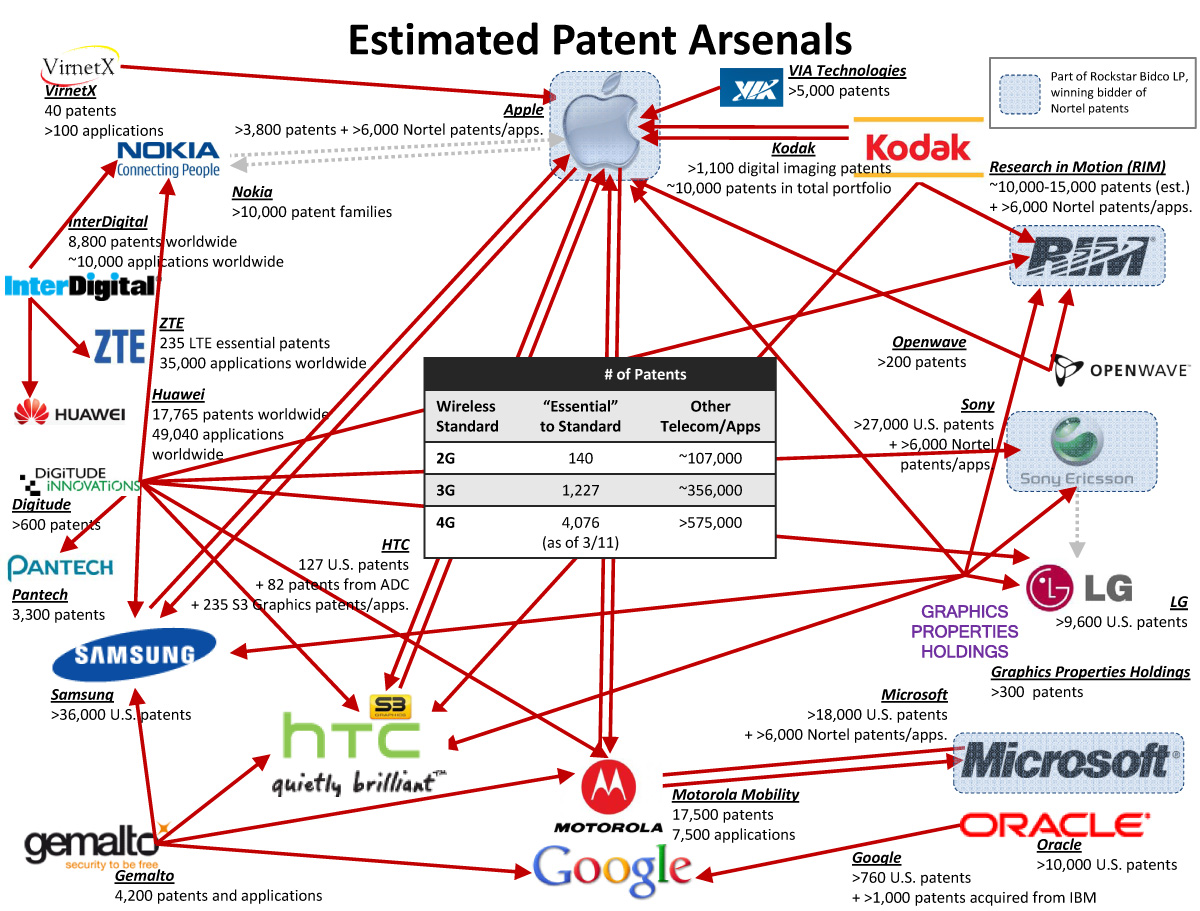
Web of Tech Patent Lawsuits [INFOGRAPHIC]

From Droid Life (via PCMag):

Web of Tech Patent Lawsuits [Infographic]

by: | posted 01.24.12 | News

It seems every other day that we hear Company A is suing Company B over patent infringement. Thanks to PCMag, we can keep track of them all through a set of infographics. These graphs give us a solid representation of the amount of firepower each company holds with their number of patents. As we can see, a lot of these companies have in the tens of thousands of patents – how they keep track of them all, don’t ask us. In the above chart, there are the major filings along with their dates, but we sort of wish they also had the outcome. We love a good Fortune 500 drama, but can’t we all just get along?

Via: PCMag

Other charts and graphics at Intellectual Property Charts, Graphs, Graphics, Diagrams.

Share
{ 2 comments }

I was interviewed Feb. 23, 2012, by Fabrizio Sitzia of the Italian libertarian group LibertariaNation.org. It was posted today on YouTube. We discussed intellectual property and related issues such as SOPA, plagiarism, IP-by-contract, and other libertarian issues such as prospects for liberty in the future; the importance of technology, the Internet, and globalism; Ron Paul and electoral politics; and libertarian sentiments and receptiveness among today’s young people. The audio file is here, and streamed below. (See also Italian Libertarian IP Debate.)

[podcast]http://www.stephankinsella.com/wp-content/uploads/media/interview-kinsella-libertarianation-2012-03.mp3[/podcast]

More info at the LibertariaNation post Intervista a Stephan Kinsella (English translation from Google translate).

[TLS]

Now at KOL162.

Share
{ 1 comment }

Nice post:

The Use of Free Software as Anti-Copyright Libertarian Activism

By  | Published: MARCH 29, 2012

Image is Copyright © 2005 Nicolas Rougier. Used with permission.For the sake of the simplicity of this blog post, I am going to assume all of my readers have at least a basic familiarity with both the ideas of free software advocates like Richard Stallman and Eben Moglen (though I try to link extensively to references within the post). For most of my libertarian readers, understanding the free software movement is very likely going to require a bit of reading unless you are a GNU/Linux geek. The page on the philosophy of the GNU project and Richard Stallman’s Wikipedia page are good places to start. Note that while free software and open source software have significant overlaps, they are not the same thing. For now, I’m going to focus on free software rather than open source to avoid further complicating this post.

I am also going to take as an assumption of my argument that the libertarian position is to be opposed to the existence of copyright. For some background on that argument see just aboutany of the work by Stephan Kinsella on the subject or for a more utilitarian approach seeAgainst Intellectual Monopoly by Boldrine and Levine.

Libertarian activist strategies range from on the most extreme, the idea of practicing full scale rejecting the system agorism as advocated by Samuel Konkin to the within the system political activism that ranges from full scale anarcho-capitalism a la Murray Rothbard to the stringently principled minarchism of those like Ron Paul to the steps in the right direction coming from more moderate or pragmatic libertarians. Efforts can range from education to campaigning to the actual act of voting.

Outside of the political system, there are few things other than education – which is usually just the means to a political ends – that a libertarian can do to create a more libertarian world. However, I believe that one relatively easy, and becoming easier by the day, thing that nearly everyone with some basic computer knowledge and a couple hours to spend can do to actively curtail the influence of copyright law is to start using free software.

Drawing on Stephan Kinsella’s ideas on the best copyright license for written work, the best software license is one that places as few restrictions on the end user as possible. The problems associated with removing all requirements or dedicated it the public domain means that only requiring acknowledgement of the author is the best solution. I don’t think it is a far stretch from his arguments the criteria that makes the fewest restrictions the best license can also be used to argue that fewer restrictions make a better license. In the context of discussing which license to issue your own work under, only determining the best license is necessary, however picking which software written by others to use doesn’t offer the same freedom and thus better rather than best will often have to suffice.

Starting with the assumption that everyone needs to use a computer with basic capabilities such as web browsing, word processing and the occasional game that they can operate without needing a computer science degree, there are really only 3 operating systems that are viable options, Windows, Mac OS X and Linux (well really GNU/Linux). With either Windows or OS X, using them merely consists of paying for the ability to use the software on one computer for your own personal use and not much more. They both leverage the full weight of copyright law to prevent you from doing basically anything beyond the bare minimum. It’s essentially the all rights reserved of the software world.

In contrast, Linux is licensed (mostly) under the GNU General Public License (GNU is a recursive acronym that stands for GNU’s Not Unix) is designed around preserving the four essential freedoms for software user (being computer geeks their numbering of course starts at 0):

(0) to run the program,
(1) to study and change the program in source code form,
(2) to redistribute exact copies, and
(3) to distribute modified versions.

In order to enable any user to do these things clearly this license is much less restrictive than the licenses under which you are permitted to run Microsoft or Apple software. The GNU GPL is not however a libertarian license and from a libertarian perspective is more restrictive than the software equivalent of the CC-BY license recommended by Kinsella for written work in two important ways through the power of copyright law.

First, that under certain it requires the release of the source code for software if an executable version is released which is a requirement of all free software. Secondly, that it is a copyleft license, which means that it requires programs that modify the code to also license those programs under the GNU GPL and is therefore less libertarian. In order to qualify as free software according to the Free Software Foundation, copyleft licenses are not necessary, but are encouraged.

There are examples of non-copyleft free software licenses that are more libertarian than the GNU GPL, such as the BSD license, and there are operating systems that largely use such licenses, I believe the most popular is FreeBSD. However, the community of Linux users is much more widespread and as a result the online support and information is much better. Plus, Canonical has spent millions of dollars working on a Linux distribution, Ubuntu, targeted specifically at non-technical users and from all accounts the next release, 12.04 due out next month, includes a much better version of the new Unity interface aimed at those users.

Shifting gears to discuss the implications of using Linux on copyright, there are impacts that switching to Linux has on the entire software market. First, the less that you use proprietary software, the less money that ends up in the pockets of proprietary software developers. Secondly, using free software creates a user base for that software which in turn makes that software more widely used for a number of reasons. For example, more users means that more software will be supported and developed for GNU/Linux operating systems allowing users who need or want access to certain critical programs like Adobe software or Netflix streaming to make a complete switch. A wer user base also facilitates the development of the documentation and help resources necessary for less advanced users.

As a closing point, it is important to note that while free software is more libertarian than proprietary software, for the bulk of free software advocates such as Richard Stallman and Eben Moglen are most definitely not libertarians. Their approach to copyright and politics in general is based much more in a leftist ideology than a libertarian one. See Stephan Kinsella on the topic here and here and Moglen on the subject here.

I realize this post inadequately covers a huge range of issues, but when I first thought of the idea for this post and began to research it, I realized that some of this is starting to break new ground from a libertarian perspective. As can be seen from many of the links above, Kinsella’s works which constitute by far the most numerous and in depth writings on the subject, focus mostly on the foundation of libertarian opposition to intellectual property and doesn’t get very far into applying it to software beyond basic discussions of the free software movement and the copyleft nature of the GNU GPL.

My hope is that this blog post will be the starting point for some feedback, more blog posts and hopefully eventually a longer more thought out essay, like the one I wrote on Ron Paul and libertarian history.

Share
{ 2 comments }

Patent Lawyers Who Don’t Toe the Line Should Be Punished!

Update: See Are anti-IP patent attorneys hypocrites?, collecting various posts about this topic.

***

A few older posts:

Update: see also Rothbard on Lawyers, Accountants, Locks and Safes–and patent lawyers?

Patent Lawyers Who Don’t Toe the Line Should Be Punished!

In his post Reality Check: Anti-Patent Patent Musings Simply Bizarre, patent attorney Gene Quinn is baffled that any patent attorney would openly oppose the patent system–or be hired by anyone. He writes, in part:

But what has me really wondering is how and why a patent attorney who is openly hostile to the patent system can get any work in the industry? Why would any inventor or company want an anti-patent patent attorney like Stephan Kinsella, who seems to be the genesis of this story, and so many other anti-patent patent stories.

Why would anyone hire me? I’ve prosecuted hundreds of patents. I’ve taught computer law as an adjunct law professor, I’ve published a great deal of legal scholarship including IP law, such as the Oxford University Press legal treatise Trademark Practice and Forms. I believe that given the patent system, tech companies have no choice but to arm themselves with patents, if only for defensive purposes. If someone went after one of my clients for patent infringement, I’d pull out all the stops to defend them from this state-backed threat. Maybe some clients like a patent attorney looking out for their interests.Apparently Quinn thinks ideological conformity is a requirement for job competence. If you have the wrong politics, you’re out. (I just hope I don’t have the wrong religion, gender, or race.) But think about it: would you hire only oncologists who were pro-cancer? Is it outlandish to think of hiring a tax attorney to defend you from the IRS who thinks the income tax is immoral and should be abolished? Is it required of a patent attorney to be in favor of the patent system? Yes, we patent attorneys learn the patent law and how to navigate the system. Does that mean we receive special education–or is it propaganda–as to the justifiability of IP? If so, where is it? Sure, we are taught in law school that the stated purpose of the patent system is to encourage innovation, and public disclosure of inventions. Okay. So what? How does knowing the state’s line for a given law prove that it is justified?

The truth is most patent attorneys are in favor of patent law. Why is this? They have no special knowledge about its normative validity. Rather, they are self-interested, and have been subjected to positivist, statist, empiricist propaganda in law school. Quinn tries to turn this defect into an advantage by hogging to the biased patent profession the right to pronounce on these matters–and then ejecting from the profession anyone who bucks the union line. The patent bar of course lobbies for the system that butters their bread. They claim special knowledge to pronounce that the system is “necessary” for innovation, even though they have no proof of this. (See below.) They marginalize non-lawyers as not having enough expertise to weigh in. And anyone who does have expertise is ostracized if they point out that the emperor is wearing no clothes. They remind of leftists who will not tolerate an African American who opposes affirmative action–they impose their supposed “benefit” on him by force, which is bad enough, and then use this imposed “benefit” to silence his criticisms of it. Terrible. (See An Anti-Patent Patent Attorney? Oh my Gawd!.) [continue reading…]

Share
{ 7 comments }

The Most Visited Libertarian Websites

The Capital Free Press has compiled a list of the top ranked “libertarian websites based on the number of unique visitors in the most recent month according to the data compiled by Compete.” The post is pasted below. Not surprisingly, LewRockwell.com is the most visited libertarian site. Four of my own sites made the list: StephanKinsella.com (#84), Libertarian Papers (#100), The Libertarian Standard (#75), and Center for the Study of Innovative Freedom (C4SIF, #78).


The Most Visited Libertarian Websites

This is a ranking of the top libertarian websites based on the number of unique visitors in the most recent month according to the data compiled by Compete. They only compile data for domains and subdomains, so perhaps this list is more accurately described as the most visited libertarian domains rather than websites. It is compiled through calls to Compete’s API, so it will automatically update when they release new data each month. For more information on this list, see the blog post introducing it.

Automating everything means that adding a new website is as simple as plugging a new url into my list, so you have any suggestions for a website to add, please email me at [email protected].

Due to the restrictions on the free use of the Compete API, there is a chance that I could run out of API calls in a 24 hour period (resets at midnight EST). The way that I compile this list and the terms and conditions on the use of their API prevent me from displaying the number of unique visitors for each website in the chart, though that information and more can be accessed via the link I have provided. [continue reading…]

Share
{ 2 comments }

How much is that patent lawsuit going to cost you?

From Cnet:

How much is that patent lawsuit going to cost you?

While the tech industry’s elite are fighting it out with their whopper patent portfolios, a recent survey shows just how scary one lawsuit can be for a small company.

by


So you’re facing a patent lawsuit. Or maybe you want to sue someone. Get out your checkbook, because this isn’t going to be cheap.

Read more>>

Share
{ 0 comments }