≡ Menu

How much is that patent lawsuit going to cost you?

From Cnet:

How much is that patent lawsuit going to cost you?

While the tech industry’s elite are fighting it out with their whopper patent portfolios, a recent survey shows just how scary one lawsuit can be for a small company.

by


So you’re facing a patent lawsuit. Or maybe you want to sue someone. Get out your checkbook, because this isn’t going to be cheap.

Read more>>

Share
{ 0 comments }

The Organization for Transformative Work

Geoff Plauche called to my attention a groups called the Organization for Transformative Work, “a nonprofit organization run by and for fans to provide access to and preserve the history of fanworks and fan cultures”. See its “beliefs” statement below, which “envision[s] a future in which all fannish works are recognized as legal and transformative and are accepted as a legitimate creative activity.” This laudable goal would require modifying copyright law’s “derivative work” provision.

What We Believe

Our Mission

The Organization for Transformative Works (OTW) is a nonprofit organization established by fans to serve the interests of fans by providing access to and preserving the history of fanworks and fan culture in its myriad forms. We believe that fanworks are transformative and that transformative works are legitimate.

The OTW represents a practice of transformative fanwork historically rooted in a primarily female culture. The OTW will preserve the record of that history as we pursue our mission while encouraging new and non-mainstream expressions of cultural identity within fandom.

Our Vision

We envision a future in which all fannish works are recognized as legal and transformative and are accepted as a legitimate creative activity. We are proactive and innovative in protecting and defending our work from commercial exploitation and legal challenge. We preserve our fannish economy, values, and creative expression by protecting and nurturing our fellow fans, our work, our commentary, our history, and our identity while providing the broadest possible access to fannish activity for all fans.

Our Values

  1. We value transformative fanworks and the innovative communities from which they have arisen, including media, real person fiction, anime, comics, music, and vidding.
  2. We value our identity as a predominantly female community with a rich history of creativity and commentary.
  3. We value our volunteer-based infrastructure and the fannish gift economy that recognizes and celebrates worth in myriad and diverse activities.
  4. We value making fannish activities as accessible as possible to all those who wish to participate.
  5. We value infinite diversity in infinite combinations. We value all fans engaged in transformative work: fans of any race, gender, culture, sexual identity, or ability. We value the unhindered cross-pollination and exchange of fannish ideas and cultures while seeking to avoid the homogenization or centralization of fandom.

Our Goals

During our first two years, the OTW has laid the groundwork for a vibrant and creative organization by:

  • Establishing the OTW as an IRS-recognized nonprofit organization.
  • Creating infrastructure for OTW by establishing a board and creating committees, soliciting membership and donations, forming alliances, and holding elections.
  • Encouraging community interaction and input via the OTW’s Web site and across the online and offline spaces where fans congregate.
  • Designing, programming, and launching the Archive of Our Own, a Web archive to host transformative fanworks.
  • Exploring ways to make fanworks as accessible as possible.
  • Establishing a legal advocacy project and forming alliances to defend fanworks from legal challenge.
  • Creating a fan wiki to preserve the history of transformative fanworks and the fandoms from which they have arisen.
  • Establishing a refereed academic journal to promote scholarship on fanworks and fan practices.
  • Developing a long-term plan for the organization.
  • Undertaking additional projects relevant to transformative fandom, such as the preservation of fan history and fanworks, building and maintaining infrastructure for use by fans, and sponsoring academic scholarship on fandom.
Share
{ 0 comments }

Italian Libertarian IP Debate

My Interview on IP and libertarianism (with Fabrizio Sitzia) is forthcoming at LibertariaNation.org (Italy) (recorded Feb. 23, 2012). In the meantime the group has a post up about the IP issue with a vigorous series of pro- and con-comments in the thread. Italian libertarians are arguing about this just like Americans are.

The original post is Non proprietà intellettuale?; the automatic Google translation, Not Intellectual Property?, is surprisingly good.

Share
{ 2 comments }

Writing Without Copyright

In the 22 years I’ve been writing seriously, I’ve never registered a copyright with the US Copyright Office. In the beginning, I thought it was wonderful that once I wrote something, it was protected. Somewhere in that first year of writing, though, I learned that I didn’t stand much of a chance in winning a copyright case in court without registering a copyright with the US Copyright Office.

In my first year of serious writing, I made what averaged out to a couple hundred dollars a month writing independent (i.e., creator owned) comic books, short stories, and the occasional article. The $20 fee to register copyright for each substantial work — when I was producing, in some months, close to a dozen substantial works — was more than I could afford. So I took my chances and never registered a copyright.

I never really thought about it until a friend asked me how I’d view a world without copyright as a writer. My first thought was a knee-jerk reaction: “That would be terrible — we need copyright protection!” But when I thought about how I’ve never had to enforce a copyright in all my years writing, I came to this conclusion: copyright really benefits those who use it to coerce writers, artists, musicians, consumers, and others.

In the News

In much the same way that if somebody tells me to look for purple things throughout my day I will notice purple more than usual, I started noticing articles about copyright abuse: musicians producing original work being accused of stealing sounds; writers receiving cease and desist letters for writing parodies; independent filmmakers willing to offer what they were doing for free via bit torrents seeing their means of distribution shut down because some people used the same services to share movies. Just a few weeks ago, my wife loaded a video on YouTube that was flagged because she used a Creative Commons Haydn piano sonata. And just yesterday, I came home and read this on BoingBoing.net.

Add to that how it seems a handful of years can’t pass by when one doesn’t read about Disney — a company that largely exists from creating derivative works — claiming others are creating derivative works of their derivative works. If it weren’t so stifling, it would almost be humorous.

Fortunately, innovation often outpaces coercion, and there are now other ways for musicians and filmmakers to get their work out there. But at the time of Napster and the beginning of bit torrents, there were people offering their art and having their means of distribution shut down by corporations, organizations, and the government — all in the name of copyright protection.

The Writer’s Turn

Just as musicians and filmmakers have had to deal with the suppression of their rights to create and distribute their work by non-traditional means in recent years, writers are now getting their turn. Books weren’t the easiest thing to copy in the past; it was easier to just buy or borrow a book than to copy War and Peace one page at a time on a Xerox machine. Because of this (and many other reasons), publishing has always been a slow industry with gatekeepers deciding who got in…and who stayed out.

With the rise of e-books, novels are now like albums — something that can be copied, shared, and read on computers, tablets, and smart phones. Even with early demand, publishers were slow to catch on. At a 2009 South by Southwest panel called “New Think for Old Publishers,” publishers walked away looking like a lonely middle aged guy desperately trying to convince a bunch of 20-year-olds that he’s still hip. It wasn’t until Amazon pushed for e-books that people really paid attention.

The Big River (Apparently Full of Piranha)

Amazon quickly made the e-book a viable thing through the innovation of the Kindle and the means by which they were able to distribute e-books. While other e-readers existed, it’s safe to say it took Amazon to make the e-book an everyday thing. And with that quick success (Amazon making the market and then claiming 90%), came the cries that Amazon wasn’t playing fair. They were a monopoly with aggressive tactics — that was the claim by some companies angry that they didn’t think of it all first!

It’s hard to feel bad for Barnes and Noble — a company that aggressively targeted small booksellers in an effort to drive them out of business — crying foul when they are on the receiving end of similar tactics they once used. It’s kind of like seeing a playground bully bested in battle by a crafty, tough nerd.

I’ve heard people say “Amazon is a monopoly! They own the market share of e-books!” Why shouldn’t Amazon have the biggest share when they were the ones who thought, “Let’s make publishing easy and give indie publishers a 35% royalty on anything between $.99 – $1.99, and a 70% royalty on anything more than $1.99.”?

A seventy percent royalty is unheard of! Why wouldn’t writers consider self-publishing e-books when traditional royalties on hardbacks are considerably less than Amazon’s low end of 35%. When I self published comic books back in the 90s and got 40% for each book sold through the direct market, I thought it was the greatest deal in the world! And now I can do that with novels that cost next to nothing to produce.

The “Evils” of Amazon’s “Monopoly”

Amazon no longer has a 90% share of the e-book market; in large part because their aggressive tactics and “stranglehold” on the industry opened the door for other booksellers, publishers, and e-reader/tablet manufacturers. The Nook, in part, owes its life to the Kindle — and Barnes and Noble followed Amazon’s lead with an online store and e-book sales. Barnes and Noble and other companies are all benefiting from Amazon’s innovation.

But there are still those who think otherwise. My favorite Internet battle in recent weeks has been J.A. Konrath and Barry Eisler’s challenge to Author’s Guild president, Scott Turow. (More about that here and here.) The quick version: Scott Turow came out in support of the agency pricing model in publishing, and in the process, attacked the way Amazon does business. Instead of siding with the interests of the writers he’s supposed to support, he sided with the pricing model used by major publishers that puts a smaller percent of royalties in writers’ pockets.

If you’re not familiar with Konrath and Eisler, they are midlist writers who broke away from traditional publishing and did it on their own, using e-books as their main product. Konrath was unsuccessful at convincing his then publisher to re-release his out-of-print books. He was told it wasn’t worth it. He fought for the rights, released them as e-books, and they’ve pulled in decent 6-figure totals. Eisler, seeing Konrath’s success, walked away from a 2-book, $500,000 publishing deal to do it himself. (He says it was more than worth it.)

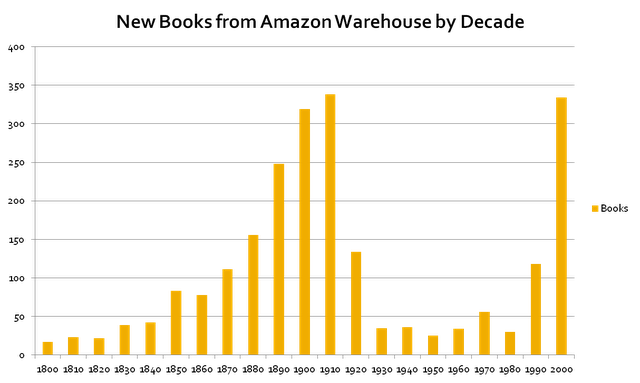
When the same friend who challenged me to imagine a world without copyright sent me the graph featured by Stephan here last Saturday, I was not at all surprised to see Amazon moving more books in the public domain — and then since the rise of print-on-demand technology and e-books. The dip in the numbers of books released during times of industry coercion through copyright claims says it all.

The Traditional Way

I’m lucky enough to be friends with a handful of writers much more successful than me. A few of those writers — and a couple writers I follow online — have made no secret that they would love to see fewer writers being published. Fewer writers being published means more for them. In some ways, I find it hard to totally fault them; they are writers who came up in a time of gatekeepers. Once invited to that side of the wall, they want to cling to what they have — even if they are the same writers who once complained about gatekeepers holding them back.

Should one believe I’m bitter because I’m not on that side of the wall, I am not opposed to going the traditional publishing route. While genre fiction has seen e-book successes like Amanda Hocking and John Locke, upmarket and literary fiction doesn’t have a similar kind of e-book success story. Despite getting rejections letters that amount to, “Loved this–you’re a talented writer, but…it’s too quirky and I don’t know how I’d market this,” I still try to find success the traditional way with some stories. But I’m also a fan of e-books. I’m an even bigger fan of having so many options!

Where I Stand

I offer some of my writing for free, and some for $.99 – $2.99 in the hope that people will buy it instead of copying and distributing it themselves. But if people want to copy and share my writing (everything I offer is DRM-free), I’m fine with that. While I want nothing more than to write full time, I am not owed a career as a writer.

There seems to be a belief that if one works hard at a creative pursuit that it’s somehow more noble than the person making a widget or other product. (And having to fight patent law like some writers fight copyright law.) I love what I do, but it’s no more special or requiring extra protection than a guy who loves making bars of soap.

To those who say we need at least some kind of IP law to protect me, since the night a friend challenged me to imagine a world without copyright, I’ve realized that if I’m doing my job right, you know who I am. If you don’t know who I am (and most people don’t), I need to work harder to generate excitement about what I do so people come to me for my writing — not go to others. But even if others released my writing, I find it hard to lay claim to your interpretation of the stories I write as you see them in your heads.

In addition to being paid to write, I’ve been paid for photographs accompanying travel articles I’ve written. I have a hard time believing that I should be extended copyright for those photos, when all I’ve done is capture what’s already there. If I do my job as a writer — like a photograph — I’m simply capturing what’s already there around me. And I find it quite arrogant — even bordering on hostile — to lay claim to my surroundings.

* * *

About Christopher Gronlund

Christopher Gronlund is a writer living in Texas. His first novel, Hell Comes with Wood Paneled Doors, can easily be seen as a derivative of National Lampoon’s Vacation, Stephen King’s Christine, and TV’s Wonder Years. He blogs at thejugglingwriter.com.

Share
{ 10 comments }

From the notes to this Youtube video Singer/Songwriter

Daria Musk knew her global audience was out there, somewhere — and she found it on Google+. google.com/+/business

Before joining Google+, Daria was, as she likes to say, “singing for the trees.” She’d played gigs but hadn’t been able to build her following. Now, with her entrepreneurial streak and global-sized heart, she’s utilizing Google+ to put her career in fast-forward.

As the post from Google’s blog below notes, she used a Google+ Hangout to do a live concert, and drew an astounding audience of 200,000. Wow!

Put your business in fast forward with Google+

Wednesday, March 28, 2012 | 9:50 AM

Today, we’re thrilled to share with you the story of musician and Google+ breakout star Daria Musk.

We often get asked for examples of how to use Google+ to engage with users. Lighting up Google+ with live concerts, as Daria’s done, can seem a song apart from selling wares such as designer laptop cases, hotel rooms or even car insurance — but the principles of building an engaged Google+ community ring true across industries. Daria’s story is a shining example of what working with an active audience can look like.

Be authentic and committed

On March 13, Daria crossed the amazing milestone of having more than one million followers. That means more than one million Google+ users have added Daria to their circles, all in the space of about eight months.

Daria was looking for those listeners when she joined Google+. “I was dreaming maybe there’s this wider world that I can sing for,” she said. “Maybe my people are out there somewhere.”
Through posts and Hangouts, Daria has kept her fans engaged. Keys to success, Daria said, include starting with enthusiasm and authenticity. “Right now if you get on Google+ and you show that you’re doing something remarkable, they’ll notice you,” she said.
Being remarkable, Daria coached, includes being yourself and avoiding canned-message posts. Users can tell if you’re trying to make a real connection. Be genuinely excited to connect with them and they’ll connect back.
When users do notice you, make sure you commit enough time to connect back. Taking just 10 to 15 minutes to respond to comments can keep the conversation going.
Share
{ 1 comment }

This is amazing, and sad and tragic. This is a little recap by Brian Doherty on Reason’s Hit & Run. (One wonders how the heroic Doherty still waffles on IP despite all this.)

How Copyright Seems to Keep Books Unavailable and Unexploited: A Graph

| March 30, 2012

Via the “Offsetting Behavior” blog from Eric Crampton:

Crampton explains:

Recall that books published through 1922 are in the public domain in the US; those published since then are covered by copyright…..

So any arguments about underexploitation of unprotected works seem untenable.

If this were a moving wall, maybe it wouldn’t be so bad: eventually, books would come out of copyright and be released in new editions. But Disney does keep going back and insisting that nothing can ever be returned to the Commons from which they so liberally drew, and Congress loves Disney; we might reasonably expect another copyright term extension act to keep the wall fairly rigid.

I do not, by the way, blog this as a confirmed anti-IP libertarian, but as data about how copyright contributes to the actual access to and use of old books, I found it interesting.

Jesse Walker wrote on how IP enforcement can hobble cultural production in his March 2000 Reason classic “Copy Catfight.”

Share
{ 5 comments }

Kinsella on The Corbett Report

I was a guest tonight (Mar. 28, 2012, Houston time; Mar. 29 Japan time) on The Corbett Report, with host James Corbett (from Japan), discussing IP. Here’s the audio (local MP3).

[podcast]http://www.stephankinsella.com/wp-content/uploads/media/corbett-report-099.mp3[/podcast]

Writer, thinker, lawyer and Austro-anarchist libertarian legal theorist Stephan Kinsella joins us to discuss his writing on intellectual property. We discuss the philosophical roots of property rights, how IP differs from those concepts, and how alternative models of making money from creative work are being pioneered in the age of the internet.

Share
{ 0 comments }

Kinsella on Liberty Conspiracy

I was a guest on Mar. 26 on Liberty Conspiracy, with host Gardner Goldsmith, discussing IP and related libertarian matters. Here’s the audio (local MP3).

Share
{ 0 comments }

Patents Threaten To Silence A Little Girl, Literally

By Leigh Beadon on Techdirt, a horrible story. It’s another example of how patents can lead to censorship. It’s not only copyrights that censor, as I note in Copyright and Free Trade; Patents and Censorship.


Patents Threaten To Silence A Little Girl, Literally

from the profit-motives dept


Slashdot points us to a sad story from blogger Dana Nieder, providing yet more evidence of how patent monopolies can hold back innovation and do very real damage to people’s lives in the process—and how people are interested in progress, not patents. As Dana says in her post, she understandably doesn’t give a damn about legal details when something as important as her daughter’s ability to communicate is at stake:

My daughter, Maya, will turn four in May and she can’t speak. The only word that she can consistently say with 100% clarity is “done”—which, while helpful, isn’t really enough to functionally communicate. When Maya was two and a half we introduced her to the iPad, and we’ve danced with AAC (augmentative and alternative communication) ever since. We experimented with a few communication apps, but nothing was a perfect fit. After an extensive search for the perfect app, we found it: Speak for Yourself. Simple and brilliant, we saw that it had the potential to serve Maya into adulthood, but was also simple enough for her to start using immediately.

And she liked it. And it worked. And I started to have little flashes of the future, in which she could rapidly tap out phrases and ideas and tell me more and more of the secret thoughts that fill her head—the ones that I’m hungry to hear and she’s dying to share but her uncooperative mouth just can’t get out.

My kid is learning how to “talk.” It’s breathtaking.

But now Speak for Yourself in under fire, and from a surprising (to an AAC outsider) or not-so-surprising (to an AAC insider) source. They’re being sued by Semantic Compaction Systems and Prentke Romich Company, big names in the AAC world. SCS and PRC allege that Speak for Yourself is infringing on their patents. I’m going to be honest: I don’t know about patents and infringement, and I’m not going to get into debates about the legal merits of the case, because that’s a conversation in which I would quickly drown.

Dana explains that her defense of the app isn’t arbitrary. Before discovering Speak For Yourself, she explored dedicated speech devices from the big AAC companies, including Prentke Romich. None of their options were suited to her daughter, and they all carried hefty price tags—as in $7,000+ hefty. She began asking around to see if PRC or any of the other big companies were planning on releasing an iPad app, and learned that although many customers were clamoring for one, the companies had no intention of meeting their demands. They didn’t want an affordable option out there reducing sales of their expensive systems.

Whenever the incumbents of any industry are ignoring the demands of their customers, you can bet that someone else is paying attention. In this case, it was speech-language pathologists Heidi LoStracco and Renee Collender, the pair behind Speak For Yourself. The app’s website explainshow it came about:

Mrs. LoStracco and Mrs. Collender began to see a shift in the field when the iPad was released. Mrs. Collender says, “Districts and parents were buying an iPad with an ‘AAC’ app on it and saying, ‘Make this work.’ We would try to reprogram the applications with the language that the children needed, but it took forever and it was never really ‘right.'” Heidi and Renee say that it got to the point that someone was asking them about iPad applications for AAC every day, and they decided that they needed a better answer. Heidi says, “We would tell them, there’s not really an effective AAC app out there yet, but when there, is, we’ll be the first to tell you about it.” Then we started thinking that we could create something that followed motor learning principles and gave individuals access to the language they needed to communicate effectively, and that’s when we designed Speak for Yourself.” Renee says, “We’ve always believed that communication is a basic human right, and the only AAC pre-requisite skill that a nonverbal person needs is a pulse.”

Dana points out that PRC’s mission statement begins “We Believe Everyone Deserves A Voice” and that their refusal to create an affordable iPad app, and now their attempts to crush a competitor who did, clearly runs counter to that mission. For her, that’s basically where the discussion ends: a company is trying to take away the only thing that has been able to give her daughter a voice, and she couldn’t care less whether or not they have the legal right to do so.

It’s hard not to sympathize with her position, even though the lawsuit and the patent in question, #5,920,303, both appear to be solid. As Dana’s story gains traction, we can only hope that it will increase social pressure on PRC and possibly shame them into allowing Speak For Yourself to survive by offering them an affordable license, or at least releasing their own iPad app at a similar price point—but as we’ve seen with pharmaceutical companies, the holders of life-saving and life-changing patents often don’t seem too bothered about withholding them no matter what it does to their public image.

Ultimately, this is more evidence that in today’s world of rapid innovation, tech monopolies are increasingly untenable. Big companies that have dominated niche markets for years—and have long since paid off their R&D costs by charging monopoly rates—are being disrupted by nimbler competitors. As we’ve seen with media and software piracy, this happens whether or not the competitors are “legitimate” under intellectual property law. Can there be any doubt that, if Speak For Yourself is shut down and the app eliminated, Dana will seek out a way to keep it running on her daughter’s iPad? Since her story is running on Slashdot, she’s already received comments with advice on how to do so, and suggestions that she contact Speak For Yourself and convince them to release their source code on github. At the moment, it looks like she just plans on turning off all connectivity on the iPad so that it will no longer sync and the app will remain even if it is removed from the iTunes store. Can anyone blame her? The simple fact is that markets always eventually find a way to meet demands—and if companies (especially those in industries that seriously affect people’s lives) use their intellectual property to block powerful market forces, that control will eventually be wrested from them, one way or another.

Share
{ 4 comments }

Yet another example of how trademark law is incompatible with property rights and free markets:

DHS Raids Home To Seize Deadly Hair Straighteners

Federal agency founded to fight terrorism continues war on grooming appliancesPaul Joseph Watson
Infowars.com
Monday, March 26, 2012

The Department of Homeland Security, a federal agency created in the aftermath of 9/11 to fight terrorism, has continued its war on potentially deadly grooming appliances by raiding a home in the affluent Orange County city of Laguna Niguel to seize allegedly counterfeit hair straighteners.

“About 10 investigators with the Orange County District Attorney’s Office and special ICE Homeland Security Investigations agents combed through the garage and the single-story house in the 29500 block of Pelican Way near Niguel Road and Alicia Parkway,” reports the Orange County Register.

According to the feds, the American people need to be protected from the threat of counterfeit hair straighteners because they could pose a safety hazard to consumers.

Read more>>

Share
{ 0 comments }

Guest on the Corbett Report

I’ll be a guest on The Corbett Report this Wed. night, Mar. 28, 2012, discussing IP and other matters. I was a guest last night on  Liberty Conspiracy last night, with host Gardner Goldsmith, discussing IP and other matters; it should be podcast soon.

Share
{ 0 comments }

Doug French: Freedom Through Technology

From Andy Duncan at The God That Failed. Great talk by Doug French. His story about how he had to copy Rothbard’s The Mystery of Banking by hand on a library photocopy machine, feeding dimes into it. In the old days. The dark ages. In 1991 I lived in London. I had at that time read a lot of libertarian books but for the past couple years I had gotten more interested in Rothbard and Mises and Austro-libertarianism. I had read For A New Liberty but The Ethics of Liberty was out of print. I found a copy in the University of London library and spent an hour or so making my own photocopy by hand. I spiral bound it with a clear plastic cover since it was my only copy. I had it for years, dog-eared and annotated, until it was re-published in 1998.

Doug ends his inspiring talk with a great quote from Mises’s Liberalism:

No sect and no political party has believed that it could afford to forgo advancing its cause by appealing to men’s senses. Rhetorical bombast, music and song resound, banners wave, flowers and colors serve as symbols, and the leaders seek to attach their followers to their own person. Liberalism has nothing to do with all this. It has no party flower and no party color, no party song and no party idols, no symbols and no slogans. It has the substance and the arguments. These must lead it to victory.

Here’s Andy Duncan’s post:

Doug French: Freedom Through Technology
Posted on March 23, 2012
Doug French discusses how things have changed in the last thirty years, and perhaps his insights explain why the nascent world government is so desperate to shut down the Internet, via the mechanism of ‘Intellectual Property’, or as they knew it in Elizabethan England, Royalty-granted monopoly:

Share
{ 0 comments }

Update: Update: A Defiant Dude: “Eat More Kale” T-Shirt Designer Fighting Back Against Chick-fil-A’s Trademark Bullying

As I noted in Folk Artist’s “Eat More Kale” versus Chick-Fil-A’s “Eat More Chikin” [Trademark],

In another example of trademark insanity and corporate bullying, Chick-fil-A is demanding that a folk artist stop using the phrase “Eat More Kale” and turn over his website, on the grounds that it “is likely to cause confusion of the public and dilutes the distinctiveness of Chick-fil-A’s intellectual property [in its phrase “Eat Mor Chikin”] and diminishes its value.1

Now the victim, Bo Muller-Moore, is fighting back–he’s using Kickstarter to try to raise at least $75k to fund a documentary that will follow his fight against Chick-fil-A. As of now he has about $60k pledged, with only 3 days go to… let’s hope he makes it.

  1. For other examples, see Hobbit pub in Southampton threatened with legal action; Michael Jordan claims ownership of number 23; Can you trademark a color?; LSU Football, Trademark, and “Honey Badger”; Disney to use Trademark against Canadian Pixar Oil, Ltd.; Is Getty Guilty Of Trademark Infringement For Every Photo It Has That Shows A Trademark?; Insanity(TM): Apple Claims Ownership of Leaf Shape; Boise State Warns High School with Blue Turf not to Call it Blue Turf; In-N-Out Sues Grab-N-Go; The Great Dr. Pepper Feud (Trademark);Thank goodness you are still free to make a shoe with red soles; others here. []
Share
{ 2 comments }

Reposted from http://http://whoownsyou-drkoepsell.blogspot.com/

The Patent Religion’s believers think that “anything under the sun made by man” is patent-eligible, even where nature made it first. This is the liturgy to which they appeal when challenged about patenting “isolated” or “synthesized” natural products. They think it means that even scientific discoveries, if properly couched in some “transformative” phrasing, are sometimes man-made. This was the case in the Mayo v. Prometheus case in which the patented claims included the correlations between, on the one hand, thiopurine drug metabolite levels and, on the other hand, efficacy and toxicity. These correlations were discovered through empirical research, they were not created. But the unfortunate wording of the Patent Act in the US, which makes patentable any new invention or “discovery” has enabled the patent lawyers to continue to argue that there is essentially no boundary between science and technology. Fortunately, the Supreme Court just burst their bubble. The Court’s decision can be found here and should be read by one and all. Justice Breyer, a long-time skeptic of IP-lawyers’ rhetorical tricks, pokes through the claims to look at the underlying subject matter. He does an ontologist proud.

While the unanimous decision makes worthy policy arguments about the negative effects on innovation of granting monopolies too far upstream, it also goes a fair way in describing the distinction between laws of nature, and something inventive and patent-eligible. From the decision’s syllabus, the following language says it all:

“Because the laws of nature recited by Prometheus’ patent claims—the relationships between concentrations of certain metabolites in the blood and the likelihood that a thiopurine drug dosage will prove ineffective or cause harm—are not themselves patentable,the claimed processes are not patentable unless they have additional features that provide practical assurance that the processes are genuine applications of those laws rather than drafting efforts designed to monopolize the correlations. The three additional steps in the claimed processes here are not themselves natural laws but neither are they sufficient to transform the nature of the claims. The ‘administering’ step simply identifies a group of people who will be interested in the correlations, namely, doctors who used thiopurine drugs to treat patients suffering from autoimmune disorders. Doctors had been using these drugs for this purpose long before these patents existed … The ‘wherein’ clauses simply tell a doctor about the relevant natural laws, adding, at most, a suggestion that they should consider the test results when making their treatment decisions … The ‘determining’ step tells a doctor to measure patients’ metabolite levels, through whatever process the doctor wishes to use.”

Patenting is not a game. Simply trying to squeeze square pegs into round holes using magical phrases will not do. There is a reality that must be observed, and rhetorical tricks aside, the claimed “inventions” were merely scientific discoveries about facts of nature. In this case, the Supreme Court has made both a logical and ontologically-grounded decision, recognizing that even where a claimed invention might be “man-made” it is not created by humans. Where a claim encompasses something that nature created, it cannot be eligible for patent, and fails under section 101.

Already, the patent lawyers have gone apoplectic, claiming that the Supreme Court is not qualified to make such decisions. The wailing and gnashing of teeth is certain to grow before it fades. Industry will not come to a halt, but science can flourish a little less hesitantly, secure in exploring nature and her truths without impinging upon some governmentally-created monopoly.

So what does this mean for gene patents, and the much anticipated AMP v. Myriad, Supreme Court showdown? Notably, Myriad had submitted an amicus brief in the case for the losing side. They know the implications of this decision for their practices and patents. Of course, I think the writing is on the wall. Breyer’s language is sufficiently broad and suggestive in the Mayo v. Prometheus decision to indicate that they will be very skeptical of claims by Myriad that “isolated” sequences, not created by man, but identified as existing in nature, are patent-eligible. Procedurally, the case is interesting because in late February everyone expected SCOTUS to either accept the appeal on certiorari, and reconsider the case, or reject the cert petition and let the CAFC decision stand. But nothing happened. Some speculated that they were booting it over to the Solicitor General, who had put in an amicus brief opposing Myriad, to change his mind. But perhaps there is a clue here as to what’s going on from the procedural history of Mayo. After the Bilski decision, SCOTUS kicked Prometheus back to the appellate court to reconsider the case in light of Bilski. They did that, and did so wrongly, upholding their previous decision, only to get overturned by a unanimous Supreme Court. Could SCOTUS now do the same with the Myriad case, and if they do, will the Federal Circuit once again ignore SCOTUS, make the wrong decision, only to get overturned, or will they actually try to apply the law of the land? Time will tell.

** UPDATE **

The Supreme Court has scheduled a meeting on the Myriad case for Friday, Mar 23. It seems likely, based on the Mayo v. Prometheus ruling that they will remand to the appellate court, or take the case up on cert. It seems highly unlikely that they would refuse cert outright. We should know by Monday.

Share
{ 0 comments }