Related
- Classical Liberals, Libertarians, Anarchists and Others on Intellectual Property
- on Konkin, see Copywrongs
From Wendy McElroy, Oct. 8, 2010:
An intriguing anti-IP argument
One of the most intriguing arguments against intellectual property — that is, the claim to owning a copyright or patent on any basis other than contract — was first presented to me by the science fiction writer Victor Koman. It is simple but profound.
A imparts an original idea to B. However, the idea in B’s mind is immediately and, perhaps, radically different from the ‘same‘ idea in A’s mind because B automatically integrates it with every other experience and prior piece of knowledge he has; the idea is filtered through the human being that B is. If the idea is about music and B is tone deaf, then the idea may be retained superficially. If B plays an instrument, then he may immediately apply the idea to the specific one he plays and, so, alter it. But the process need not be conscious. In fact, the vast majority of the process is automatic. The human brain is so constructed as to make most connections, associations, judgments, etc. in much the same way that eyes see without anyone consciously attempting to have vision.
Thus, to tell B he cannot use the now-unique idea that is in his own mind is tantamount to claiming ownership of his body…or, at least, ownership of an aspect of it. A might as well use force (or the law) to prevent B from using one finger or one hand; the principle is the same. In short, enforcing A’s claim is a form of slavery over B. The only proper basis on which A can possibly make such an ownership claim over B is if B agrees to the arrangement — to confidentiality as a condition of employment, for example — and, so, A’s claim derives solely from contract.
I argue against intellectual property being a “natural right” on many other grounds as well but the elegance and originality of Vic’s argument has always impressed me. Of course, I immediately and unconsciously integrated it with Benjamin Tucker’s approach about which I was reading at that time…which is why the topic arose…and, so, the idea I ‘heard’ was different from the one Vic imparted because I filtered it through and into my other anti-IP arguments, my knowledge of psychology, a Randian approach to epistemology, etc. After reading this post, you, too, will hold a somewhat different idea in your mind than the one I am expressing.
See also Wendy McElroy, Samuel Edward Konkin III: Revolutionary Friend (Agorist Nexus, 2024):
By contrast, SEK3 was a rare kindred spirit on IP, as were most of the Anarcho Villagers despite the fact that many were full-time or occasional writers and publishers. I credit the SF novelist Victor Koman with first edging me toward an anti-IP position. At a party where neither of us, fortunately, had consumed too much alcohol to be incoherent or to forget conversations from the night before, we got into a friendly discussion of IP. At one point he asked me, “How can you own something that is in my mind?” Given my deep commitment to self-ownership, I had to answer, “I don’t know.” The question stayed with me for weeks afterward, partly because Vic had put an extra twist on IP. Even if he had a word-for-word memory of an idea I communicated, he argued, the instant the idea entered his mind, it changed by being integrated with other ideas, memories, and convictions he held. It became a different idea that was uniquely his own. This dynamic made my ownership of what was in his mind seem even more unlikely.
Re Konkin: see Copywrongs, and this facebook post from Koman
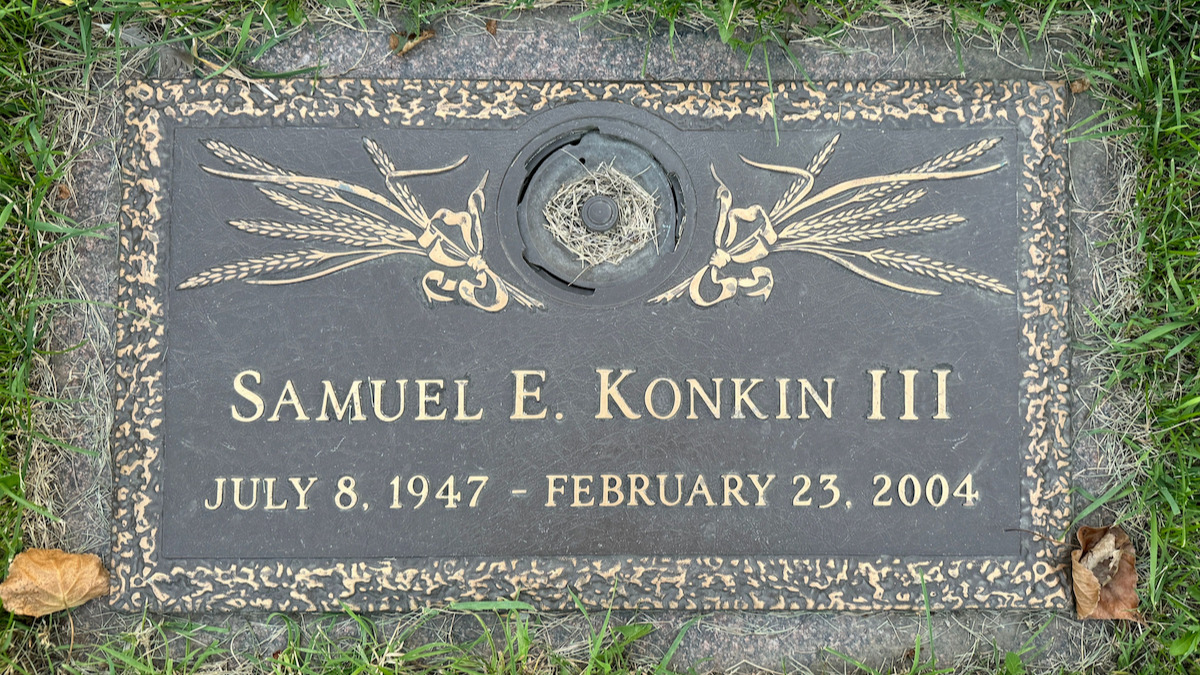
Finally, someone uploaded a photo of the headstone for Samuel Edward Konkin III (#SEK3). Rest in the Agora, old friend.